Why Generic CRMs Fail Growing Businesses (& What to Do Instead)
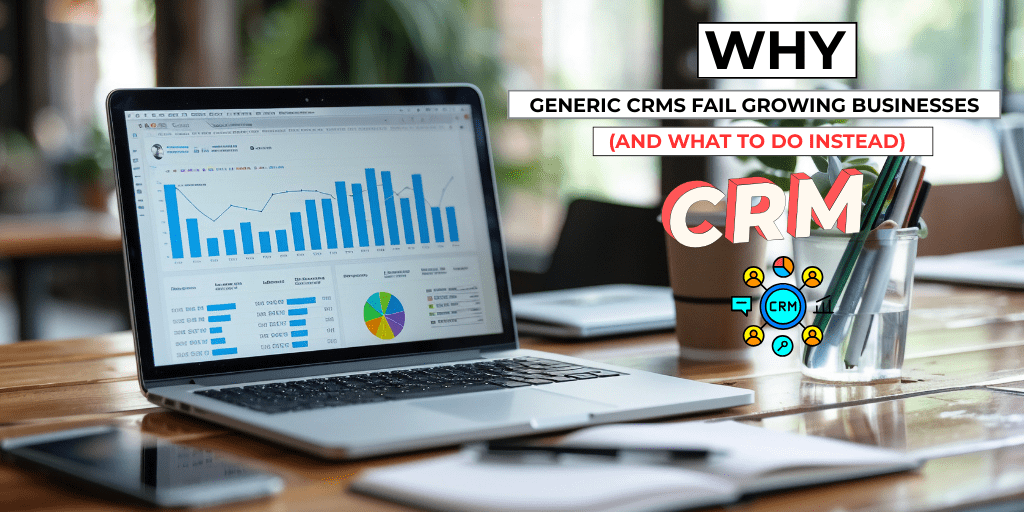
As your business scales, one of the most important decisions you’ll make is choosing the right Customer Relationship Management (CRM) system. It’s not just a tool—it’s the backbone of your customer experience, sales efficiency, and internal communication.
But here’s the catch: Most growing businesses start with the wrong CRM.
Generic, off-the-shelf CRMs may seem like a good idea at first—affordable, easy to set up, and quick to learn. But once your business starts picking up pace, these “starter” systems often create more problems than they solve.
Let’s explore why that happens—and more importantly, what you should do instead.
❌ The Problem: Why Generic CRMs Don’t Work Long-Term
Generic CRMs are designed to serve everyone—which often means they serve no one particularly well. Here’s where they usually fall short for growing businesses:
1. Rigid Workflow Limitations
Your sales pipeline is unique to your business. But most generic CRMs come with pre-defined workflows and limited customization, forcing your team to adapt to the software—not the other way around.
2. Disjointed Tool Ecosystem
As you grow, you’re likely using multiple platforms—email marketing, accounting, customer support, and more. Generic CRMs often fail to integrate smoothly, leading to data silos and miscommunication across departments.
3. Scalability Bottlenecks
Most basic CRMs aren't built for scale. As your team, leads, and processes grow, performance can slow, user roles become confusing, and your database gets cluttered.
4. Poor Analytics & Reporting
Data is critical for decision-making. But with limited dashboards and reporting features, generic CRMs make it hard to track your KPIs, customer trends, or sales performance in real time.
💡 A Real-World Example:
A mid-sized service agency approached us after struggling for months with a popular off-the-shelf CRM. Despite their growth, they were:We helped them migrate to a customized CRM system tailored to their workflow. Within weeks, they saw:
- Missing follow-ups
- Losing visibility over campaigns
- Managing tasks outside the CRM
- Struggling to train new team members
- ✔ 40% increase in productivity
- ✔ Unified data across sales, support, and billing
- ✔ Real-time dashboards for faster decisions
- ✔ Happier team members and smoother onboarding
✅ The Solution: What to Look for in a Growth-Ready CRM
A growing business needs a CRM that doesn’t just manage customer relationships—but actively supports scaling, efficiency, and automation.
Here’s what to look for:
🔧 Custom Workflows & Pipelines
Your CRM should mirror your internal processes, not force you to change them.
🔗 Seamless Integrations
Whether it’s your website forms, email marketing, or payment system—your CRM should connect it all.
⚙️ Automation at the Core
Eliminate repetitive tasks like lead assignment, follow-ups, and reminders to free up your team for high-value work.
📊 Real-Time Reporting
Make smarter decisions with dashboards that track performance, forecasts, and growth metrics.
🔐 Scalability & Role Management
From 5 users to 500, your CRM should remain fast, secure, and easy to manage.
🧠 Educational Insight: The Cost of Not Switching
Many businesses delay switching CRMs because they fear the learning curve or data migration. But the real cost lies in inefficiency—missed leads, delayed responses, lost sales, and team burnout.
If your CRM is holding your team back, it’s not a tool—it’s a liability.
🎯 Final Thought: Your CRM Should Grow With You
At Technobits Digital, we specialize in custom CRM solutions designed to scale with your business. Whether you're a growing agency, tech startup, or enterprise service provider, we can help you build a CRM that’s flexible, automated, and aligned with your goals.
📧 Email us directly at [email protected] to schedule a free consultation with our CRM experts and discover how the right system can fuel your business growth.