AI Agents for Business: What They Are and How Companies Can Use Them in 2026
AI is moving beyond tools that simply answer questions or generate content. Businesses are beginning to use AI agents that can understand goals, plan tasks, access connected systems and complete parts of a workflow with limited human intervention.
For example, instead of only drafting a customer response, an AI agent may identify the customer, review previous conversations, retrieve relevant information, prepare a reply, update the CRM and schedule the next follow-up.
AI agents have become a major focus in enterprise technology in 2026, with organizations exploring how agentic systems can support multi-step business workflows under human oversight.
Direct Answer: What Are AI Agents for Business?
AI agents are software systems that use artificial intelligence to understand a goal, decide what steps are required and take actions through connected tools or business systems.
Unlike a basic chatbot that responds to one prompt at a time, an AI agent may complete a multi-step process. It can collect information, analyse data, select an action, use an application and continue until the assigned task is completed or requires human approval.
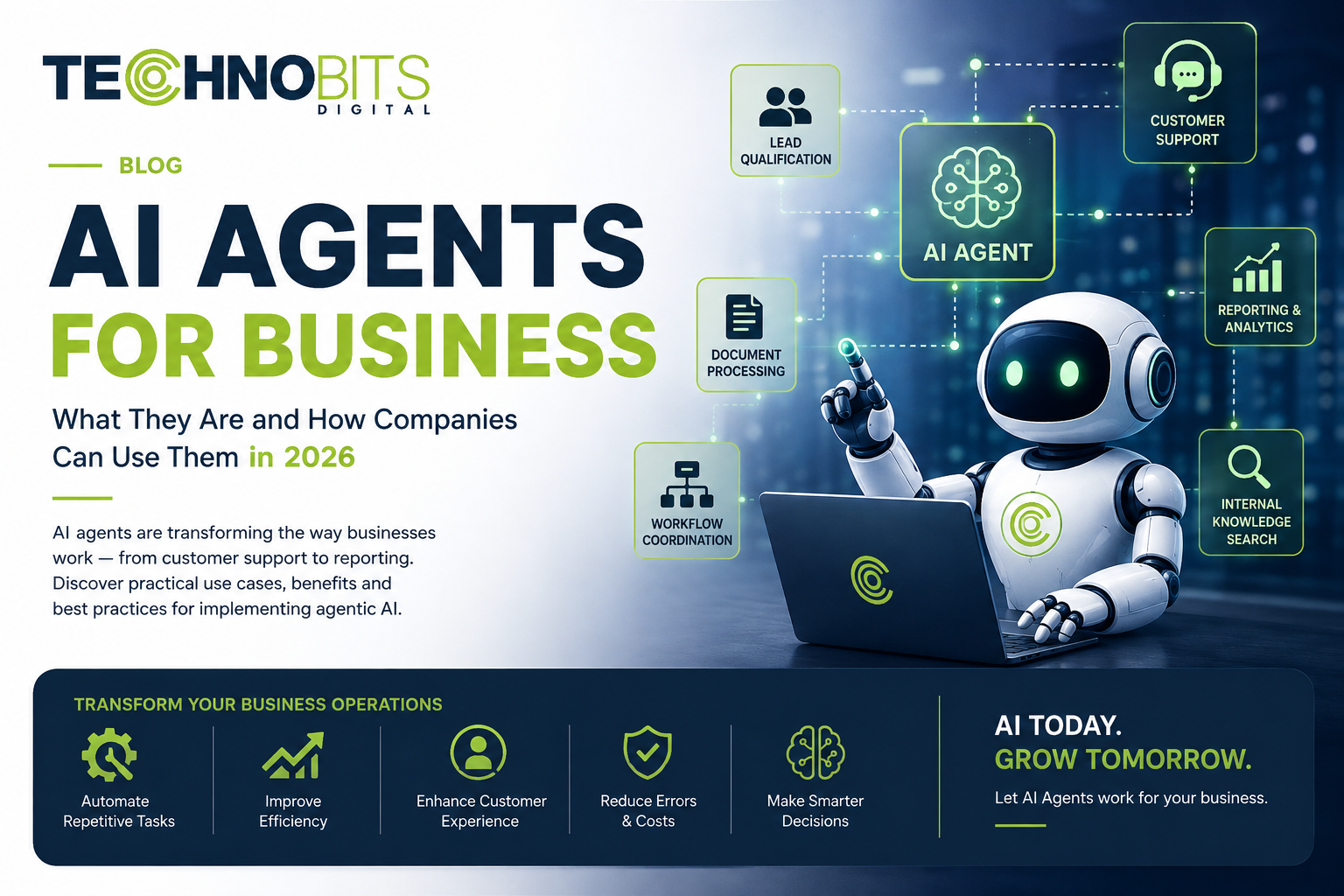
Businesses can use AI agents for customer service, sales support, reporting, document processing, internal knowledge retrieval and operational coordination.
How Are AI Agents Different From Traditional Automation?
Traditional automation usually follows a fixed set of rules.
For example:
When a form is submitted, send an email.
When an invoice becomes overdue, create a reminder.
When a lead enters the CRM, assign it to a salesperson.
These workflows are useful, but they normally cannot interpret an unfamiliar situation or adjust their actions without additional programming.
Agentic AI can evaluate the available information and choose the next step according to the goal. This makes it suitable for processes where every case may not follow exactly the same path.
However, AI agents should not be treated as fully independent employees. Important decisions, sensitive information and high-risk actions still require clear permissions, controls and human oversight.
How Can Companies Use AI Agents in 2026?
1. Customer Support and Service Coordination
An AI agent can review a customer’s question, search an approved knowledge base and prepare a relevant response.
It may also classify the issue, identify its urgency, create a support ticket and route the case to the correct team. When the issue requires human attention, the agent can provide the support representative with the customer’s history and a summary of the problem.
This can reduce repetitive work while helping customers receive faster and more consistent assistance.
2. Lead Qualification and Sales Follow-Ups
Sales teams often receive enquiries from website forms, email, advertisements and social media. Manually reviewing every enquiry can delay the first response.
An AI agent can examine the information submitted by a prospect, compare it with qualification criteria and organise the lead according to service, budget, location or urgency.
It can then prepare a personalised follow-up, update the CRM and alert a salesperson when the lead is ready for direct engagement.
AI should support the sales team rather than make uncontrolled promises or final commercial decisions.
3. Document Processing
Businesses regularly process invoices, applications, contracts, forms and reports.
An AI agent can extract important details, check whether required information is missing and transfer approved data into another system. It may also flag unusual entries or send incomplete documents for human review.
This type of business process automation can reduce repetitive data entry and make document-heavy operations easier to manage.
4. Reporting and Data Analysis
Preparing recurring reports often requires employees to collect information from several platforms.
An AI agent can retrieve approved data, organise it into a standard structure and produce a draft summary. It can highlight changes, unusual results or items that need attention.
For example, a reporting agent could collect website traffic, campaign performance and lead data, then prepare a weekly performance summary for the marketing team.
5. Internal Knowledge Search
Employees may spend significant time searching through policies, project files, instructions and previous conversations.
An AI agent connected to an approved internal knowledge base can help employees locate relevant information using natural-language questions.
Instead of searching through several folders, an employee could ask, “What is the approval process for a new vendor?” The agent could retrieve the relevant policy, summarise the steps and link to the original document.
6. Workflow Coordination
Many business processes involve several teams, systems and approvals.
An AI agent can monitor the workflow, identify the next required action and notify the responsible person. It may also update task status, organise supporting information and escalate delays.
This can be useful for employee onboarding, purchase approvals, project delivery, customer onboarding and service-request management.
What Are the Benefits of AI Agents for Business?
When implemented responsibly, AI agents can help companies:
Reduce repetitive administrative work
Respond to customers more quickly
Improve consistency across routine processes
Connect information across multiple systems
Give employees more time for strategic work
Improve visibility into workflow progress
Scale selected operations without manually increasing every task
Google Cloud's 2026 research highlights a shift toward agentic workflows that can support multi-step business processes. The same body of guidance emphasizes that reliable data, governance and organizational readiness remain important to successful implementation
What Should Businesses Consider Before Implementing AI Agents?
Begin With One Clear Process
Do not begin with the goal of automating the entire organisation. Select one repetitive, measurable process where the rules, data sources and expected result are understood.
Define Permissions and Human Approval
Decide what the agent can read, recommend, create or change. Financial transactions, legal decisions, employee matters and sensitive customer actions may require mandatory human approval.
Where an agent accesses personal, confidential or commercially sensitive information, organizations should apply appropriate privacy, security, access-control and data-retention requirements to that workflow.
Prepare Reliable Business Data
An agent cannot produce dependable results from incomplete, outdated or poorly organised information. Businesses should first review their documents, system access, data quality and knowledge sources.
Measure a Business Outcome
Track whether the agent reduces response time, manual effort, errors or processing delays. The goal should be measurable operational improvement—not simply adding AI to an existing process.
Google Cloud’s 2026 guidance similarly describes AI agents as systems that can develop multi-step plans and take actions under expert guidance and oversight.
Build AI Agents Around Your Actual Business Process
An effective AI agent must fit the organisation’s systems, permissions, data and operating requirements.
Technobits Digital provides AI-powered digital services and develops intelligent software solutions for specific business processes. These solutions may include custom platforms, enterprise portals, API integrations, automated workflows and AI-assisted software capabilities.
The objective is not to automate every decision. It is to identify where AI can reduce friction while keeping people responsible for judgement, control and accountability.
Frequently Asked Questions About AI Agents
Can small businesses use AI agents?
Yes.A small business can begin with a focused use case such as enquiry classification, appointment coordination, document checking or recurring report preparation.
Are AI agents the same as chatbots?
No. A chatbot mainly conducts a conversation. An AI agent can also plan actions, access approved tools and complete multiple steps within a workflow.
Can AI agents replace employees?
AI agents are better suited to supporting employees by handling repetitive tasks. Human judgement, relationships, accountability and complex decision-making remain essential.
Are AI agents secure?
Their security depends on how they are designed. Businesses must control system access, permissions, data handling, monitoring and human approval.
How should a company start an AI-agent project?
Start by identifying one repeated process, defining the expected outcome, reviewing available data and deciding which actions require human approval.
Final Thoughts
AI agents are changing business automation from fixed, isolated actions into more adaptive workflows.
Their strongest value in 2026 is not unrestricted autonomy. It is the ability to support employees, coordinate routine work and connect information across approved systems.
Businesses that begin with clear use cases, reliable data, limited permissions and measurable outcomes will be better positioned to gain practical value from agentic AI.
Ready to explore how AI agents could support your operations? Start a project with Technobits Digital.