Why Healthcare AI Pilots Struggle in Real-World Use and How Better Software Can Improve Adoption
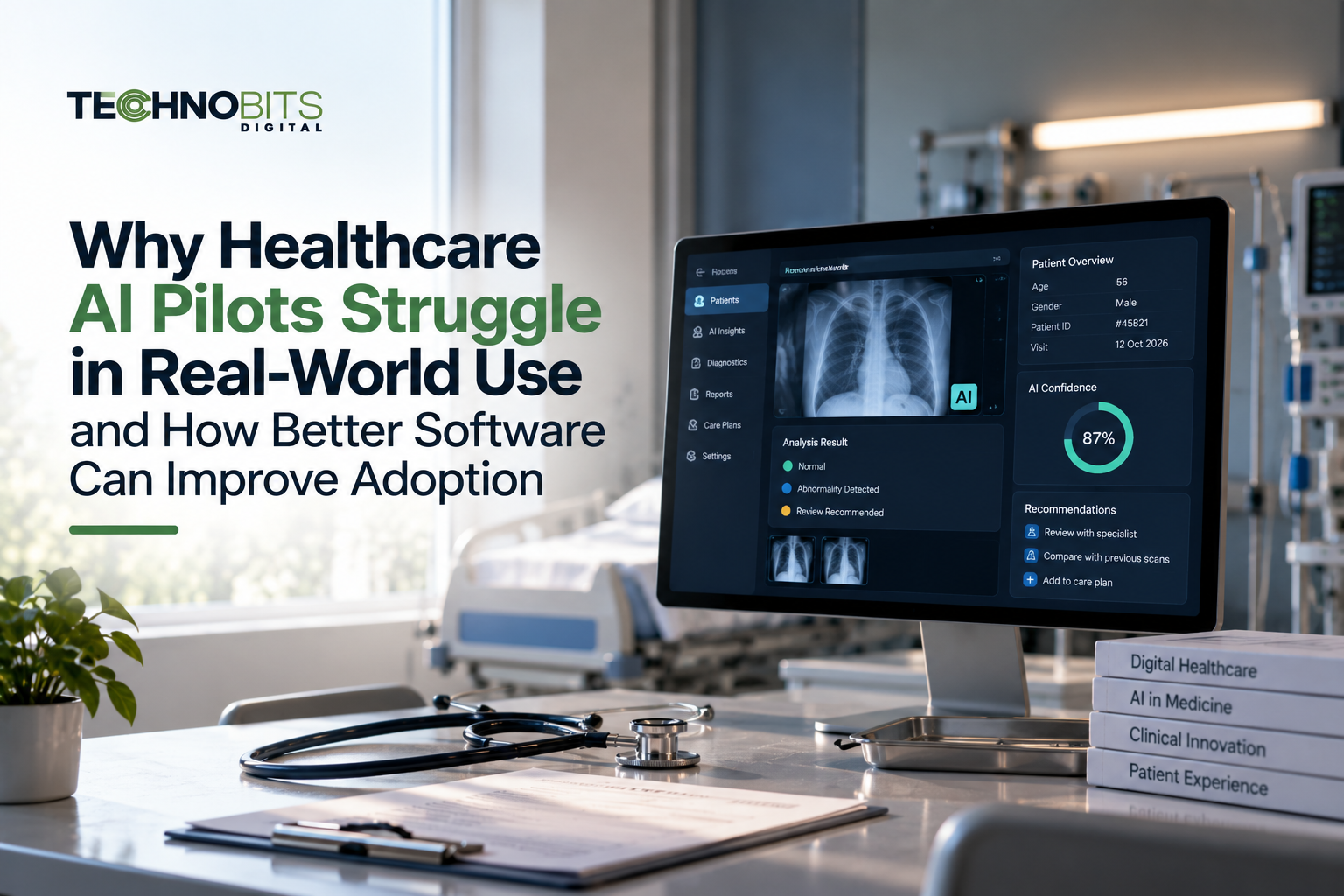
A healthcare AI pilot can produce an impressive summary, risk score or scheduling recommendation while avoiding the conditions that determine whether staff will adopt it. Demonstrations normally use selected data, known scenarios and cooperative users. Operational software must contend with incomplete records, changing clinical context, identity controls, integration failures, time-constrained staff and decisions that may require human review. The difficult question is therefore not whether the model can generate an answer. It is whether the complete system can place a trustworthy, explainable and recoverable result inside an existing healthcare workflow.
Healthcare AI software needs more than a capable model. A production system may also require dependable application interfaces, data validation, secure access, integration with existing healthcare systems, monitoring and appropriate human oversight.
Adoption depends on whether the software fits the daily work of healthcare staff and helps them complete tasks without introducing unnecessary steps or unmanageable risks.
Founders, CTOs and healthcare operations leaders should consequently evaluate the operating system around the AI, not only model accuracy. Before funding production development, define the intended user, permitted data, decision boundary, failure response, integration points and evidence needed for release. AI-accelerated delivery can assist with code generation, test preparation and documentation, but full-stack engineering remains necessary to convert a model demonstration into a supportable healthcare service.
What Should Owners Evaluate Before Moving a Healthcare AI Pilot Into Operations?
Begin with a precise workflow statement. “Use AI to improve patient administration” is too broad to govern architecture or testing. A useful statement identifies the user, trigger, input, output and authorised action. For example, an intake assistant might classify a submitted form, identify missing information and prepare a review queue for administrative staff. That definition prevents the pilot from drifting into clinical decision-making if its approved purpose is administrative. It also exposes the complete sequence around inference: patient submission, identity matching, data validation, model processing, confidence assessment, staff review, record update and exception handling.
Next, establish the decision boundary. Some outputs may be suitable for drafting or prioritisation but not autonomous action. A generated appointment message can still require confirmation of the patient, destination and approved wording. A summarisation tool may assist a clinician, but the source record must remain available and the user must be able to identify omissions. For every output, specify whether AI may recommend, draft, classify, route or execute. Record who remains accountable and what evidence must be retained. These distinctions should inform the design of Intelligent Software, including confirmation screens, confidence indicators, source citations and overrides.
Adoption evidence should cover more than a successful demonstration. Observe how representative users complete the task without coaching, how often they correct outputs and whether the AI creates additional work downstream. Test uncommon but credible situations such as duplicate patients, contradictory records, missing fields, unsupported document formats and interrupted network requests. You should also identify non-AI causes of friction. If staff cannot retrieve the right data or the current process has unclear ownership, adding a model may conceal rather than resolve the underlying operational problem.
Where Healthcare AI Adoption Breaks Across Workflow, Data and Application Layers
Healthcare AI frequently fails at the workflow boundary. A technically valid output may arrive after the user has already made the decision, appear in a separate portal or omit the context needed for action. Consider a tool that flags an appointment as likely to require follow-up. If reception staff must copy the patient identifier into another system, verify contact preferences and manually record the outcome, the tool has added a queue without completing the job. Production design should place the recommendation at the correct point in the task and capture the user’s disposition so that work does not disappear between systems.
Data behaviour creates another gap between pilot and production. Demonstration datasets are often clean, static and already mapped to the model’s expected schema. Live information may contain abbreviations, stale demographics, duplicate identities, scanned documents and fields interpreted differently by separate facilities. A production pipeline needs schema validation, provenance, versioning and rules for missing or conflicting values. Where electronic medical records, laboratory platforms, scheduling systems or customer-service tools must exchange information, system integration services should address authentication, field mapping, retries, idempotency and reconciliation—not merely establish that an API call succeeds.
The application layer can undermine trust even when the data and model are sound. Users need to distinguish source facts from generated text, recognise when an output is provisional and understand what an override will do. Poor interface decisions can encourage automation bias by presenting uncertain content as definitive. They can also produce alert fatigue if every low-confidence event interrupts the same queue. Web, mobile, backend and AI components therefore need one coherent interaction model. If patients or field staff use mobile channels,
Operational ownership is the final recurring failure point. Someone must monitor model errors, application failures, integration queues, access events and user feedback. Model quality can change when patient populations, coding practices, input formats or upstream systems change. An incident may also be ambiguous: an unexpected recommendation could originate in source data, transformation logic, retrieval, model behaviour or interface presentation. Observability should correlate events across those layers while protecting sensitive information. Without named owners and escalation paths, a pilot may technically remain online while users quietly return to spreadsheets, email and manual workarounds.
Which Architecture Trade-Offs Should Govern a Healthcare AI Production Decision?
The first trade-off is between a general model and a more constrained system. A broad generative model can support flexible language tasks, but flexibility increases the range of outputs that must be evaluated. Retrieval, templates, structured output schemas and deterministic business rules can narrow that range. For a patient-message workflow, the model might draft text only from approved information while conventional software verifies identity, consent status, communication channel and required disclosures. This division allows AI to handle language variability without assigning it decisions that are better implemented as explicit rules.
The second trade-off concerns automation and human control. Requiring approval for every output can limit risk but may eliminate the intended efficiency if reviewers simply repeat the original task. Full automation may be inappropriate where an error could materially affect care, privacy or access to a service. A tiered design can route low-confidence, novel or high-impact cases to review while permitting narrowly defined actions under approved conditions. The correct threshold depends on the use case, local requirements, evidence quality and the organisation’s risk tolerance; it should not be copied from a model benchmark.
Decision area | Lower-complexity option | Higher-control option | Question for buyers |
|---|---|---|---|
Model interaction | Open-ended prompt and response | Structured output with validation | What malformed or unsupported output must be blocked? |
Data access | Manual upload | Permission-aware system integration | Which source is authoritative, and who may access it? |
Action | Recommendation only | Conditional workflow execution | Which actions require confirmation or dual control? |
Deployment | Single model provider | Provider abstraction and fallback handling | What happens during latency, quota or service failure? |
Evaluation | Aggregate quality score | Scenario-based acceptance thresholds | Which error types are operationally unacceptable? |
Deployment choices also affect privacy, latency, cost and maintainability. Sending complete records to an external service may be unnecessary when the task requires only selected fields. Data minimisation, regional hosting requirements, retention settings and contractual controls should be evaluated against the applicable jurisdiction and organisational policy. Security architecture should include least-privilege access, secret management, data protection, audit events and incident procedures. An IT security audit can help identify gaps across the application and infrastructure, but it does not replace legal, privacy or clinical governance review.
Buyers should also examine portability without demanding abstraction for its own sake. A model gateway can make provider changes easier, but different models may use distinct context limits, safety controls, tool-calling formats and plans structures. Excessive abstraction can conceal useful capabilities and increase maintenance. A practical architecture isolates provider-specific code, stores evaluation cases independently and avoids placing critical business rules inside prompts. This supports controlled substitution while recognising that a provider change still requires regression testing and approval.
How Should an Adoption-Ready Healthcare AI System Be Implemented and Tested?
Implementation should proceed from workflow evidence rather than a model-first backlog. Map the current task with the people who perform, supervise and support it. Identify hand-offs, duplicate entry, unofficial workarounds and points where the user needs professional judgement. Then define a thin operational slice that includes the real identity, data, interface and monitoring path. A small end-to-end workflow produces more useful evidence than a sophisticated model isolated from production systems because it reveals integration delays, access restrictions and user behaviour early.
Define the operating contract. Record the permitted purpose, user groups, data classes, output types, prohibited actions and accountable owner.
Design the workflow states. Include pending, accepted, corrected, rejected, escalated, failed and retried outcomes rather than treating every request as successful.
Build data controls. Validate schemas, minimise transferred information, preserve provenance and prevent unsupported records from reaching inference.
Establish evaluation cases. Test routine, edge, ambiguous and adversarial inputs using acceptance criteria tied to operational consequences.
Instrument the service. Monitor latency, failures, overrides, integration queues, model versions and user abandonment without exposing unnecessary sensitive data.
Release under controlled conditions. Limit initial scope, maintain a rollback route and review evidence before expanding users, locations or automated actions.
Testing must cover the full stack. Model evaluation should examine factual grounding, omission, unsafe transformation, inconsistent classification and sensitivity to input variations. Application testing should cover permissions, session behaviour, form validation, accessibility and error messages. Integration testing should simulate timeouts, duplicate events, partial updates and unavailable dependencies. Custom software testing can align scenarios with the healthcare workflow, while AI quality assurance can address model-dependent behaviour that conventional deterministic tests cannot fully represent.
AI-accelerated delivery can support implementation by generating test scaffolds, documenting interfaces, identifying repetitive code and proposing edge cases. Generated artefacts still require engineering review, secure configuration and validation against the intended workflow. Full-stack expertise matters because a healthcare AI failure rarely belongs to one component. A delayed response may involve mobile connectivity, an API gateway, a retrieval service, the model provider or a downstream record system. Engineers need enough cross-layer visibility to diagnose the chain rather than optimise the model while the actual constraint remains elsewhere.
Support planning should begin before release. Define who handles user questions, integration incidents, security events, model-quality concerns and requested workflow changes. Global multi-office support can assist organisations operating across time zones, but coverage must be translated into explicit ownership, communication channels and escalation expectations. Release documentation should identify current model and prompt versions, connected systems, approved use cases, known constraints and rollback procedures. This creates a maintainable service rather than a pilot whose logic survives only in workshop notes.
Frequently Asked Questions About Healthcare AI Adoption
Why can a healthcare AI demo succeed while operational adoption fails?
A demo proves that a model can perform a selected task under controlled conditions. Adoption requires the result to arrive inside a real workflow with representative data, appropriate permissions, understandable controls and reliable failure handling. Staff may reject an otherwise capable model if it creates duplicate entry, interrupts established work or provides outputs without enough evidence to verify them.
Should every healthcare AI output receive human review?
Not necessarily. The review model should reflect the consequence of error, output uncertainty and permitted action. Drafting, routing and low-impact administrative tasks may support conditional automation, while decisions affecting care or access may require qualified review. The organisation should define thresholds and escalation rules before implementation rather than leaving individual users to decide informally.
Is model accuracy the main production-readiness measure?
No. Accuracy is meaningful only when the evaluation data, error categories and intended workflow are clear. Production readiness also includes data quality, latency, reliability, security, usability, override behaviour and recoverability. A lower aggregate score may sometimes be acceptable if critical error types are controlled, while a high score can conceal rare but unacceptable failures.
Can AI-accelerated delivery replace full-stack healthcare software engineering?
AI tools can assist with coding, documentation and test generation, but they do not establish architecture, accountability or acceptable clinical and operational risk. Full-stack engineers must still coordinate interfaces, backend services, databases, model providers, identity controls, infrastructure and monitoring. Human review is also required to determine whether generated code and tests reflect the intended healthcare workflow.
What evidence should be gathered before expanding a pilot?
Completion and abandonment patterns for the intended workflow
Corrections, overrides and escalation reasons by scenario
Performance with missing, conflicting and out-of-distribution inputs
Integration failures, retries and reconciliation outcomes
User feedback from representative operational roles
Security, privacy and governance findings relevant to the deployment
Support demand and the ability to diagnose incidents across the stack
Planning to Move a Healthcare AI Pilot Into Everyday Operations?
A successful demonstration is only the beginning. Healthcare organisations also need to consider workflow integration, reliable software behaviour, appropriate data protection and clear human responsibilities.
Technobits Digital offers Software Solutions, Mobile App Development and Testing & Analysis services that may support different technical aspects of a healthcare software project.
The appropriate project scope should be based on the software's intended purpose, existing systems, operational requirements and applicable privacy or clinical oversight obligations.