AI-Generated Brand Assets Need More Than Prompts: What Businesses Should Control Before Scaling Creative Production
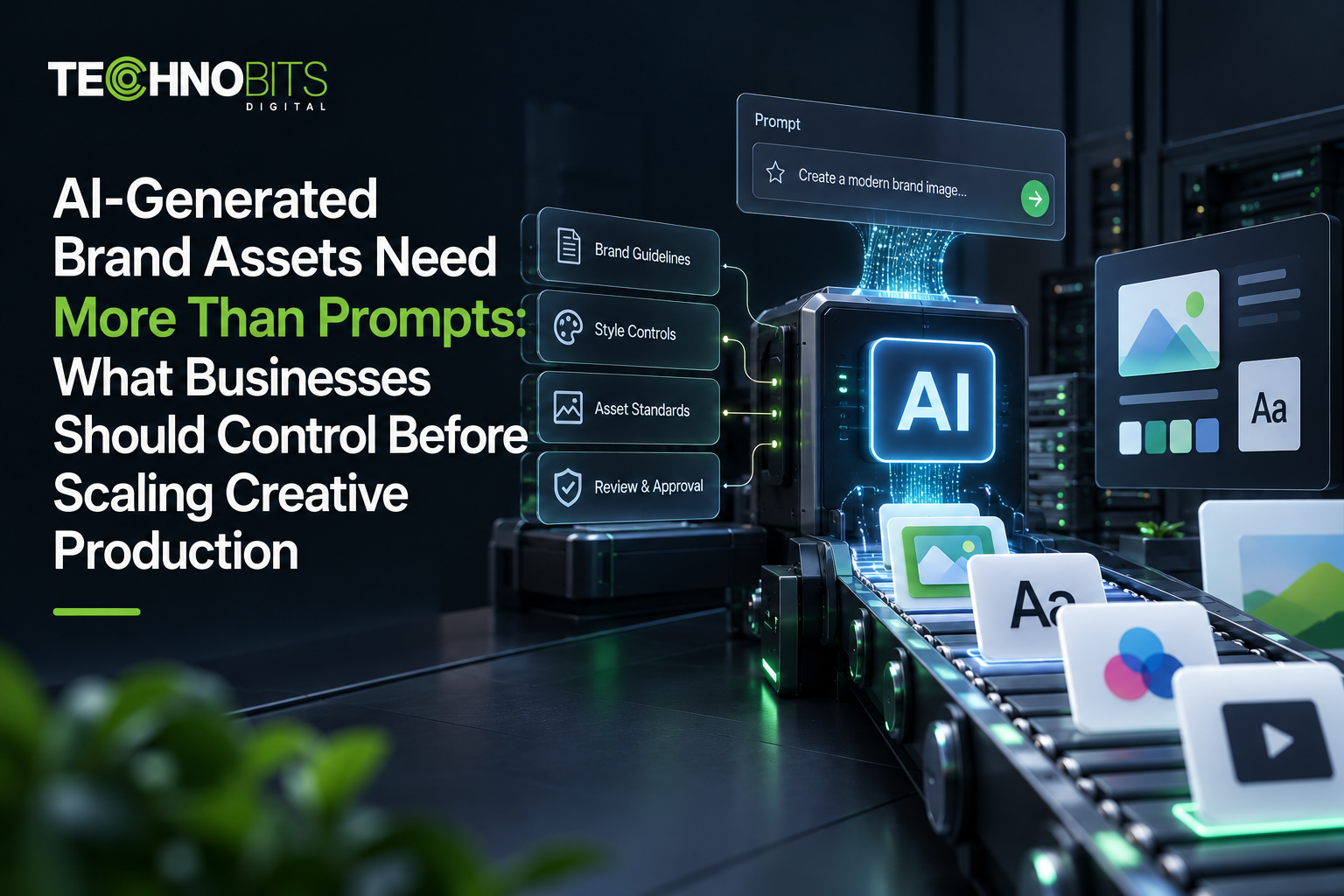
Generative AI has made it easier for businesses to produce visual concepts, campaign variations and marketing assets quickly.
But generating more designs does not automatically create a stronger brand.
As AI-assisted creative production expands, businesses need to answer a harder set of questions: Which brand rules should never change? Who approves final assets? What source material can AI tools use? How are trademarks, customer images and licensed assets handled? And how does a company prevent dozens of AI-generated variations from gradually making the brand look inconsistent?
This challenge is becoming more relevant in 2026. Adobe's research on AI-powered content operations shows that organisations are increasing AI use across content production while still facing governance, brand-consistency and compliance challenges.
The practical lesson is simple:
A prompt can generate an asset. It cannot replace a brand system.
Businesses that want to scale creative production need defined brand rules, appropriate human review, asset governance and a workflow that distinguishes experimentation from approved customer-facing material.
Technobits Digital's public Graphic Design services include logo and corporate identity work, brochures, banners, posters, icons and social-media graphics, with AI-assisted concept exploration used as part of the creative process.
Why More AI-Generated Content Can Create Brand Drift
A single AI-generated concept is relatively easy to review.
The problem becomes harder when teams start generating dozens or hundreds of variations for:
Social media
Paid advertising
Email campaigns
Landing pages
Presentations
Brochures
Event materials
Sales collateral
Each individual asset may look reasonable while the complete collection gradually loses consistency.
For example, one campaign might use slightly different logo proportions, another may introduce an unapproved illustration style, while a third changes typography or visual tone because the prompt was written by a different team member.
That creates brand drift.
Brand drift does not necessarily mean a design looks bad. It means the visual language no longer consistently represents the organisation.
A scalable creative workflow should therefore define what AI is allowed to explore and what must remain controlled.
Typical fixed elements can include:
Logo usage → typography → core colours → spacing rules → imagery direction → icon style → tone → required disclaimers → approval requirements
These controls are especially important when multiple employees, agencies or AI tools create content for the same brand.
For businesses still establishing these foundations, Technobits' Graphic Design and Corporate Identity offering is the most relevant internal service connection. Its public service page specifically lists corporate identity systems and brand guidelines among its capabilities.
Prompts Should Not Become the Brand Guideline
Prompts are useful instructions, but they are not a reliable replacement for a structured brand system.
Consider a prompt such as:
Create a premium modern social-media advertisement using our brand colours.
That leaves several important decisions undefined.
What does premium mean for this brand? Which colours are primary or secondary? Which fonts are approved? How much clear space should surround the logo? Are photographs preferred over illustrations? Can gradients be used? Which visual treatments should never appear?
Different AI tools—or even repeated generations from the same tool—can interpret those instructions differently.
A better workflow starts with structured brand information before prompt writing.
Teams should document areas such as:
Brand control | What should be defined |
|---|---|
Logo | Approved versions, spacing, placement and prohibited modifications |
Colour | Primary, secondary and supporting colour values |
Typography | Approved fonts, hierarchy and usage |
Imagery | Photography, illustration and image-treatment direction |
Layout | Grid, spacing and composition principles |
Voice | Tone and messaging boundaries |
Compliance | Mandatory wording, disclaimers or approval requirements |
Channels | Format requirements for social, digital, print and presentations |
AI can then assist within those boundaries rather than inventing the boundaries itself.
This distinction is particularly important for logo and identity work. Technobits publicly positions its AI use primarily as AI-assisted concept exploration, while final creative work remains a designed output rather than a purely generated result.
Human Review Should Remain Part of High-Visibility Brand Work
AI can help creative teams explore directions, generate rough concepts, develop variations or test different compositions.
But customer-facing assets still benefit from deliberate review.
Reviewers should examine more than whether a design looks attractive.
They should check:
Is the correct logo being used?
Are colours and typography consistent?
Does the design match the intended audience?
Is the message factually accurate?
Are product features represented correctly?
Are images appropriate for the business?
Are required disclosures present?
Does the design contain accidental or invented text?
Does it imitate another company's identity too closely?
Are the source images and other materials appropriate for the intended use?
This becomes even more important when AI-generated assets include people, products, locations or realistic scenes.
The reviewer should understand what the asset is intended to communicate and whether the visual could create a misleading impression.
Human review therefore should not be treated as merely “fixing AI mistakes.”
Its role is to make the final creative decision.
This aligns with the wider 2026 creative trend toward intentional rather than simply highly polished output. Canva's current design research describes a shift toward more human, distinctive visual expression even as AI remains integrated into creative workflows.
Copyright, Trademarks and Source Assets Need Clear Rules
Creative governance also involves rights and permissions.
Businesses should not assume that every asset produced through an AI tool can automatically be used for every commercial purpose.
Relevant questions may include:
What material was supplied to the AI system?
Teams should know whether prompts or references contain confidential designs, licensed stock imagery, customer materials or third-party intellectual property.
Are company trademarks being reproduced accurately?
Logos should normally come from approved brand files rather than relying on a generative model to recreate them.
Are photographs or likenesses properly authorised?
The requirements depend on how the image was obtained, where it will be used and the applicable laws and agreements.
What are the AI provider's usage terms?
Commercial-use terms, data handling and treatment of uploaded material vary between providers and can change.
The appropriate legal requirements depend on the organisation, jurisdiction, asset and use case. Businesses should therefore involve qualified legal or compliance professionals when necessary rather than treating a creative workflow as legal approval.
The goal is not to make every social post a legal project. It is to ensure that higher-risk assets have an appropriate review path.
Content Provenance Is Becoming More Relevant
Another emerging consideration is content provenance.
In July 2026, the Coalition for Content Provenance and Authenticity published additional implementation guidance explaining how Content Credentials can communicate whether media was AI-generated, AI-modified or non-synthetic using tamper-evident signed information.
For businesses, this is worth understanding—but it should not be overstated.
Content Credentials can provide useful provenance information. They do not, by themselves:
prove that a claim inside an image is true,
guarantee copyright ownership,
certify that a design follows brand standards,
or prove that the asset is commercially suitable.
Provenance and creative approval solve different problems.
A mature asset workflow may therefore record information such as:
Original asset → creator/tool → modifications → approval status → published version
The appropriate level of tracking depends on the organisation and the risk associated with the content.
AI Should Help Creative Production, Not Remove Creative Direction
One of the easiest mistakes to make is measuring AI adoption by output volume.
A team may generate 50 campaign variations instead of five, but that is useful only if the additional assets serve a defined purpose.
Before scaling production, ask:
Why do we need more versions?
The answer might be:
different platforms,
different aspect ratios,
regional campaigns,
audience segments,
product variants,
localisation,
or controlled creative testing.
Those are meaningful reasons.
“Because AI can generate more” is not.
Adobe's 2026 research makes a similar distinction between generating content quickly and building an effective, governed content supply chain. Its findings show that governance and consistency remain unresolved challenges even as organisations adopt generative AI more broadly.
A sensible model is:
Brand strategy → Creative brief → AI-assisted exploration → Designer review → Brand/compliance check → Final production → Channel adaptation → Approval → Publishing
Not:
Prompt → Generate → Publish
What Businesses Should Control Before Scaling AI Creative Production
Before increasing AI-generated creative volume, businesses should have clear answers in six areas:
1. Brand system
Define approved logos, typography, colours, imagery and layout principles.
2. Asset ownership
Keep approved source files and distinguish master assets from temporary AI-generated concepts.
3. Tool permissions
Define which AI tools employees or agencies may use and what company material may be uploaded.
4. Human approval
Specify which assets can be produced through routine templates and which require designer, marketing, product or compliance review.
5. Claims and product accuracy
AI should not invent product capabilities, prices, certifications, customer results or performance claims.
Marketing claims should come from verified business information.
6. Publishing control
Make it clear which file is approved for publication and maintain appropriate version control for important campaign assets.
This structure allows AI to support creative scale without allowing every employee or tool to redefine the brand independently.
Where visual content also supports campaigns across social channels, Technobits' Social Media Marketing service provides a related internal service connection. Technobits publicly lists strategy, content creation, community management and paid social among that offering.
Frequently Asked Questions
Can AI create brand assets without a designer?
AI tools can generate visual concepts and variations, but whether a designer is required depends on the asset and its importance. Logo systems, corporate identity, high-visibility campaigns and materials involving complex brand or compliance requirements generally benefit from professional creative review.
What is brand drift in AI-generated content?
Brand drift occurs when content gradually becomes visually or tonally inconsistent with an organisation's established identity. It can result from inconsistent prompts, different AI tools, incorrect logos, changing colours, unapproved typography or varying visual styles.
Should businesses allow employees to use any AI image generator?
That should depend on company policy and the type of information being used. Businesses should consider provider terms, confidentiality, access controls, permitted source assets and approval requirements before allowing commercial content to be generated through a tool.
Can AI-generated images be used commercially?
There is no universal answer for every tool, asset or jurisdiction. Commercial-use conditions depend on the provider's terms, the source material, third-party rights and applicable law. Businesses should review these issues for relevant commercial assets rather than assuming generation automatically establishes unrestricted rights.
What are Content Credentials?
Content Credentials are part of the C2PA provenance framework and can provide tamper-evident information about how digital media was created or modified. They can help communicate provenance, but they do not independently prove factual accuracy, copyright ownership or brand approval.
How can a company scale AI-generated social-media graphics without losing brand consistency?
Start with defined brand guidelines, approved templates and source assets. Then establish tool rules, human-review requirements and an approval process before publishing. AI can assist with variations, but the same brand and product-accuracy rules should apply to every version.
Scaling Creative Production Without Losing the Brand
The value of generative AI in design is not simply the ability to produce more images.
Its useful role is to support creative exploration and production while the organisation maintains control over what represents the brand publicly.
That requires more than better prompts.
It requires:
a defined visual identity, approved source assets, human creative judgment, appropriate rights controls, accurate product information and a clear publishing process.
When those foundations are in place, AI can become one part of a structured creative workflow rather than an uncontrolled source of visual variation.
Technobits Digital publicly offers Graphic Design and AI Creative Studio services covering logo design, corporate identity, brochures, banners, posters, icons and social-media graphics, with AI-assisted concept exploration included within its stated capabilities.
Planning a Brand or Creative Design Project?
Before scaling creative production, define the visual identity, approved assets, intended channels and review requirements that every design should follow.
Technobits Digital can support relevant creative requirements through Graphic Design and Corporate Identity services, while organisations planning campaign execution can also explore Social Media Marketing services.
For a project-specific discussion based on your brand, required assets and intended channels: