AI Shopping Agents Are Changing E-Commerce: What Businesses Should Prepare Before Agentic Commerce Becomes Mainstream
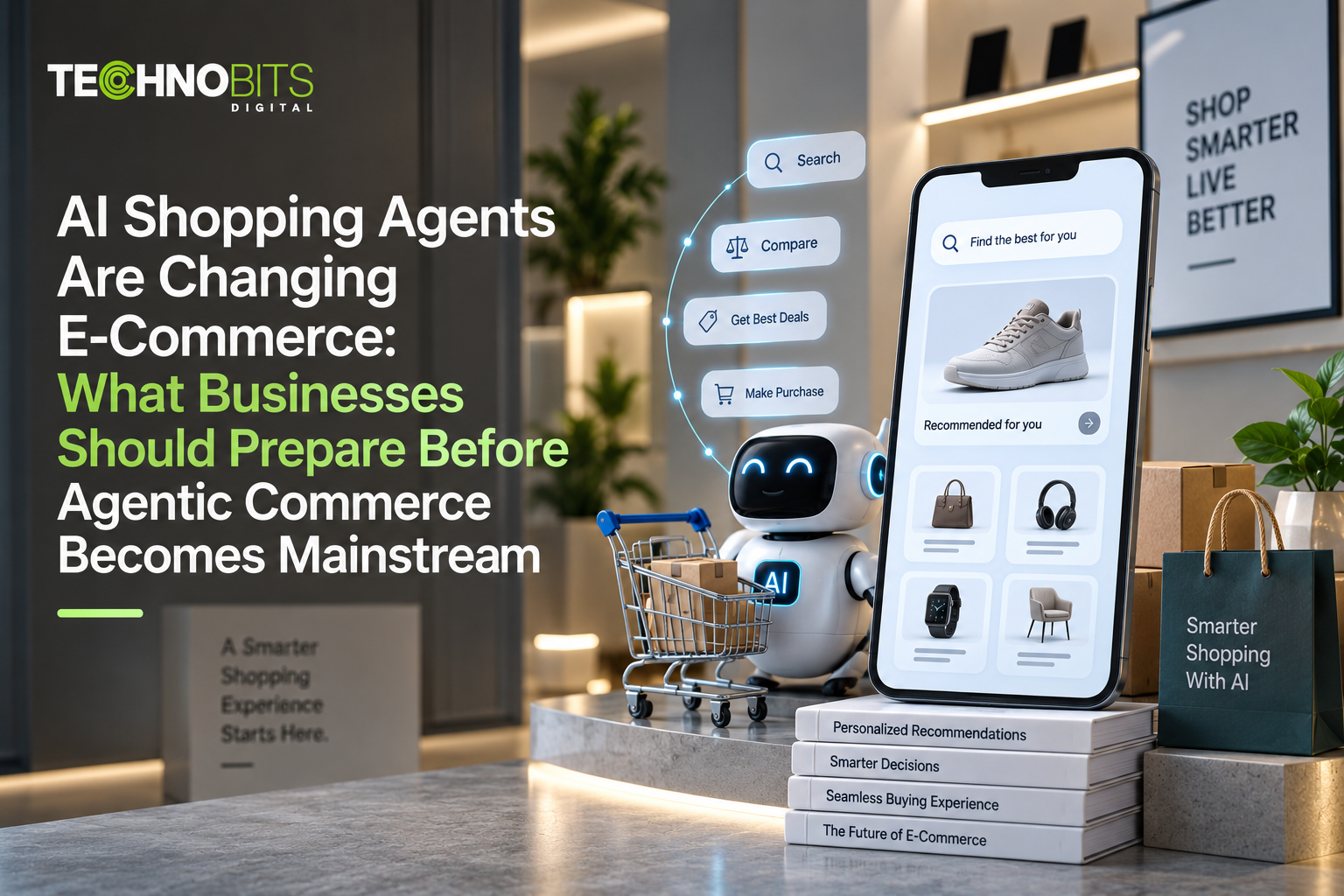
Online shopping is beginning to move beyond traditional search, product pages and checkout flows.
AI shopping agents can already help users discover products, compare options and, in some environments, progress toward or complete purchases based on instructions provided by the customer. This emerging model is commonly described as agentic commerce.
The important change for businesses is not simply that shoppers may use a chatbot instead of a search box.
It is that part of the buying journey may increasingly be performed by software acting on a customer's behalf.
In 2026, Google introduced the Universal Commerce Protocol as an open framework intended to help AI agents and commerce systems communicate across product discovery, checkout and related workflows. Google has also introduced Universal Cart as part of its wider agentic-shopping infrastructure. Shopify has made agentic-commerce tooling including UCP and its Catalog API available to developers.
For merchants, this creates a practical question:
Is the existing e-commerce platform structured well enough for both people and AI-assisted shopping channels to understand product information, availability, pricing and transaction rules accurately?
What Is Agentic Commerce?
Agentic commerce describes shopping journeys in which an AI system can perform some combination of searching, comparing, recommending and taking permitted actions on behalf of a customer.
A customer might ask:
Find a waterproof travel backpack under a particular budget that can arrive before Friday.
Instead of manually opening multiple product pages, an AI agent may evaluate available information against those conditions.
More advanced systems can potentially progress further into transaction workflows, provided the necessary merchant, payment and authorization infrastructure is available.
Shopify describes agentic commerce as AI-assisted shopping that can move from product discovery and comparison toward purchasing within conversational experiences. Visa similarly describes agentic commerce as AI agents searching, comparing and potentially paying within rules defined by the user.
That does not mean traditional e-commerce websites are disappearing.
Websites, merchant systems, inventory, payments, fulfilment and customer support remain important. Agentic commerce introduces another interface through which those existing systems may be accessed.
Why Product Data Becomes More Important
An attractive product page may be understandable to a human shopper while still containing information that is difficult for another system to interpret reliably.
Consider a product with:
Title → Description → Size → Colour → Price → Availability → Delivery → Return policy
If key information is incomplete, inconsistent or stored only inside images or promotional copy, automated shopping systems may have difficulty determining whether the product matches a customer's request.
Businesses preparing for AI-assisted commerce should review whether important product information is:
accurate and current
consistently named
structured where appropriate
connected to the correct variants
synchronized with pricing and inventory
supported by clear delivery and return information
Shopify's 2026 guidance similarly places structured product data, accurate attributes, variants, pricing, inventory and policy information among the foundations merchants should review for agentic-commerce readiness.
For businesses planning or modernising an online store, Technobits Digital publicly provides E-Commerce Development and AI Commerce services covering custom e-commerce portals, product management, checkout and integration with systems such as ERP, CRM and inventory platforms.
Agentic Commerce Depends on More Than the Storefront
AI shopping is sometimes presented as a front-end innovation.
Technically, the harder problem often sits behind the interface.
A commerce journey may involve:
AI channel → Product catalogue → Inventory → Pricing → Cart → Payment → Order system → Fulfilment
If an AI agent receives yesterday's inventory data, it may present a product that is no longer available.
If product variants are inconsistent between the website and inventory system, the agent may struggle to interpret what can actually be ordered.
If promotional pricing is not exposed correctly, the amount shown during discovery may differ from checkout.
Agentic-commerce readiness therefore depends on reliable connections between systems.
Businesses should understand:
which system owns product information
where pricing is calculated
which system owns inventory
how frequently those values change
how APIs report errors
what happens when a connected service is unavailable
which actions require customer confirmation
Where e-commerce depends on multiple operational systems, custom software and API work may also become relevant. Technobits Digital's Software Solutions service publicly includes custom software and integration-oriented development.
Payments and Authorization Need Clear Boundaries
Product recommendation and product purchasing are different levels of authority.
An AI system suggesting:
“This product appears to match your requirements.”
is different from an AI system being permitted to place an order.
Once software can take transaction-related actions, businesses need clear rules governing what the customer has authorised.
Questions include:
Area | Question businesses should answer |
|---|---|
Customer intent | What exactly did the customer authorise? |
Spending limits | Can the agent purchase at any price or only within defined limits? |
Product variation | Can it substitute a size, colour or model? |
Payment | How are valid payment credentials handled? |
Confirmation | Which purchases require explicit approval? |
Returns | Who handles cancellations, disputes and refunds? |
Auditability | Can the merchant determine what the agent requested and what was actually executed? |
These are becoming central industry issues. Mastercard's recent work on agentic commerce emphasizes verifiable intent, secure credentials, authorization and agent identity, while Visa similarly highlights trust and visibility as important conditions for agent-led purchasing.
The goal should not be maximum automation.
The goal should be appropriate automation with clear authority and traceable transactions.
Technobits publicly lists secure payment-gateway integration within its E-Commerce service. Any specific payment architecture should still be scoped according to the selected provider, transaction model and applicable merchant requirements.
Security Becomes More Important When Software Can Act
AI agents introduce a different security question from traditional browsing:
How does the merchant know which actions are legitimate and permitted?
Potential areas requiring controls can include:
authentication, API permissions, payment authorization, session handling, account access, rate limits, logging and third-party integrations.
An agent should not receive unrestricted access simply because it represents a customer.
Permissions should reflect the action being performed.
For example, a product-search request does not require the same level of authorization as:
placing an order, changing an address, applying account credit or requesting a refund.
Businesses should therefore separate:
read actions → recommendation actions → transaction actions → account-management actions
and apply controls appropriate to each level.
Technobits Digital's Cybersecurity Services publicly include security audits, VAPT, SIEM, web-application penetration testing and network security. These capabilities may be relevant where new commerce integrations increase application or API exposure, but they should not be presented as a guarantee that an agentic-commerce implementation is automatically secure.
Businesses Should Not Rebuild Their Store Just Because Agentic Commerce Is Growing
The emergence of AI shopping channels does not mean every business needs a completely new e-commerce platform.
That would be an expensive and potentially unnecessary response.
Start by assessing the current system.
A well-maintained commerce platform may already have:
structured catalogue data, reliable inventory, APIs, payment integration and clear order-management processes.
In that case, the work may involve improving specific data feeds or integrations rather than replacing the entire store.
A more extensive modernization becomes relevant when the current environment has problems such as:
fragmented product data, unreliable inventory synchronization, tightly coupled legacy systems, limited APIs or inconsistent checkout logic.
The appropriate question is therefore not:
“Do we need to build an AI shopping store?”
It is:
“Can our existing commerce systems provide accurate information and controlled actions to emerging shopping channels?”
For larger application changes, Technobits Digital's Web Development services may be relevant alongside e-commerce development where storefront, application or portal changes are required.
What Should Businesses Prepare Before Agentic Commerce?
Businesses do not need to predict exactly which AI shopping platform will dominate.
They should focus on foundations that remain useful regardless of channel.
The highest-value preparation areas are:
Product data — accurate descriptions, attributes, variants and identifiers.
Inventory — reliable availability information.
Pricing — consistent pricing and promotion logic.
Policies — clear shipping, returns, warranties and restrictions.
APIs and integrations — dependable communication between commerce systems.
Payments — secure transaction processing with clear customer authorization.
Identity and permissions — clear boundaries around what users and automated systems can do.
Monitoring — enough visibility to investigate failed or unexpected transactions.
Customer support — processes for correcting orders or resolving disputes when an automated shopping journey goes wrong.
These are useful e-commerce practices even if agentic commerce develops more slowly than expected.
That is one reason businesses should focus on improving the underlying commerce infrastructure rather than chasing every new AI interface.
How Should Agentic-Commerce Readiness Be Measured?
Do not measure readiness by whether an AI chatbot has been added to the website.
Useful measurements should connect to the underlying commerce process.
Depending on the implementation, businesses may examine:
Product-data accuracy
Are price, inventory and variants consistent across systems?
Transaction completion
Can an agent-assisted journey reach checkout without broken hand-offs?
Order accuracy
Does the final order match the user's authorised request?
Integration failures
How often do catalogue, inventory or payment dependencies fail?
Exception handling
Can customers or staff correct an incorrect automated action?
AI-channel traffic and orders
Can the business distinguish traffic or transactions originating from emerging AI shopping channels where its analytics setup makes this possible?
The objective is to understand whether the new channel produces reliable commerce—not simply whether AI is present.
Frequently Asked Questions
What is an AI shopping agent?
An AI shopping agent is software that can assist a user with tasks such as searching for products, comparing options and, where supported and authorised, progressing into transaction-related actions.
What is agentic commerce?
Agentic commerce is an emerging model in which AI agents participate in commerce workflows on behalf of users. This can range from product discovery and comparison to purchasing in environments where payment and authorization infrastructure supports it.
Will AI shopping agents replace e-commerce websites?
There is not enough basis to assume that. Websites continue to provide product information, brand experience, account management, support and the commerce infrastructure underlying many transactions. AI agents are better understood as an additional discovery or transaction channel.
Does every business need to support UCP?
No. UCP is an emerging open commerce protocol, not a universal legal or technical requirement for every merchant. Businesses should first understand their current platforms, channels and customer needs before deciding whether a particular protocol or integration is relevant. Google introduced UCP in collaboration with commerce-industry participants in 2026.
What Agentic Commerce Really Means for E-Commerce Teams
The important change in agentic commerce is not that every shopper will suddenly stop visiting websites.
It is that commerce platforms may increasingly need to serve both human interfaces and software-mediated shopping journeys.
That makes foundational e-commerce engineering more important:
accurate product data → reliable integrations → controlled permissions → secure payments → clear policies → observable transactions
Businesses that improve those foundations are better positioned for new shopping channels without committing themselves to one unproven interface or platform.
Google, Shopify, Visa and Mastercard's work in 2026 shows that agentic commerce is moving from experimentation toward real commerce infrastructure, but the ecosystem is still evolving. Businesses should therefore prepare their systems while avoiding assumptions that every transaction will soon become autonomous.
Is Your E-Commerce Platform Ready for AI Shopping Channels?
Agentic commerce readiness begins with the systems that already run your online store: product data, inventory, pricing, checkout, payments, integrations and security.
Technobits Digital provides E-Commerce Development, Software Solutions, Web Development and Cybersecurity Services that may support different parts of an e-commerce modernization or integration project.
The appropriate next step should depend on the current store architecture and business requirements rather than on adopting AI for its own sake.
Discuss Your E-Commerce Requirements with Technobits Digital