Face Recognition Testing for Digital Banking: Why a Successful Demo Is Not Enough
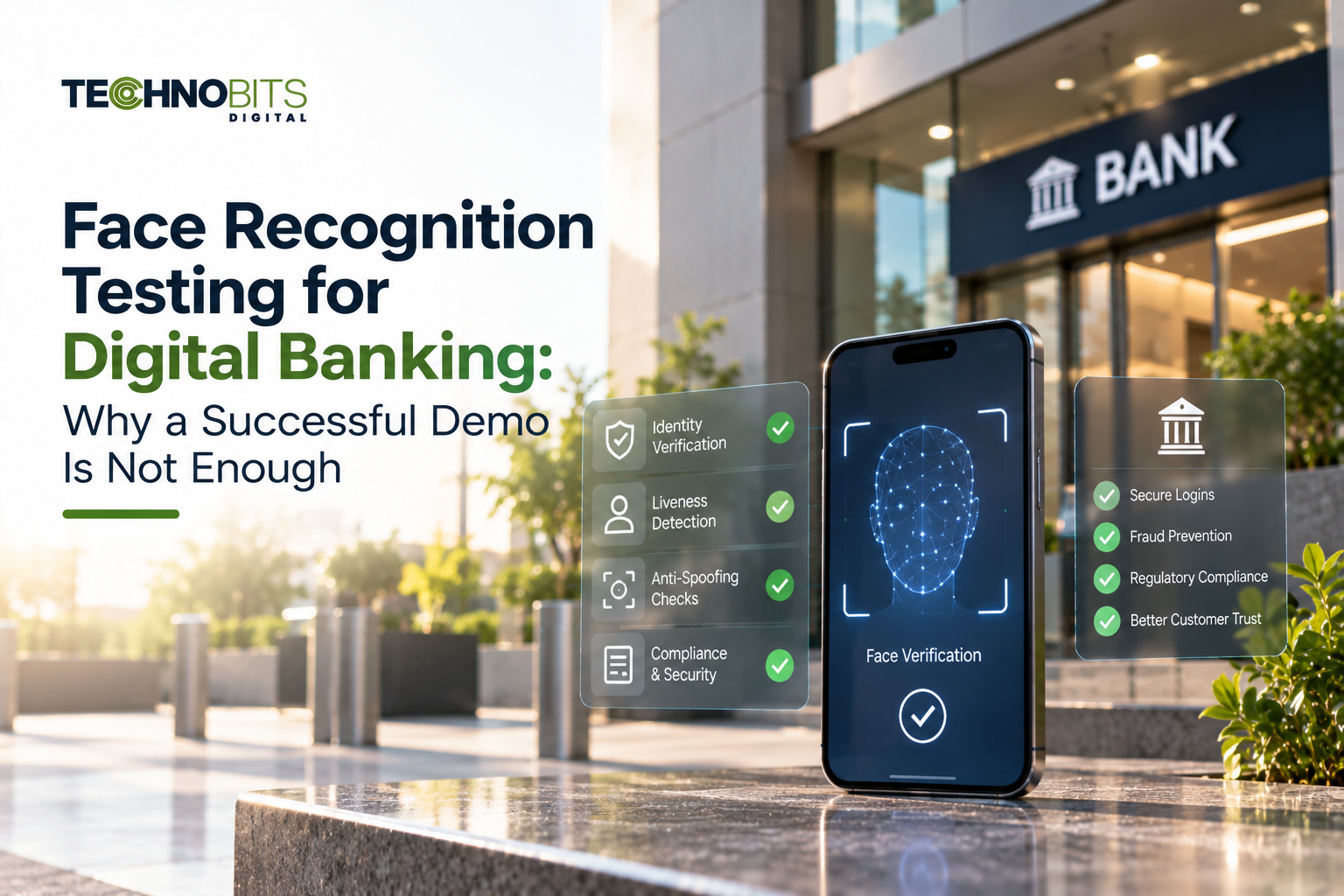
A face-recognition journey can work perfectly in a controlled demonstration yet reject genuine banking customers in production. Demonstrations normally use supported phones, stable networks, cooperative users, favourable lighting and a small collection of reference images. Real customers arrive with older cameras, accessibility requirements, weak connectivity, appearance changes, reflective glasses, damaged identity documents and different levels of confidence following on-screen instructions.
Custom Software Testing for face recognition systems must therefore assess the complete identity workflow rather than ask only whether the recognition model returns a match. Digital banking owners need evidence about biometric accuracy, presentation-attack detection, mobile capture, API behaviour, privacy controls, retry logic, manual review and account recovery. A technically accurate model can still create an unusable or unsafe banking process when these connected components behave differently under production conditions.
What Should Digital Banking Owners Evaluate Before Approving Face Recognition?
Start by defining the biometric decision being made. Face verification compares a live capture with a claimed identity, such as the portrait extracted from an identity document. Face identification searches one face against a larger gallery and introduces different operational and privacy risks. Most onboarding and account-recovery journeys require verification, but product documentation sometimes uses “recognition” for both processes. The test strategy should state the comparison type, enrolment source, similarity threshold, permitted retries and action taken when the score falls near the decision boundary. Without those details, a test can report that an API responded successfully without proving that the banking decision was appropriate.
Model outcomes should be evaluated using more than a general accuracy figure. Relevant measures include false match rate, where an unauthorised person is accepted; false non-match rate, where the genuine customer is rejected; failure to acquire, where the system cannot capture a usable face; and failure to enrol, where no reliable reference can be established. Results should be segmented by device, operating-system version, camera position, lighting condition and other legally and ethically appropriate test dimensions. Aggregate results can conceal concentrated failure patterns. The acceptance threshold also requires a documented business decision because lowering it may reduce customer rejection while increasing the chance of incorrect acceptance.
Evaluate the customer journey around the model as carefully as the model itself. A mobile application may crop the face incorrectly, compress the image before upload, rotate frames using faulty metadata or lose a capture when the app moves into the background. The backend may time out after the biometric provider has processed the request, leaving the bank and customer with conflicting transaction states. Testing should cover capture guidance, consent, data transfer, response mapping, retries, customer messaging and assisted alternatives. Where banking access depends on mobile delivery, coordinated AI mobile app engineering and testing can expose defects that isolated model evaluation will not find.
Where Production Face Verification Breaks Across Devices, APIs and Customer Journeys
Capture quality is one of the clearest differences between a demonstration and production use. Front-facing cameras vary in resolution, focus behaviour, colour processing and performance in low light. Some devices apply aggressive image enhancement; others produce motion blur when customers hold the phone at arm’s length. Browser permissions, operating-system privacy controls and application lifecycle events can also interrupt capture. Test coverage should include supported and borderline devices, portrait and landscape transitions, permission denial, incoming calls, low-memory conditions and interrupted uploads. Separate iOS application testing and Android application testing are important because camera APIs, background behaviour and device fragmentation differ materially.
Presentation-attack detection introduces another failure surface. Liveness controls may assess motion, depth, texture, challenge responses or signals from multiple frames to distinguish a person from a photograph, replayed video, mask or manipulated input. Testing needs approved attack artefacts and controlled procedures rather than improvised attempts by the delivery team. It should verify both attack detection and the effect on genuine users. A challenge that asks for precise head movement may disadvantage a customer with limited mobility, while repeated flashing instructions may create accessibility concerns. The application also needs safe handling for failed or inconclusive liveness checks without revealing enough detail to help an attacker tune subsequent attempts.
Integration defects can invalidate an otherwise acceptable biometric result. A provider may return statuses such as matched, not matched, low quality, suspected attack, expired session or service unavailable. If the banking platform reduces these states to a Boolean response, it can send genuine customers into an inappropriate rejection path or treat an operational outage as an identity failure. System integration services should validate status mapping, idempotency, timeout handling, webhook authentication, duplicate callbacks and correlation identifiers across the mobile client, orchestration layer, biometric service and core onboarding platform. Logs must support investigation without storing unrestricted face images, document portraits or biometric templates.
Which Accuracy, Security and Customer-Experience Trade-offs Should Govern Release?
No single threshold optimises every banking use case. Opening a low-function account, authorising a high-value payment and recovering access to an established account carry different consequences. Risk owners should define the permitted outcome for each context rather than reuse one model threshold across every journey. Step-up controls may combine face verification with device possession, document validation, account history or manual review. This is not a reason to collect every available signal. Each signal should have a defined purpose, retention rule and decision role, with privacy and security review built into release governance.
Decision area | Question for the owner | Required test evidence |
|---|---|---|
Similarity threshold | What balance between false acceptance and genuine-customer rejection is acceptable for this transaction? | Threshold results segmented by journey, capture condition and relevant test cohort |
Retry policy | Can retries improve capture quality without enabling repeated attack attempts? | Boundary, rate-limit, lockout and interrupted-session tests |
Fallback route | What happens when a customer cannot or does not wish to use face verification? | Manual-review, alternative-verification and recovery-path tests |
Biometric retention | Which images, templates and decision records are necessary, and for how long? | Deletion, access-control, backup and audit-log verification |
Supplier outage | Should the journey pause, fail safely or use an approved alternative? | Timeout, degraded-service and recovery reconciliation tests |
Release criteria should combine functional, biometric, operational and security evidence. A passing functional test confirms that a request reached the provider and produced an expected response; it does not establish suitability for customers. AI Quality Assurance can support broader scenario generation, log clustering and regression selection, but AI-generated cases still require human review against banking policy and intended customer outcomes. AI-accelerated delivery is most useful when it expands coverage or shortens analysis without allowing a generated test, synthetic identity or model explanation to become its own acceptance oracle.
A practical release decision should examine the following controls together:
Representativeness: production-relevant devices, environments, capture conditions and customer journeys are covered.
Traceability: each banking requirement maps to tests, results, defects and an accountable release decision.
Recoverability: interrupted sessions, duplicate submissions and provider outages do not create unresolved identity states.
Accessibility: customers who cannot complete the standard capture flow have an appropriate alternative.
Observability: teams can distinguish poor capture, biometric rejection, suspected attacks and integration failures.
Change control: model, SDK, threshold and mobile-release changes trigger proportionate regression testing.
Frequently Asked Questions About Testing Banking Face Recognition
Can a successful proof of concept establish that the system is ready?
No. A proof of concept can confirm basic technical feasibility, provider connectivity and a limited happy path. Production readiness requires device coverage, biometric error analysis, presentation-attack testing, accessibility assessment, security controls, operational fallbacks and monitoring. The production configuration must also be tested because SDK versions, image preprocessing, thresholds and orchestration logic may differ from the demonstration.
Should a bank test the face-recognition model or the complete application?
Both are necessary. Model evaluation measures biometric behaviour under defined conditions, while application testing examines capture, permissions, data transfer, API mapping and customer outcomes. Full-stack expertise is valuable because a rejection may originate in camera handling, image compression, network behaviour, backend orchestration or the model itself. Testing only the provider API leaves those other causes unexamined.
Can synthetic faces replace testing with representative participants?
Synthetic data may support scale, privacy-conscious development and testing of rare technical conditions, but it should not be treated as a complete substitute for appropriately governed human evaluation. Generated images may fail to reproduce camera optics, user movement, environmental variation and interactions between facial characteristics and capture hardware. Test-data provenance and permitted use should be documented regardless of the source.
What should be monitored after release?
Monitor failure to acquire, false non-match indicators, retry frequency, abandonment, manual-review referrals, provider latency, error statuses and device-specific failure patterns. Monitoring should separate fraud signals from technical and usability failures. A rise in rejection after an SDK or application update needs different investigation from an increase in suspected presentation attacks. Production data access should follow defined privacy and security controls.
What Must Be Defined Before Commissioning a Banking Face-Recognition Test Programme?
Begin with the decision inventory rather than a list of test scripts. Identify where face verification appears, what banking action it controls, which systems exchange biometric or identity data, and who owns acceptance of residual risk. Then document supported devices, biometric-provider versions, thresholds, retry limits, fallbacks, data locations and release dependencies. An effective sequence is:
Map enrolment, verification, recovery and manual-review journeys from the customer interface to downstream banking systems.
Define measurable acceptance criteria for biometric outcomes, capture quality, accessibility, latency and operational recovery.
Build a risk-based test matrix covering devices, networks, environmental conditions, API states and approved attack scenarios.
Execute functional, integration, security, usability and biometric evaluations with controlled test data.
Review defects by customer and banking risk rather than counting pass rates alone.
Establish regression triggers and production monitoring for SDK, model, threshold and application changes.
Technobits Digital provides Testing & Analysis, Mobile App Development, Software Solutions and IT Security Audit services. Depending on project scope, these capabilities may support functional, integration, performance and security testing around an application that uses third-party biometric technology.
Specialist biometric accuracy evaluation, presentation-attack testing, regulated banking assessments and independent certification should be explicitly scoped and assigned to suitably qualified parties where required.
Planning to Launch a Face-Verification Feature in a Banking App?
A successful demonstration is only one part of release readiness. Mobile capture, application behaviour, APIs, access controls, failure handling and security requirements all need appropriate testing before customer rollout.
Technobits Digital provides Testing & Analysis, Mobile App Development and IT Security Audit services that may support relevant parts of a software testing and security review.
Specialist biometric evaluation and banking compliance requirements should be defined separately as part of the project scope.