AI Mobile App Prototype to Production: Key Challenges
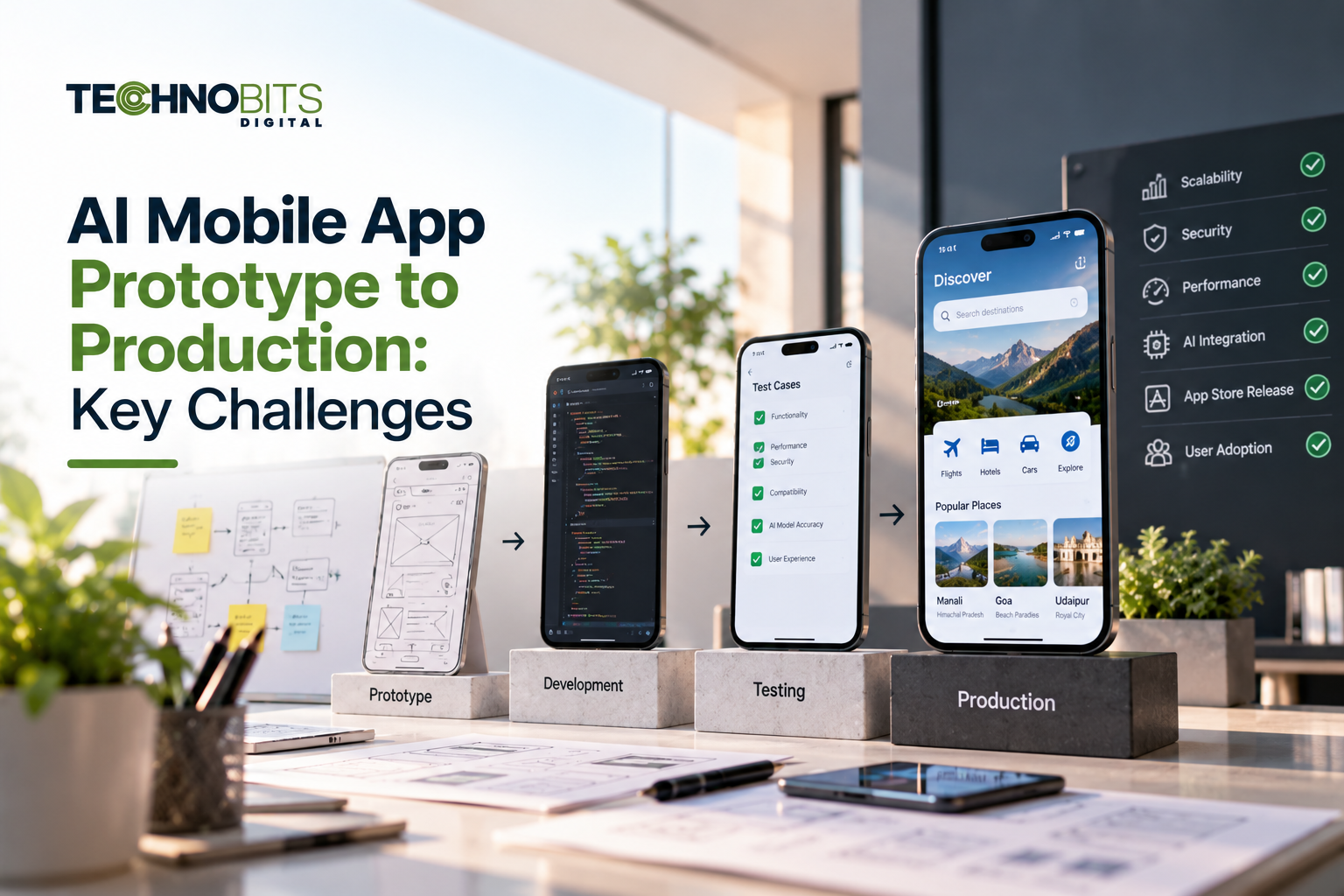
An AI mobile app can work well during a demonstration but still require significant work before customers can use it reliably.
A prototype may validate one feature using selected inputs and stable conditions. A production application must also handle real user behaviour, changing network conditions, authentication, data access, model errors, operating costs and ongoing support.Before expanding development, businesses should determine which parts of the prototype are reusable, which need additional engineering and what evidence is required for release.That gap explains why many AI mobile apps work in a workshop but stall before customers can depend on them.
The transition succeeds when business owners treat the prototype as evidence for a product decision, not as an almost-finished application. The team must identify the user outcome, establish acceptable response quality, choose where inference will run, define data controls and design a supportable backend. It must also budget for testing, observability, cloud usage, model evaluation and mobile release management. AI-accelerated delivery can shorten coding, documentation and test-generation tasks, but it cannot replace architecture decisions or establish whether an AI response is commercially, legally or operationally acceptable.
What Must Business Owners Validate Before an AI Mobile Prototype Becomes a Product?
Start by separating demonstration success from product success. A prototype may prove that a model can classify an image, summarise a document or answer a question. Production readiness asks whether the complete service can perform that task for the intended user, under realistic conditions, at an acceptable cost and with recoverable failure modes. Define the primary workflow as a sequence: user input, validation, data retrieval, inference, post-processing, user confirmation and system action. For each stage, record who owns the decision and what happens when the stage fails. If a field technician photographs damaged equipment, for example, an uncertain classification should not silently create a confirmed maintenance order. The application may need to display confidence information, request another image or route the case to a qualified reviewer.
Next, establish measurable acceptance criteria for the AI behaviour. Conventional software can often be checked against a fixed expected result, but generative and probabilistic systems require evaluation sets, scoring rules and human review thresholds. Your evaluation data should represent the languages, document formats, image conditions, user vocabulary and edge cases expected after release. It should also include deliberately difficult examples, such as incomplete forms, ambiguous questions and unsupported requests. A product team developing intelligent software should distinguish factual accuracy, task completion, response relevance, safety and presentation quality. A fluent response can still contain the wrong account information or recommend an action outside the application’s authorised scope.
Commercial assumptions also need validation before engineering expands. Estimate usage by workflow rather than relying only on monthly active users. A single customer might initiate one inference per session, while an agentic workflow could make several model, retrieval and validation calls for one visible action. Record expected input and output volume, peak concurrency, file-storage requirements, third-party API charges and human review effort. Include fallback behaviour when an external model is unavailable or exceeds its latency target. These estimates do not need to predict demand perfectly. Their purpose is to reveal whether the proposed experience remains viable when model usage, support requirements and infrastructure grow beyond the controlled prototype.
Where the Prototype-to-Production Path Breaks Across Mobile, AI and Backend Layers
The first common fault is placing too much responsibility inside the mobile client. A prototype may call a model provider directly because this is fast to demonstrate, but embedding credentials or business rules in an application creates security and maintainability problems. Production architecture normally requires a controlled server-side layer for authentication, prompt construction, retrieval, rate limiting, audit records and provider abstraction. The application should receive only the data and permissions required for the current user and task. Native capabilities also matter. Android app development must account for device fragmentation, background execution rules and permission behaviour, while iOS app development must address platform-specific privacy declarations, entitlements and lifecycle constraints.
Data pipelines frequently remain prototype-grade as well. Teams may copy documents into a vector database without version control, access filtering or a process for deleting obsolete content. Retrieval then returns material the user should not see, or it supplies superseded policies to the model. Production retrieval-augmented generation needs document provenance, tenant separation, chunking rules, metadata filters, refresh schedules and traceability from an answer back to its sources. If the app connects to customer relationship management, inventory or field-service platforms, system integration must also handle duplicate requests, partial failures and conflicting records. An AI-generated action should carry an idempotency key so a mobile retry does not create two bookings, refunds or work orders.
Another failure point is the absence of operational ownership. Model outputs may degrade after a provider update, a retrieval index change or a shift in real user language even when the mobile binary has not changed. Product teams need telemetry that connects technical events with user outcomes: model version, prompt version, retrieval sources, latency, validation result, user correction and final action status. Sensitive prompt content should not simply be copied into unrestricted logs. Monitoring must balance diagnostic value with privacy, retention and access requirements. Named owners should review failed workflows, approve model or prompt changes and decide when to disable an automated action. Without those controls, the team cannot distinguish a user-interface defect from weak retrieval, model variability or an integration failure.
Which Architecture and Delivery Trade-Offs Should Govern the Production Decision?
The most visible choice is where inference occurs. On-device models can support offline operation, reduce transmission of sensitive data and provide predictable response times, but they are constrained by memory, battery consumption and device capability. Cloud inference can support larger models and centralised updates, yet introduces network dependence, service cost and external processing considerations. A hybrid design may classify locally, retrieve approved information through the backend and send only the necessary context to a hosted model. The right option depends on the task rather than a general preference for local or cloud AI. A keyboard assistant, medical image workflow and warehouse scanner have different latency, privacy and hardware requirements.
Decision area | Faster prototype option | Production question |
|---|---|---|
Model access | Direct provider call | How will credentials, quotas, routing and provider failure be controlled? |
Knowledge | Static demonstration documents | How will content be authorised, updated, traced and removed? |
User action | Model output displayed as final | Which actions require validation, confirmation or human approval? |
Connectivity | Assumed stable connection | What can be cached, queued or retried safely when the device is offline? |
Quality | Manual review of selected examples | Which evaluation set and release threshold will detect regressions? |
Model flexibility must be balanced against product consistency. Allowing unrestricted prompts may support exploration, but it makes testing, support and cost control difficult. Constrained workflows can use structured inputs, approved tools, response schemas and explicit confirmation screens. They may feel less open-ended, yet they are often easier to operate when an answer updates a business system or affects a customer. Provider abstraction presents a similar trade-off. A generic model gateway can reduce dependency on one vendor, but the lowest-common-denominator interface may hide useful provider-specific functions. Abstract the capabilities that genuinely need portability—authentication, logging, retries and response validation—without assuming every model behaves identically.
Speed also requires a deliberate boundary. AI-assisted coding can generate interface scaffolding, API clients, test cases and technical documentation, but generated components still require review for platform conventions, data exposure and error handling. Full-stack expertise becomes important because latency or incorrect behaviour rarely belongs to one layer. A slow answer might result from image upload, document retrieval, model generation or repeated calls from the mobile interface. Delivery planning should therefore cover the app, backend, data services, model operations and cloud controls as one product system. Accelerating only the visible interface creates the impression of progress while deferring the highest-risk engineering decisions.
How Should Businesses Prepare an AI Mobile App for Production?
The first step is a technical discovery and production-readiness assessment rather than an immediate rebuild. Technobits Digital can examine the prototype’s source code, model dependencies, data flows, integrations and deployment assumptions against the intended operating environment. The assessment should identify which components are reusable, which require hardening and which were appropriate only for experimentation. It can also define non-functional requirements covering response time, availability, device support, accessibility, privacy and operational recovery. For businesses coordinating stakeholders in several regions, global multi-office support can help maintain a shared decision record and structured handovers, provided architecture ownership and approval responsibilities remain explicit.
A practical implementation sequence should reduce the highest uncertainties before expanding feature scope. The team can use the following order:
Define the production workflow. Map user intent, model calls, business rules, approval points and failure paths.
Secure the service boundary. Move credentials and privileged operations behind authenticated APIs with role and tenant controls.
Build representative evaluations. Create test cases from expected inputs, edge conditions and prohibited actions.
Stabilise integrations. Add validation, idempotency, retries, timeouts and reconciliation for external systems.
Add operational visibility. Capture model, prompt, retrieval and transaction versions without exposing unnecessary personal data.
Release through controlled stages. Use internal testing, limited user groups, feature flags and rollback criteria before broad distribution.
Testing must cover deterministic software and variable AI behaviour separately, then verify how they interact. Conventional tests should inspect authentication, permissions, API contracts, offline queues, deep links, notifications and device-specific behaviour. Model evaluations should examine unsupported claims, instruction following, retrieval grounding and response schemas. End-to-end scenarios should confirm that an acceptable AI response produces the correct business action and that an unacceptable response is blocked or escalated. AI Quality Assurance can support this layered evaluation, while AI Cyber Defense considerations become relevant when prompts, uploaded files, model tools or connected records introduce new attack paths.
After release, the product needs a change-management process that treats prompts, models, retrieval content and policy rules as versioned production assets. A mobile release is not the only event capable of changing behaviour. Establish approval requirements for model swaps, prompt revisions, tool access and knowledge-base updates. Maintain rollback options and compare proposed changes against a stable evaluation set before deployment. Technobits Digital’s full-stack delivery perspective can help connect mobile engineering with backend services, AI orchestration, integrations and operational controls. The objective is not to remove all model uncertainty; it is to make uncertainty visible, testable and governable within the business workflow.
Frequently Asked Questions About Taking AI Mobile Apps into Production
Can a working prototype be converted directly into a production app?
Sometimes parts can be retained, but a direct conversion should not be assumed. Interface components, domain models and validated workflows may be reusable. Embedded API keys, hard-coded prompts, demonstration datasets and direct model-provider calls usually require redesign. Review the prototype for maintainability, security, accessibility, error recovery and platform practices before deciding whether to harden it or rebuild selected layers.
Should the business choose a model provider before designing the backend?
A provisional model choice can support experimentation, but backend design should reflect the product’s required capabilities rather than one provider’s demonstration API. Define context limits, structured output, tool use, regional processing, latency and evaluation requirements first. Where practical, isolate provider-specific code behind a controlled service boundary. Do not create an abstraction so generic that it prevents the team from using capabilities essential to the workflow.
What should be tested before an app-store release?
Testing should extend beyond whether the model produces plausible text. The release checklist should include:
Authentication, authorisation and tenant isolation
Permissions for camera, microphone, files and location
Offline, slow-network and interrupted-request behaviour
Prompt injection and unsafe uploaded content
Model latency, timeouts and quota exhaustion
Accessibility and device-specific interface behaviour
Data deletion, retention and account closure workflows
Human review and rollback procedures for automated actions
Does AI-accelerated delivery remove the need for full-stack engineers?
No. It can reduce effort in repetitive implementation, code explanation, test drafting and documentation, depending on review quality. Full-stack engineers are still needed to decide service boundaries, secure data movement, integrate business systems and diagnose behaviour across the mobile client, backend and model layer. Generated code must be assessed in the same way as other production code, including dependency, security and maintainability reviews.
Have an AI Mobile App Prototype That Needs to Become a Real Product?
Moving from prototype to production may require more than additional screens or features. Businesses need to assess mobile architecture, backend integration, security, AI-model behaviour, operational costs and release testing.
Technobits Digital provides Mobile App Development, Software Solutions and Testing & Analysis services that may support different parts of an AI-enabled application project.
The appropriate work should depend on the current prototype, intended users, technical requirements and agreed scope.