AI Development for Tech-Savvy Entrepreneurs: How to Deploy Faster Without Building the Wrong Product
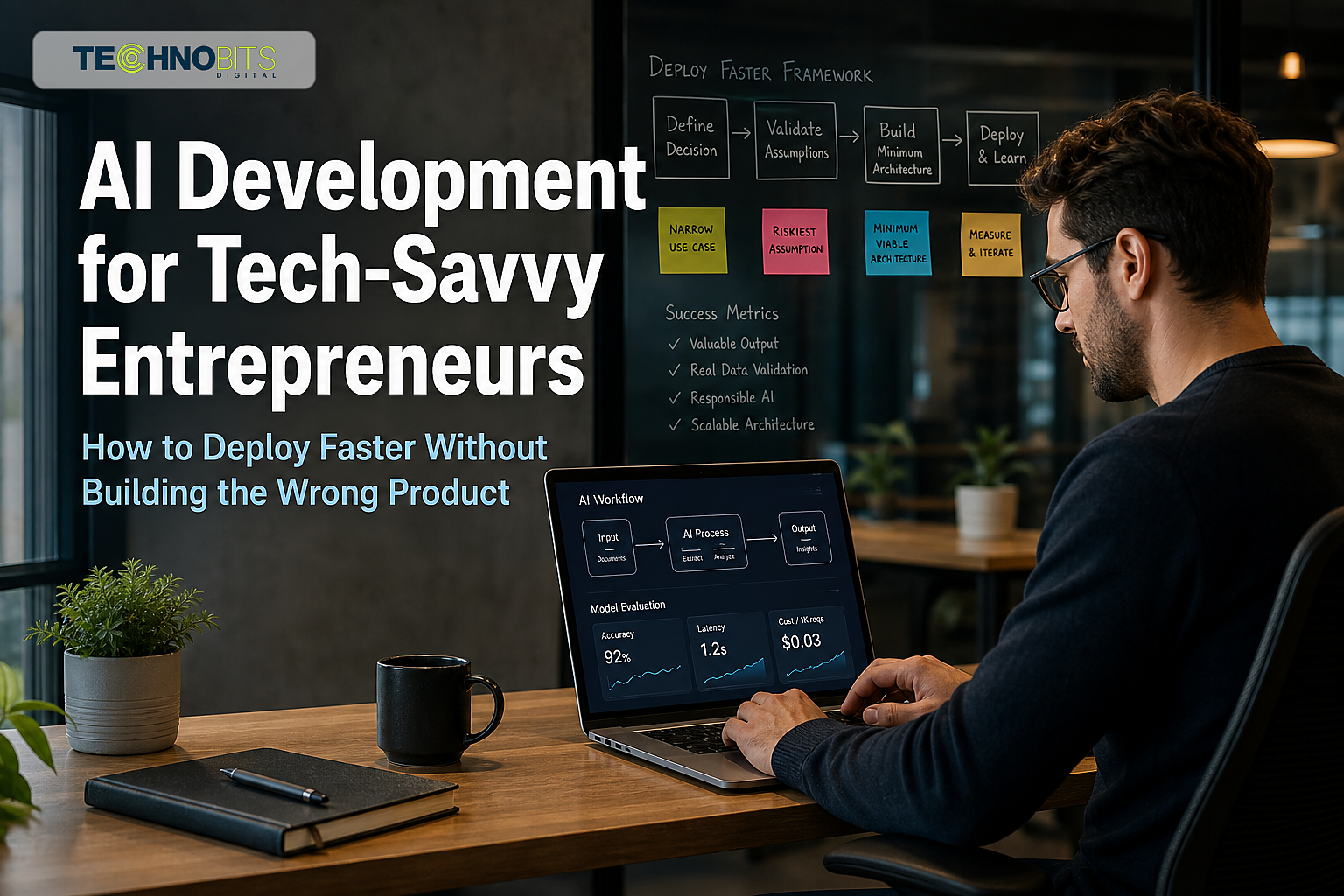
AI development for tech-savvy entrepreneurs should begin with a narrow business decision, not a model demonstration. The fastest responsible route to deployment is to identify one valuable workflow, define what a satisfactory output looks like, test the riskiest assumptions with real data and build only the architecture needed for that test. This avoids spending months on an impressive interface that users cannot trust, integrate or justify commercially.
Speed still matters, particularly when competitors can access similar foundation models and development tools. However, code generation and hosted AI APIs have made software production faster without making product judgement automatic. Founders must still decide whose problem is being solved, which data the system can access, when a person must intervene and whether the economics remain workable at production volume. AI-accelerated delivery is useful when it shortens validated engineering work rather than accelerating untested assumptions.
Define the AI Decision Before Selecting a Model or Interface
An AI product needs a clearly bounded decision or transformation. “Build an intelligent operations assistant” is too broad to estimate, evaluate or secure. “Extract supplier, invoice number, currency and total from uploaded invoices, then flag uncertain fields for review” creates measurable boundaries. You can assemble representative documents, specify acceptable formats and identify consequences when extraction is incorrect. This level of definition also reveals whether AI is necessary. Deterministic rules, database queries or conventional search may be more predictable for parts of the workflow, while AI handles variable language or unstructured documents.
The product hypothesis should connect user behaviour to commercial value. For example, a founder considering a proposal-generation assistant must verify that sales teams need faster drafting, that approved source material exists and that generated proposals can fit the existing review process. A technically successful prototype may still be the wrong product if staff continue using established templates because the assistant creates additional checking work. Before commissioning broad AI development services, define the user, triggering event, expected output, downstream action and evidence that would support continued investment.
Evaluation criteria should be written before implementation because teams otherwise tend to judge outputs by whether they “look good”. Classification systems may require precision, recall and per-category error analysis. Retrieval-based assistants need tests for source relevance, citation accuracy and unsupported statements. Generative workflows may require structured human scoring for correctness, completeness, tone and policy practices. Operational requirements belong in the same specification: response time, cost per completed task, supported languages, data retention and escalation behaviour can determine whether a concept is deployable even when model quality appears strong.
Choose an Architecture That Preserves Evidence, Control and Replacement Options
There is no single architecture for an AI-powered product. A simple feature may call a hosted model through an API and validate the response against a schema. A knowledge assistant may use retrieval-augmented generation, where documents are processed, divided into suitable segments, embedded and retrieved at query time. Higher-risk workflows may require a pipeline of classification, deterministic checks, model inference and human approval. Fine-tuning can be relevant when repeated task behaviour cannot be achieved reliably through prompts and examples, but it introduces dataset preparation, evaluation and model-lifecycle obligations that a first release may not need.
Founders should separate the product layer from the model provider where practical. An orchestration service can manage prompts, tool permissions, response validation, retries and model selection without embedding provider-specific logic across the application. Store version identifiers for prompts, retrieval configurations and models alongside evaluation results. This makes regressions easier to investigate and supports controlled replacement if plans, capability, latency or contractual terms change. Abstraction should remain proportionate: building an elaborate multi-provider platform for an unvalidated feature creates another product to maintain.
The surrounding software often determines whether the AI capability is useful. Authentication, account permissions, billing rules, audit records, file handling, notifications and responsive interfaces remain conventional engineering concerns. An AI answer that ignores customer-level permissions can expose restricted information even if the underlying model performs correctly. Combining model integration with full-stack web development allows the intelligence layer, user journey and business systems to be designed as one product rather than disconnected demonstrations.
Hosted model API: suitable for rapid validation when external processing is acceptable and provider dependency is understood.
Retrieval-augmented generation: useful when answers must draw from controlled, changing documents rather than model memory alone.
Fine-tuned model: potentially suitable for specialised, repeated behaviour when sufficient high-quality examples and evaluation capacity exist.
Deterministic and AI hybrid: appropriate when fixed rules should govern calculations, permissions or practices-sensitive actions.
Remove Product and Engineering Risks That Commonly Delay Deployment
A frequent product mistake is treating conversational interaction as the default interface. Chat is suitable when users need exploratory questions, but structured tasks may work better with forms, recommended actions or AI-generated drafts placed inside an existing workflow. A finance operator reviewing extracted invoice fields does not necessarily need a chatbot; the operator needs highlighted uncertainty, source evidence and an efficient correction mechanism. Interface choice should follow task structure, frequency and error consequences rather than current AI product conventions.
Another risk is validating with polished demonstration data. Real inputs contain incomplete records, abbreviations, scans, conflicting instructions, unsupported file types and adversarial content. A retrieval system can also fail through poor document segmentation, missing metadata or permission filters applied after retrieval instead of before it. Build a test set from realistic cases and include deliberately difficult examples. The dataset should represent different customers, languages, document structures and edge conditions where relevant, while excluding personal or confidential information that is not authorised for development use.
Security and operating cost must be considered before the public launch. Model endpoints require rate limits, authentication and controls against excessive tool use. Prompt injection can attempt to override application instructions or extract retrieved information, so untrusted content should never receive unrestricted access to databases, email or business actions. Threat modelling through cybersecurity services can help identify trust boundaries across the browser, application, model provider, vector store and connected systems. Cost controls should track tokens, retrieval operations, storage, retries and third-party API calls by feature or customer.
Risk | Early evidence to collect | Practical response |
|---|---|---|
Users do not adopt the workflow | Observed task completion and interview feedback | Test the workflow with a lightweight interface before expanding scope |
Outputs appear plausible but are incorrect | Versioned test cases and expert scoring | Add source grounding, validation rules and human review |
Production costs become unstable | Cost per task across typical and long inputs | Set limits, reduce context and route simpler work appropriately |
Restricted information is exposed | Permission and adversarial test results | Filter retrieval by access rights and minimise data sent to models |
Use a Stage-Gated Delivery Workflow Instead of Building the Entire Product
A practical first stage is a discovery sprint focused on evidence rather than screens. Map the current task, people involved, systems touched, data sources and failure consequences. Then rank assumptions by uncertainty and impact. If document quality is uncertain, test extraction before building account management. If users may reject AI-generated recommendations, run a supervised workflow where a specialist creates and reviews outputs behind the scenes. This “concierge” approach can validate demand and acceptance without pretending that an incomplete automation is coming soon.
Specify the use case: define the user, input, expected output, action and exclusion boundaries.
Establish a baseline: measure the current process or a simple non-AI alternative.
Create an evaluation set: include typical cases, edge conditions and known failure modes.
Build the thinnest vertical slice: connect interface, backend, model and one necessary integration.
Run controlled user testing: observe behaviour rather than relying only on stated preferences.
Add production controls: implement permissions, logging, monitoring, fallbacks and support ownership.
Release gradually: limit users or workload while comparing operational evidence against the release criteria.
The vertical slice should exercise the complete technical path. For a support copilot, that could mean authenticating an employee, retrieving authorised knowledge, generating a cited draft and recording feedback in the support system. It should not initially include every channel, language and reporting screen. AI-assisted coding, automated test generation and design exploration may support faster delivery, but generated artefacts still require review for architecture consistency, dependency risk, accessibility and security. Faster delivery with fewer revisions comes from exposing weak assumptions early, not merely producing more code per day.
Deployment is a decision gate rather than the end of development. Before expanding access, compare the system with the baseline and predetermined thresholds. Examine error categories, not only an average score: a model that performs well overall may consistently fail on one commercially important customer segment. Instrument accepted suggestions, corrections, abandonment, escalations, latency and cost without collecting unnecessary sensitive content. Version prompts and retrieval settings, use staged releases for material changes and maintain a rollback path when a model or dependency update changes behaviour.
Balance Faster Release Cycles Against AI Cost, Accuracy and Governance
A narrow AI release can generate evidence sooner and reduce expenditure on unsupported features. It also creates architectural flexibility because the team has not committed every workflow to one model or interaction pattern. Reusable components such as evaluation pipelines, permission-aware retrieval and structured output validators may support later use cases. These are meaningful advantages, but they depend on disciplined scope. A fast release that omits logging, ownership or representative testing transfers unresolved work into production and may slow every subsequent iteration.
Model quality is probabilistic and can vary with phrasing, context, provider updates and retrieved material. Human oversight therefore needs an explicit design. Low-impact content suggestions may allow users to accept, edit or reject an output. A financial, legal or safety-sensitive recommendation may require mandatory specialist review and a record of the evidence considered. Teams should define who handles disputed outputs, how corrections enter future evaluations and when the feature should stop automatically. Human review is not a universal remedy; if every result needs extensive checking, the product may not improve the underlying workflow.
Commercial viability also depends on volume and service design. A prototype tested with short prompts can become expensive when production users upload long documents or trigger repeated agentic tool calls. Estimate unit economics using representative input sizes, peak concurrency, storage, support and external service charges. Consider smaller models, caching, context reduction or deterministic routing where these choices preserve required quality. The goal is not to minimise every inference cost; it is to establish whether the complete service can operate within acceptable performance, risk and commercial boundaries.
Align AI, Product Engineering and Global Delivery With One Technical Plan
Technobits Digital approaches AI-powered delivery as a product engineering problem spanning discovery, model integration, application development and operational controls. That means the work can begin with use-case boundaries and evaluation design, then move through API architecture, frontend experience, backend services and deployment planning. This full-stack perspective is particularly relevant when an AI feature must work inside an existing customer portal, operations platform or digital transformation programme rather than as an isolated chatbot.
AI woven into the delivery workflow can support requirements analysis, implementation, testing and documentation, subject to engineering review. It does not replace product discovery or technical accountability. For founders concerned about complexity or cost, staged scope creates explicit decision points before broader investment. For corporate IT teams, architecture discussions can include identity, permissions, integration ownership, data movement and service dependencies. A global presence may also support businesses coordinating stakeholders, users or systems across markets, although deployment choices still need to reflect each organisation’s operating and regulatory context.
The right engagement may be a technical assessment, an experiment around one uncertain capability or a production-oriented application build. It may also reveal that the immediate requirement is stronger data preparation, integration work or a conventional software feature rather than additional AI. Technobits Digital can connect AI-powered solution development with web engineering and security considerations so that the proposed route reflects the whole service users will rely on.
Questions Founders and Technology Leaders Ask Before Approving an AI Build
How small should the first AI release be?
It should be small enough to isolate the main product and technical risks but complete enough to produce credible user evidence. One user role, one workflow, one principal data source and one downstream action can be sufficient. The release still needs authentication, relevant permissions, evaluation and error handling if real business information is involved.
Should we build with one model provider or support several?
Start with the provider that satisfies the use case, data requirements and commercial constraints. Keep model calls behind a controlled application layer and store provider-independent evaluation cases. Multi-provider routing can be added when there is evidence that resilience, capability differences or cost justify its engineering and testing overhead.
How do we know whether an AI feature is the wrong product?
Warning signs include users avoiding the proposed workflow, outputs requiring more effort to verify than the original task, unavailable source data, unacceptable error consequences and unit economics that deteriorate under realistic usage. A technically capable model does not compensate for weak demand or a poorly placed interaction.
Can AI-assisted development reduce delivery time?
AI tools can help draft code, tests, interface variants and technical documentation. The benefit depends on repository quality, review practices and task suitability. Generated code can introduce insecure patterns, unnecessary dependencies or inconsistent abstractions, so experienced engineers still need to validate behaviour, maintainability and fit with the wider architecture.
Fund the Next AI Release With Evidence Rather Than Model Excitement
Deploying faster means reducing the time required to answer the most important product questions. Define one decision, test it with representative data, build a complete vertical slice and expand only when user behaviour, evaluation results, operating risk and service economics support the next investment. This approach keeps speed connected to a product that people can use and the business can operate.
Technobits Digital works with founders, CTOs and operations leaders evaluating AI, software, web and integration requirements. A consultation can examine the use case, architecture constraints and most useful validation step without assuming that a large AI build is the correct starting point.
Planning an AI Product or Feature?
Before expanding an AI build, define the workflow, test the critical assumptions and determine what the production system actually needs across data, model integration, software architecture, security and evaluation.
Technobits Digital can help assess the technical requirements and determine whether the appropriate next step is a focused prototype, integration project or production-oriented AI application.