From Working Prompts to Maintainable AI Agents: How to Engineer Agents Like Real Software
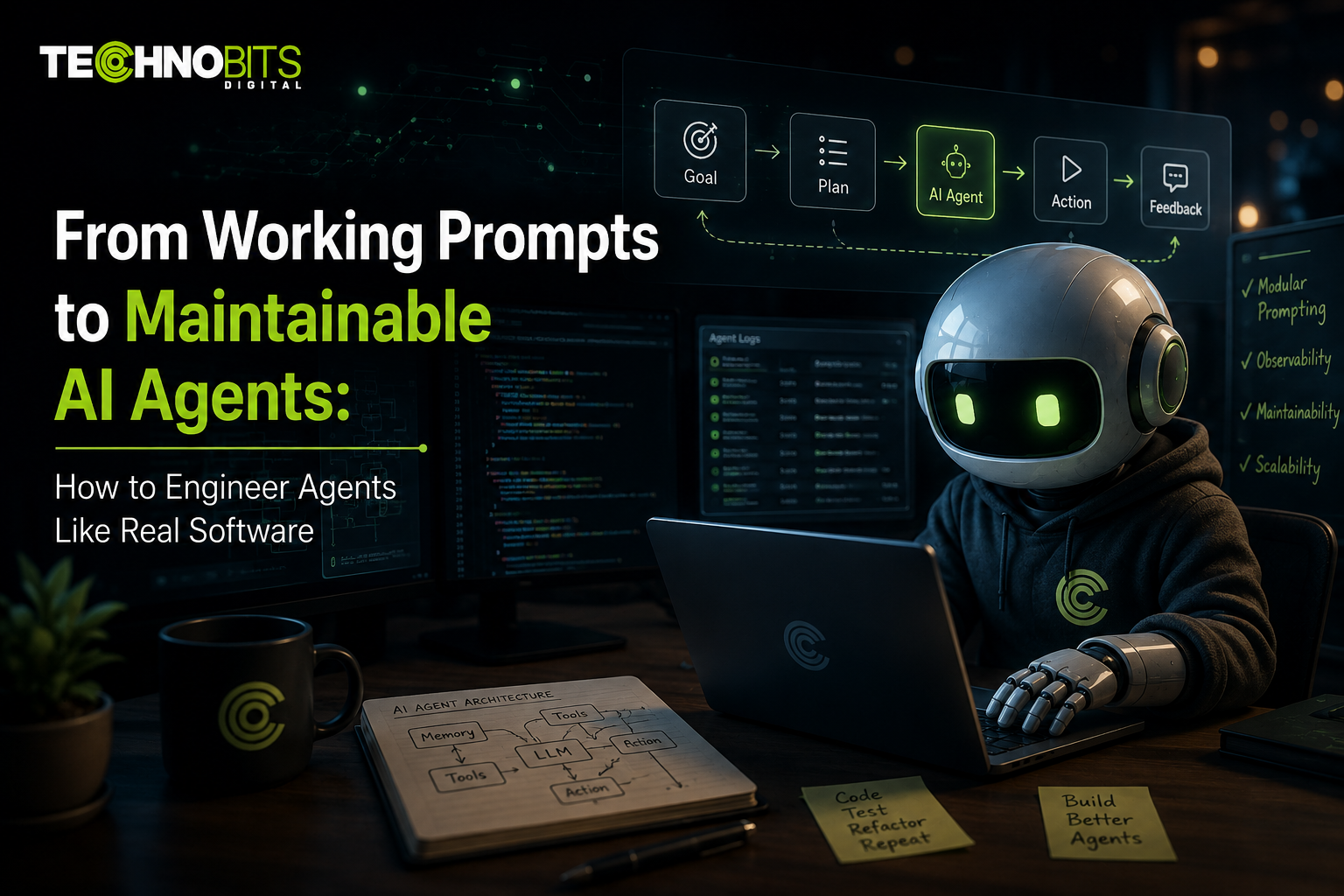
AI agents often begin as small experiments. A developer writes a system prompt, connects one or two tools, adds a model API and tests whether the workflow appears to work.
That can be enough for a prototype.
It is rarely enough for a maintainable production system.
As agents become responsible for multi-step workflows, tool calls, retrieval, data access and external actions, prompt text starts behaving more like application logic. A small prompt change can alter tool selection, output structure, failure behaviour or the way an agent interprets user requests.
For this reason, maintainable AI agents should be engineered with many of the same disciplines used for conventional software: version control, modularity, testing, contracts, observability, rollback and security boundaries.
What Does It Mean to Treat an AI Agent Like Software?
Treating an AI agent like software means managing the agent as a versioned system rather than as a single prompt that is edited until the output looks acceptable.
A production agent may include:
System prompts
Model configuration
Tool definitions
Retrieval logic
Memory
Output schemas
Guardrails
Business rules
Evaluation tests
Logging and monitoring
All of these components can influence behaviour.
Current industry guidance on production prompt management recommends treating prompt changes as deployable artefacts that are tested, promoted through environments and kept traceable for rollback.
Why Large Prompts Become Difficult to Maintain
A common early-stage pattern is to put everything into one long system prompt.
That prompt may contain:
Role definition
Task instructions
Tool rules
Output format
Exception handling
Tone guidance
Security restrictions
Business policies
Examples
This can work initially, but as requirements grow, the prompt becomes harder to reason about.
A change intended to improve one behaviour may unintentionally affect another.
For example, modifying an instruction about when to call a tool could also change how the agent interprets uncertainty or whether it asks for clarification.
Instead of allowing the prompt to become an unstructured block of instructions, developers should separate responsibilities where practical.
1. Version Prompts Like Deployable Code
Prompt changes should be traceable.
A production workflow should make it possible to answer:
Which prompt version produced this output?
Which model version was used?
Which tools were available?
Which retrieval configuration was active?
What changed between releases?
Can the previous behaviour be restored?
A useful prompt-release record may include:
Prompt version
Change description
Model configuration
Tool definitions
Output contract
Evaluation results
Owner
Release date
This allows teams to investigate regressions instead of guessing which change caused an agent to behave differently.
2. Break Agent Logic Into Clear Components
Maintainable software uses separation of concerns.
AI agents benefit from the same principle.
Instead of one component deciding everything, developers can separate functions such as:
Intent classification
Retrieval
Tool selection
Validation
Response generation
Approval
Output formatting
For example:
User Request → Intent Classification → Retrieve Context → Select Tool → Validate Action → Execute → Format Response
The exact architecture depends on the use case, but the goal is to make important responsibilities easier to test and reason about.
Modular architecture also makes it easier to replace one component without rebuilding the entire agent.
3. Define Contracts Between Components
Conventional software components communicate through defined interfaces.
Agent components should also have clear expectations.
For example, a retrieval component might return:
Document ID
Source
Relevant text
Access status
Confidence or relevance information
A tool-execution component might require:
Valid action type
User identity
Required parameters
Permission state
Structured contracts reduce ambiguity between model-generated decisions and application logic.
Where possible, developers should validate outputs against schemas rather than relying entirely on free-form text.
4. Keep Business Rules Outside the Model Where Practical
Not every decision should be delegated to an AI model.
Some rules are better enforced directly in software.
Examples include:
Permission checks
Financial limits
Required approvals
Data-access restrictions
Input validation
Rate limits
Record ownership
An agent may recommend an action, but the application should independently decide whether that action is permitted.
This is especially important when agents can modify records, send messages, execute code or interact with production systems.
5. Create Evaluation Tests Before Changing Agent Behaviour
Prompt changes should be tested against representative scenarios.
A useful evaluation set may include:
Normal requests
Ambiguous requests
Edge cases
Invalid inputs
Restricted actions
Tool failures
Prompt-injection attempts
Missing data
Conflicting instructions
Depending on the system, teams may measure:
Task completion
Correct tool selection
Output validity
Retrieval quality
Safety
Error rate
Human-review rate
NIST’s AI Risk Management Framework treats testing, evaluation, verification and validation as lifecycle activities rather than one-time checks before release.
6. Use Release Gates for Prompt and Agent Changes
A prompt edit may look small but can alter application behaviour significantly.
Teams should therefore define release criteria.
For example:
Development → Evaluation → Review → Staging → Production
A change should move forward only when it meets the required thresholds for the use case.
If behaviour regresses, the team should have a clear rollback path.
This is more reliable than editing a production prompt directly and waiting to see whether users report problems.
7. Add Observability to Agent Workflows
Traditional applications use logs, metrics and tracing to understand behaviour.
Agents need similar visibility.
Useful information may include:
Prompt version
Model version
Tool calls
Tool arguments
Retrieval sources
Validation failures
Errors
Latency
User corrections
Escalations
Final outcome
The purpose is not to store every possible detail indefinitely.
The purpose is to collect enough information to understand how the agent behaved and why a workflow failed.
Recent industry discussion around production agents increasingly highlights observability and traceability as core maintainability requirements.
8. Handle Errors Explicitly
AI systems can fail in ways that conventional software does not.
A model may:
Return an invalid structure
Choose the wrong tool
Misinterpret an instruction
Produce unsupported information
Fail to use available context
Repeat an action unnecessarily
Tools and external services can also fail through timeouts, invalid responses or unavailable dependencies.
Developers should define what happens when these conditions occur.
Possible responses include:
Retry with limits
Use a fallback
Ask the user for clarification
Escalate to a person
Stop the workflow
Return a safe error state
Failure behaviour should be designed rather than left entirely to the model.
9. Protect Tool Access and Agent Permissions
As agents gain access to tools, security becomes part of maintainability.
A tool-enabled agent may interact with:
Databases
Email
CRM systems
File systems
APIs
Cloud services
Internal applications
Each capability should have a clear boundary.
OWASP’s current agentic-AI guidance highlights risks involving privilege escalation, tool misuse, prompt injection and other behaviours that emerge when AI agents can act through external systems.
Important controls can include:
Least-privilege permissions
Scoped credentials
Input validation
Tool allowlists
Approval for high-impact actions
Logging
Rate limits
Security controls should exist outside the prompt wherever practical.
For projects requiring application-security review, explore Technobits Digital’s Cybersecurity Services.
10. Keep Human Approval Where Impact Requires It
Not every AI-agent action requires manual review.
The appropriate level of human involvement depends on risk.
For example:
Lower impact
Agent → Draft internal summary → User reviews if needed
Higher impact
Agent → Propose financial action → Validate → Human approval → Execute
Human approval can help reduce risk, but it should not be used as a substitute for poorly designed technical controls.
If every agent output requires extensive checking, teams should also ask whether the workflow is providing enough practical value.
11. Treat Memory as Managed Application State
Agent memory should not be viewed as an unlimited store of trusted information.
Depending on the architecture, memory may include:
User preferences
Prior conversations
Task state
Retrieved information
Previous decisions
Developers should decide:
What should be stored?
How long should it be retained?
Who can access it?
Can it be corrected?
Can it affect future tool calls?
Does it contain sensitive information?
Memory can become another source of incorrect behaviour if outdated or manipulated information is treated as trusted context.
12. Make Model Changes Safe to Deploy
Agent behaviour may change when:
The model changes
Prompt wording changes
Retrieval data changes
Tools change
Tool descriptions change
Model parameters change
Dependencies change
These changes should not be treated as isolated implementation details.
A production process should re-evaluate material changes before broad release.
This is particularly important because model behaviour is probabilistic and may vary even when the surrounding application code remains unchanged.
13. Test More Than the Happy Path
An agent that performs well in a demonstration may still fail under real operating conditions.
Testing should include:
Messy user requests
Incomplete data
Unexpected tool responses
Permission failures
Adversarial instructions
Long contexts
Conflicting information
Dependency outages
Current industry commentary on maintainable agents specifically warns that demos often hide assumptions that become visible only when agents encounter real users and imperfect data.
A Practical Maintainable-Agent Lifecycle
A maintainable agent can be managed through a lifecycle such as:
Design → Build → Evaluate → Review → Deploy → Observe → Improve
Design
Define the workflow, permissions, tools and expected outcomes.
Build
Implement the prompt, application logic, tool integrations and validation.
Evaluate
Run representative and adversarial test cases.
Review
Confirm quality, safety and operational requirements.
Deploy
Release through a controlled process.
Observe
Monitor behaviour, failures, cost and user corrections.
Improve
Update components using measured evidence rather than ad hoc prompt edits.
This aligns with NIST’s broader lifecycle approach to AI development, deployment, monitoring and evaluation.
Common Mistakes When Engineering AI Agents
Editing Production Prompts Directly
Small prompt changes can create unexpected behavioural changes.
Use controlled versions and testing.
Relying on One Large System Prompt
As requirements grow, a monolithic prompt becomes difficult to maintain and test.
Separate responsibilities where useful.
Trusting Model Output Without Validation
Model-generated actions should be validated before they affect important systems.
Logging Too Little
Without traceability, teams may be unable to explain regressions or tool failures.
Logging Too Much Sensitive Data
Observability should be designed with privacy and security requirements in mind.
Adding Too Many Tools
Every tool expands the agent’s capability and potential failure surface.
Add tools only when they support a defined workflow.
Treating Human Review as the Only Safety Control
Important controls such as permissions and validation should exist independently of human review.
How Technobits Digital Can Support AI-Agent Engineering
Technobits Digital’s current service portfolio includes custom software development, testing and quality assurance, cybersecurity and AI-related engineering capabilities.
For maintainable agentic systems, these capabilities can be relevant across different layers of the application.
Software Engineering
AI agents still require conventional software architecture, APIs, authentication, data handling and application logic.
Explore Software Solutions.
Testing and Quality Assurance
Agent workflows benefit from regression tests, functional validation, performance testing and security testing.
Explore Testing & Analysis Services.
Cybersecurity
Agents with tool access or sensitive data require clearly defined trust boundaries, access controls and security assessment.
Explore Cybersecurity Services.
The exact implementation should depend on the agent’s workflow, data, integrations and risk profile rather than assuming that every AI application needs the same architecture.
Frequently Asked Questions
Why should prompts be versioned?
Prompt changes can alter application behaviour. Versioning helps teams trace outputs back to a specific configuration, test changes before release and roll back if behaviour regresses.
Should prompts be stored in source control?
For many engineering workflows, storing prompt definitions and related configuration in controlled versioning systems can improve traceability and review. The exact implementation depends on the deployment architecture and security requirements.
Is one large prompt always a bad design?
No. A simple agent may work well with one prompt. The problem arises when responsibilities, policies and tool rules become difficult to test or change independently.
What should be tested in an AI agent?
Testing should include task completion, tool use, output validity, edge cases, failures, permissions and adversarial scenarios relevant to the agent’s actual workflow.
Does an AI agent need observability?
Production agents generally benefit from enough logging and tracing to understand tool use, errors and behaviour changes. Logging should be designed to avoid unnecessary exposure of sensitive information.
Can AI agents be maintained like conventional software?
Not identically, because model behaviour is probabilistic. However, many software-engineering practices such as version control, modularity, testing, contracts, release gates and monitoring are highly relevant.
Can Technobits Digital help test AI-enabled applications?
Technobits Digital publicly offers software testing and QA services covering automated regression testing, manual functional testing, performance testing and security testing.
Final Thoughts
The difficult part of building an AI agent is not always getting the first prompt to work.
The harder engineering problem is keeping the system understandable, testable and safe as requirements change.
Maintainable AI agents need clear component boundaries, versioned behaviour, evaluation tests, security controls, observability and rollback processes.
The more tools, data and actions an agent can access, the more important these engineering disciplines become.
Treating agents like real software does not remove the uncertainty of AI behaviour. It gives development teams a structured way to manage that uncertainty.
Need Help Engineering or Testing an AI-Enabled Application?
Technobits Digital can support software engineering, testing and cybersecurity requirements around AI-enabled applications based on the project’s architecture, integrations and risk profile.