
AI Marketing Automation: Fix Conversion Signals Before Scaling
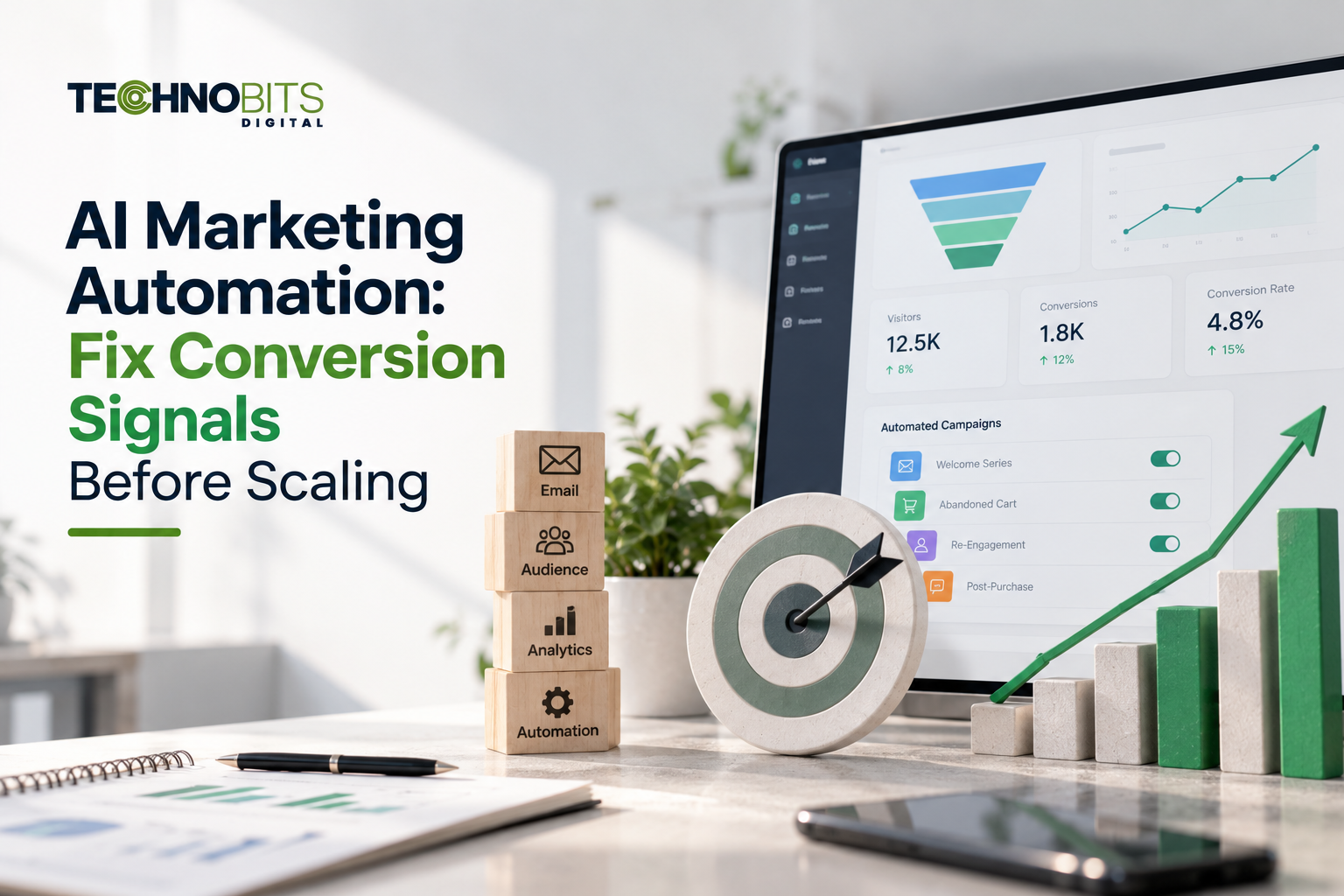
AI Growth Marketing for low online engagement should not begin by automating content volume, audience expansion or bid changes. It should begin by verifying what the measurement system treats as valuable engagement. If an optimisation model receives page views, video starts, shallow scrolls or inexpensive clicks as its primary success signals, it can increase those events while qualified enquiries, purchases, product activation or retention remain unchanged. Automation makes the feedback loop faster; it does not make the underlying objective more accurate.
The practical risk is objective misalignment across advertising platforms, analytics, customer relationship management systems and the product itself. A campaign may report improving engagement while forms fail on mobile, trial users never activate, sales teams reject low-intent leads or customers leave after their first transaction. Before commissioning AI Growth Marketing, marketing managers should connect channel signals with downstream business events, remove unreliable conversions and decide which outcomes the system is permitted to optimise.
What Should Marketing Managers Evaluate Before Automating Low-Engagement Growth?
Start by defining the engagement hierarchy for the customer journey. A social reaction or ten-second video view indicates attention, but it does not carry the same commercial meaning as viewing plans, completing an eligibility step, submitting a valid enquiry, activating a product account or placing a repeat order. Marketing and product teams should classify events as diagnostic, intermediate or outcome events. Diagnostic events help explain behaviour; intermediate events indicate progression; outcome events represent business value. This prevents an AI system from treating every measurable action as equally useful. The hierarchy should also record event ownership, data source, expected sequence and the conditions that make an event valid. For example, a form submission should not count as a qualified lead if required contact fields are malformed, duplicate or generated by spam.
Next, inspect whether the feedback loop closes beyond the advertising platform. Platform algorithms often optimise using conversions returned through browser tags, mobile SDKs or server-side APIs. Those systems cannot independently determine whether a lead became sales-qualified, whether an order was refunded or whether a new account remained active. Connect campaign identifiers and consented first-party identifiers to CRM stages, transaction records and product events where appropriate. A well-designed social media strategy should therefore define both message and measurement architecture. It should state how offline outcomes return to the acquisition system, how delayed conversions are handled and how attribution uncertainty affects automated decisions. Without that connection, the fastest available signal can become a misleading substitute for value.
Low engagement also requires segmentation before automation. An overall decline can hide very different conditions: mobile visitors may encounter a broken form, returning customers may receive acquisition messaging, one geography may have unsuitable delivery options, or paid traffic may land on content written for a different search intent. Review engagement by audience source, campaign, landing page, device, browser, geography, new-versus-returning status and journey stage. Then compare those segments with page performance, error logs, CRM disposition and fulfilment constraints. The objective is not to manufacture a universally high engagement rate. It is to identify which audience and experience combinations produce meaningful progression, and which combinations should be repaired, excluded or measured differently.
Where AI-Driven Feedback Loops Commonly Scale the Wrong Signals
The first failure point is event instrumentation. Duplicate tags can record one action several times, single-page applications can fail to emit virtual page views, consent controls can suppress some events, and cross-domain journeys can lose campaign attribution when users move between a marketing site, booking service and payment provider. Naming conventions create further ambiguity: “signup” may represent opening a form in one platform and completing account creation in another. Before increasing automated delivery, create an event specification covering trigger conditions, required parameters, deduplication keys and accepted sources. AI Quality Assurance can support this work by testing whether browser, application and server events correspond with the user action they claim to represent.
The second failure point is proxy optimisation. Advertising and recommendation systems tend to favour outcomes that occur frequently and quickly because those signals provide more training examples. If qualified opportunities take several weeks to mature, a team may substitute lead volume or landing-page engagement for revenue-related progression. The substitution can be useful for early learning, but only when the proxy has been validated against later outcomes. Otherwise, creative formats that generate curiosity, accidental taps or incentive-driven registrations can receive more delivery. Marketing managers should compare proxy events with CRM acceptance, sales progression, order quality, repeat use and cancellation behaviour. A proxy that increases while downstream progression declines should be downgraded or removed from the optimisation objective.
The third failure point sits inside the customer experience rather than the campaign. An AI system may correctly find interested audiences and still send them into a weak journey: pages load slowly, pricing or plan details are unclear, mobile keyboards obscure form fields, account verification emails arrive late or inventory data does not match the storefront. Automation can respond by finding cheaper visitors instead of exposing the product defect. Full-stack diagnosis should examine the advertisement, landing page, content management system, application APIs, identity services, checkout or enquiry workflow, analytics and CRM hand-off. Where several platforms participate in the journey, system integration services may help establish consistent identifiers and event exchange across the stack.
Which Signal Quality, Automation Speed and Control Trade-Offs Should Guide the Decision?
Marketing managers must balance signal frequency against signal quality. A purchase, activated subscription or accepted sales opportunity is commercially meaningful but may occur too infrequently for rapid optimisation. A product view, content download or form start is more frequent but less reliable. One option is a staged objective: use validated intermediate events while volumes are limited, then move towards stronger outcomes as evidence accumulates. Another is a weighted model in which events receive different values based on historical progression. The weighting should not be selected because a platform recommends it; product, finance, sales and operations teams should agree on the economic and operational meaning of each event. Delayed outcomes, refunds and rejected leads should also be incorporated where the platform and privacy model permit.
Decision area | Faster option | More controlled option | Question to resolve |
|---|---|---|---|
Optimisation event | High-volume clicks or visits | Validated journey progression | Does the event predict a useful downstream outcome? |
Audience expansion | Broad automated targeting | Constrained segments with exclusions | Can the business serve every audience the model may find? |
Creative generation | Large numbers of AI-assisted variants | Approved message components and review rules | Could variation introduce unsupported claims or intent mismatch? |
Budget control | Automated allocation across campaigns | Caps, holdouts and change thresholds | How much spend can move before human review? |
Automation speed should match the reliability of the signal and the reversibility of the decision. Automated bid adjustments within an approved range may be low risk, while changing product claims, entering a new region or suppressing established audiences requires stronger review. Define operational guardrails such as budget caps, excluded terms, audience exclusions, creative approval states, minimum sample requirements and escalation thresholds. For pay-per-click advertising, this can include separating brand and non-brand intent, preventing automated matching to irrelevant queries and reviewing search terms rather than relying only on campaign-level summaries. Human oversight should concentrate on decisions where context, regulation or customer consequences cannot be represented by a simple numeric objective.
Incrementality is another important trade-off. Attribution models identify events associated with marketing touchpoints, but association does not prove that the activity caused the outcome. Branded search, retargeting and existing-customer campaigns may capture demand that already existed. Where scale and operating conditions allow, teams can use geographic tests, audience holdouts, campaign pauses or controlled budget changes to compare outcomes against a credible baseline. These experiments reduce delivery efficiency in the short term because some users are withheld from treatment, but they can reveal whether automation is creating additional value or merely claiming credit. The testing plan should specify the hypothesis, primary outcome, guardrail metrics and stopping conditions before campaign changes begin.
Frequently Asked Questions About AI Growth Signals and Low Engagement
Can AI fix a low engagement rate without changing the website or product?
AI can help identify audience, content and timing patterns, but it cannot compensate reliably for a broken or mismatched customer journey. If visitors encounter slow pages, missing information, inaccessible controls or failed forms, increasing campaign personalisation may only send more people into the same defect. Diagnose the journey using analytics, session evidence, application logs and structured user testing. Content gaps may require content development and distribution, while technical faults may require changes to templates, APIs or integrations. The appropriate intervention depends on whether the engagement problem originates in acquisition intent, message clarity, interface behaviour or post-conversion operations.
Which metrics should replace clicks and impressions?
Clicks and impressions remain useful delivery indicators; they should not be treated as final success measures. Select metrics that represent movement through the specific journey, such as qualified product-page visits, completed comparison actions, valid form submissions, booked appointments, activated accounts, completed orders or repeat usage. Add guardrail metrics for spam, refunds, cancellations, support contacts and rejected leads. The correct set varies by business model. A business-to-business service may prioritise accepted opportunities and pipeline progression, while an online retailer may examine contribution after refunds and fulfilment costs. Document exactly how every metric is calculated so campaign, analytics and management reports do not use identical labels for different events.
How often should automated growth rules be reviewed?
Review frequency should reflect spend, conversion volume, journey stability and the consequences of an incorrect change. Delivery anomalies and tracking failures may require daily monitoring, while optimisation hypotheses need enough time and observations to avoid reacting to noise. Structural reviews should occur when plans, product availability, consent configuration, website architecture, CRM stages or platform attribution settings change. Teams should also maintain an audit trail of objective changes, audience exclusions, creative versions and tracking releases. AI-accelerated delivery can shorten production cycles, but faster execution increases the importance of version control and release notes because several simultaneous changes can make performance shifts difficult to diagnose.
How Should Businesses Improve Marketing Measurement Before Automating Growth?
Technobits Digital provides Social Media Marketing Strategy, Social PPC, Content Development & Distribution, SEO & SEM and Software Solutions. Depending on the existing marketing stack and project requirements, these services may support different parts of campaign planning, performance measurement, content improvement or technical integration.
The appropriate next step should depend on whether the main problem lies in campaign configuration, unreliable measurement, customer experience or connected business systems.
Define the outcome: Specify the customer or commercial event that automation should support.
Validate the evidence: Test tags, APIs, identifiers, attribution rules and CRM status changes.
Repair the journey: Address interface, performance, content and integration defects before scaling traffic.
Set controls: Establish budgets, exclusions, approval rules, alerts and rollback conditions.
Run measured experiments: Change one decision layer at a time and compare it with an appropriate baseline.
Technobits Digital can assess the marketing stack as a connected digital system rather than an isolated campaign dashboard. That assessment may cover acquisition configuration, website and application behaviour, event architecture, server-side integration, data quality and testing requirements. Its AI-accelerated delivery approach can support faster analysis and controlled content or campaign iteration, while human review remains responsible for objectives, claims and release decisions. Global multi-office support may also suit organisations coordinating stakeholders, systems or campaigns across regions, provided data ownership, working practices and approval responsibilities are established at the start.
Bring the current event taxonomy and analytics configuration.
Identify the CRM, commerce or product system that holds the authoritative outcome.
List known journey defects, attribution gaps and manual data transfers.
Define which automated decisions require prior approval or spending limits.
Agree on the evidence required before campaign expansion.
Getting Engagement but Not Enough Qualified Leads?
More content, broader targeting or automated bidding may not solve a marketing measurement problem.
Before scaling activity, businesses should understand which campaigns attract relevant audiences, which actions represent genuine business value and whether tracking reflects what happens after a customer enquiry or purchase.
Technobits Digital provides Social Media Marketing Strategy, Social PPC, Content Development & Distribution and related digital services that may support different parts of the customer-acquisition journey.
The appropriate scope should depend on the current campaigns, website, measurement setup and business requirements.