After an AI Security Alert: Who Owns Incident Response?
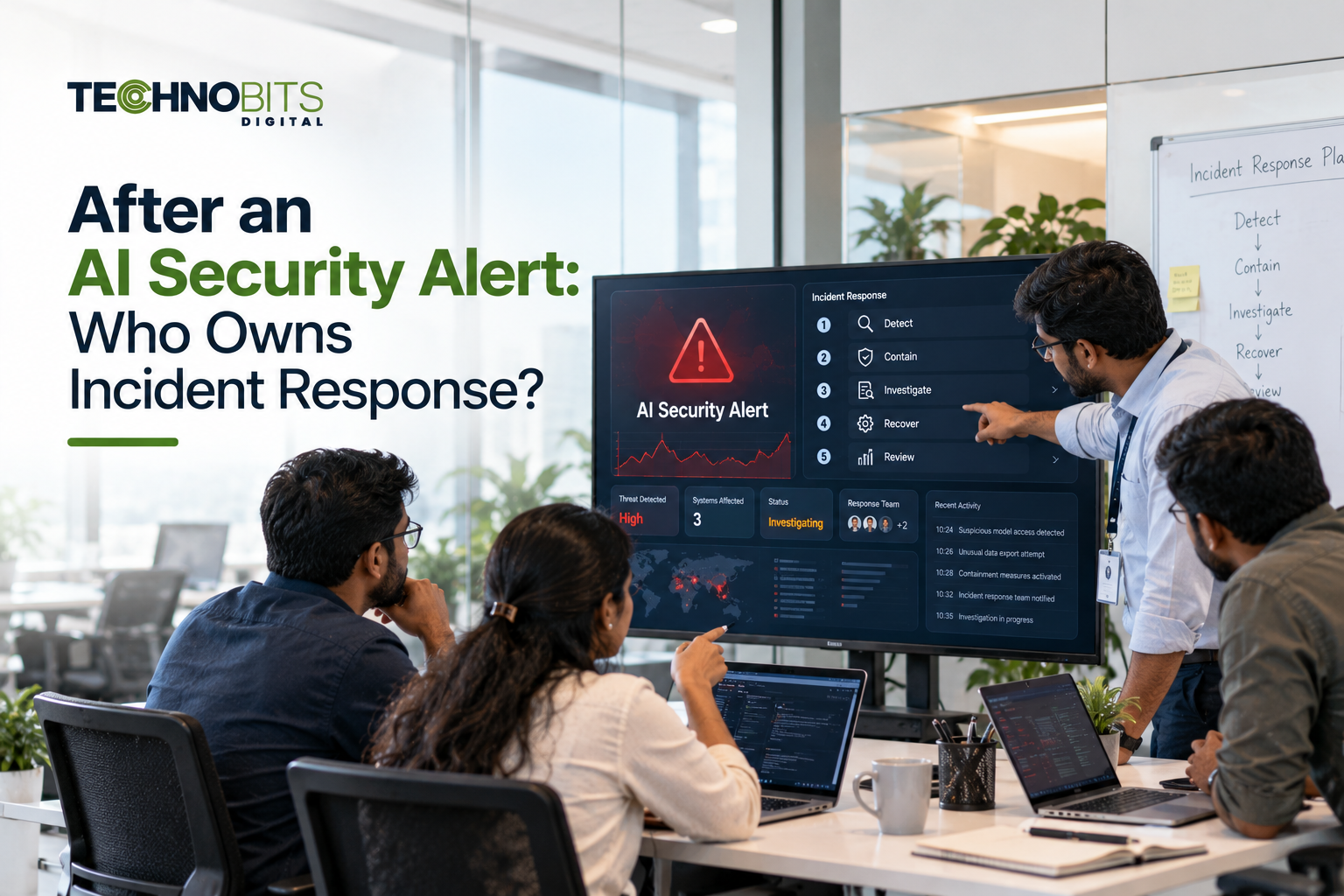
An AI security platform can classify suspicious behaviour, correlate events and trigger containment faster than a conventional manual queue. It cannot decide which customer service may be interrupted, who may isolate a production database, whether evidence must be preserved for legal review, or when executives and customers should be informed. Those decisions remain with the business. Effective AI Cyber Defense incident response ownership therefore requires named people, pre-approved actions and escalation deadlines tied to business impact—not merely a tool that produces alerts.
An automated alert should initiate the organisation's defined triage and escalation process without unnecessary delay. Security teams should record when suspicious activity was detected, when the alert was acknowledged, when an incident was confirmed and when containment began. Legal notification deadlines must be assessed separately under the applicable laws, regulations and contractual requirements. AI Cyber Defense can accelerate detection and analysis, but accountable human control remains essential when automation affects production systems, employees, customers or regulated information.
What Must Business Owners Evaluate When Automated Detection Starts the Response Clock?
Begin by defining what the platform means by an alert. A low-confidence anomaly, a confirmed malicious executable and an active privileged-account compromise should not enter the same workflow. Each alert category needs a severity definition based on asset criticality, data sensitivity, attacker behaviour, confidence and potential operational impact. A high score produced by a model is not automatically a high-severity business incident. For example, unusual access to an archived development environment may be less urgent than a moderately suspicious login to the production billing system. Security teams should document how technical signals become business priorities and which additional evidence is required before disruptive containment begins.
Next, identify the decision owner for every response stage. The monitoring team may validate events, but it may not have authority to suspend an executive account, disconnect a warehouse network or take an online storefront offline. A practical responsibility model names a primary owner, delegate and escalation contact for detection, triage, containment, eradication, recovery and communication. It should also define what the security provider, cloud administrator, application owner and executive incident lead may do independently. This is particularly important when SIEM services aggregate signals from multiple systems but operational control remains distributed across internal teams and technology suppliers.
Owners must also determine which automated actions are reversible. Enriching an alert with threat intelligence, collecting a process tree or opening a case normally creates limited operational risk. Disabling an identity, deleting a cloud resource, blocking a supplier address range or quarantining a server can interrupt legitimate work. Automation policies should distinguish evidence gathering from containment and distinguish temporary containment from destructive remediation. Reversible controls can often run under broader authority, provided they are logged. Actions with significant customer, financial or safety consequences should require human approval or tightly defined emergency conditions.
Finally, evaluate whether the organisation can receive, investigate and act on alerts outside normal working hours. An alerting contract does not establish response capacity. You need monitored channels, current contact details, an on-call rota, access to relevant systems and a clear handover process between offices or shifts. The test is simple: if a critical alert appears at 02:00 on a public holiday, can an authorised person understand the affected service and initiate an approved response without searching for undocumented credentials?
Where AI-Accelerated Security Response Commonly Breaks Across Tools and Teams
The first failure point is frequently missing context. Detection systems see telemetry, not the complete operating model. They may know that an administrator downloaded thousands of records but not that an approved migration is underway. They may identify an unfamiliar application token without knowing that a new integration entered production that morning. Asset inventories, identity directories, change records, data classifications and service ownership therefore need to enrich the alert. Without this context, analysts either overreact to legitimate activity or spend critical time locating the person who understands the workload. An IT security audit can expose ownership gaps, obsolete accounts and unmonitored assets before they undermine incident triage.
Response also breaks when multiple systems are permitted to act without orchestration. An endpoint platform might quarantine a device while an identity system disables its user, a firewall blocks the source address and a service desk simultaneously restores access after a complaint. Each action may be defensible in isolation, yet the combined sequence can destroy useful evidence or create conflicting states. Playbooks should specify the order of operations, authoritative system and rollback conditions.
A third weakness is treating containment as the end of the incident. Blocking a malicious address does not explain how access was obtained, whether persistence remains or which data was viewed. Restoring a compromised account without rotating tokens, reviewing sessions and correcting the original control failure can allow the attacker to return. Response plans must continue through scoping, eradication, validated recovery and retrospective improvement. They should preserve timestamps, model outputs, analyst notes, command histories and configuration changes so that the organisation can reconstruct what happened. Evidence quality matters when legal counsel, insurers, regulators, customers or law enforcement later ask how the incident was assessed and controlled.
Alert without owner: the signal reaches a shared mailbox that nobody monitors continuously.
Owner without authority: an analyst identifies active compromise but cannot isolate the affected production service.
Authority without context: a manager approves shutdown without understanding dependencies or recovery requirements.
Containment without evidence: automated cleanup removes artefacts needed to investigate the intrusion.
Recovery without validation: systems return to service before credentials, persistence mechanisms and exploited weaknesses are checked.
Which Automation, Control and Recovery Trade-Offs Should Govern the Decision?
The central trade-off is speed versus operational certainty. Fully automatic containment may reduce attacker dwell time, but false positives can stop revenue-generating or safety-relevant systems. Manual approval reduces accidental disruption but may allow malicious activity to continue while decision-makers gather. A tiered approach is usually more defensible than choosing one mode for every event. Low-impact evidence collection can run automatically; temporary isolation may be pre-approved for managed endpoints; production shutdown may require an incident commander and application owner. The threshold should reflect the affected asset, confidence of detection, blast radius, reversibility and likely cost of delay.
Decision area | Faster option | Control risk | Ownership requirement |
|---|---|---|---|
Endpoint containment | Automatic network isolation | Legitimate device loses access | Security owner defines exceptions and release authority |
Identity response | Immediate account suspension | Critical operator is locked out | Identity and service owners approve fallback access |
Firewall response | Automated address or domain block | Shared infrastructure or supplier traffic is blocked | Network owner defines scope, expiry and rollback |
Cloud remediation | Policy-driven resource quarantine | Dependencies fail or evidence changes | Cloud owner approves action by environment and resource type |
Public communication | Rapid incident notice | Facts remain incomplete or inaccurate | Executive, legal and communications owners approve wording |
Another trade-off concerns detection sensitivity. Lower thresholds can reveal weak signals earlier, but they also increase investigation volume. If analysts repeatedly see benign alerts, important events may be delayed or dismissed. Higher thresholds reduce noise but can omit early-stage activity that only becomes obvious after several correlated events. The decision should use observed false-positive patterns, asset criticality and analyst capacity rather than a vendor default. Rules and models need periodic review after application releases, infrastructure migrations and identity changes. Firewall and network security controls should likewise be tuned around actual service flows instead of broad assumptions about trusted and untrusted locations.
Recovery introduces a separate balance between rapid restoration and confidence that the environment is clean. Rebuilding a workload from a known image may be safer than repairing it in place, but dependencies, configuration drift and unavailable backups can complicate restoration. Owners should define recovery priorities before an incident and verify which systems can operate in a degraded mode. They should also decide who accepts residual risk when full investigation would extend an outage. Recovery approval should include evidence that access paths were corrected, secrets were rotated where necessary, monitoring was increased and essential transactions function correctly—not simply confirmation that a server responds.
How Should Businesses Prepare an Incident-Response Workflow?
Technobits Digital publicly offers Cybersecurity Services, SIEM, IT Security Audits and Firewall & Network Security services. Depending on project scope, these capabilities may support security monitoring, alert configuration, control assessment and incident-response planning. The responsibilities for incident investigation, containment approval, evidence preservation and recovery should be documented as part of the engagement.
The next task is to convert response policy into executable playbooks. Each playbook should define the trigger, required evidence, severity, decision owner, permitted automation, escalation deadline, communication path, rollback procedure and closure criteria. AI-accelerated delivery can assist with log summarisation, event correlation, case enrichment and draft investigation steps, provided outputs remain traceable and subject to review. It should not be used to obscure why an action was recommended. Where alerts depend on application behaviour, custom software testing can exercise authentication failures, suspicious API use, session revocation and degraded integrations before those conditions occur during a real incident.
The workflow should then be tested through scenarios rather than approved only as documentation. A tabletop exercise examines decisions and communications, while a controlled technical simulation tests alert routing, permissions, integrations and recovery procedures. Scenarios should include both genuine compromise and false-positive conditions. That combination reveals whether teams can stop an attack without automatically accepting every model conclusion. Network management and maintenance should feed current topology, device state and change history into these exercises so that containment plans reflect the live environment rather than an outdated diagram.
Identify critical services, sensitive data and maximum tolerable operational disruption.
Map telemetry sources, detection rules, automated actions and system dependencies.
Assign primary owners, delegates and executive escalation authority for each incident stage.
Separate automatic enrichment, reversible containment and high-impact remediation.
Test playbooks against compromised identities, endpoints, cloud resources and application APIs.
Record evidence, response times, approval delays, failed integrations and rollback problems.
Update thresholds, permissions, contact paths and recovery checks after every exercise or material incident.
Frequently Asked Questions About AI Security Alert Ownership
Does the security provider own the incident once its platform raises an alert?
No. A provider may monitor telemetry, investigate signals and recommend or perform actions within an agreed scope. The business remains responsible for decisions involving its operations, customer commitments, data, employees and legal obligations. Contracts should clearly separate monitoring responsibility from decision authority. If the provider can quarantine endpoints but cannot stop a production application, the internal application owner and incident commander must be reachable. Conversely, if the provider is authorised to act immediately, the organisation should define the conditions, affected assets, evidence requirements and rollback process. Ownership becomes ambiguous when “managed response” is purchased without documenting what response actually includes.
Should every high-severity AI alert trigger automatic containment?
Not necessarily. Severity labels are produced from configured rules, model confidence and available context; they are not universal measures of business impact. Automatic containment is more appropriate when the action is reversible, the affected asset is well understood and delay creates substantial risk. A managed laptop showing ransomware behaviour may warrant immediate isolation. A database supporting several customer-facing services may require rapid human approval because isolation could cause wider failure. The automation policy should account for confidence, criticality, dependencies and compensating controls. It should also include expiry or review points so that temporary blocks do not remain indefinitely after the original event is resolved.
How often should incident-response ownership and playbooks be reviewed?
Review should follow meaningful change rather than depend only on a calendar. New cloud platforms, application releases, acquisitions, office openings, supplier integrations and leadership changes can all invalidate an existing escalation path. A review is also appropriate after a material alert, even when it proves benign, because the event may expose missing telemetry or slow decisions. Exercises should confirm that delegates still have access, automated actions remain safe and recovery instructions match current architecture. The organisation should retain versioned playbooks and decision records so responders know which procedure was active at the time of an event.
Does an AI security alert automatically mean a confirmed cyberattack?
No. An alert indicates that a detection system identified activity matching its rules or models. Security personnel or authorised automated processes must assess the supporting evidence and determine whether the activity represents a genuine incident.
Need Clearer Ownership of Your Cybersecurity Alerts and Response?
Security alerts become useful when the right people can assess them, act within approved boundaries and coordinate recovery when an incident occurs.
Before increasing threat automation, organisations should review alert ownership, escalation procedures, response permissions, evidence handling and recovery responsibilities.
Technobits Digital provides Cybersecurity Services, SIEM and IT Security Audits that may support relevant parts of a cybersecurity assessment or implementation.
The appropriate scope should depend on the existing security tools, risk exposure and operational requirements.
Discuss Your Cybersecurity Requirements
Planning an AI Product or Feature?
Before expanding an AI build, define the workflow, test the critical assumptions and determine what the production system actually needs across data, model integration, software architecture, security and evaluation.
Technobits Digital can help assess the technical requirements and determine whether the appropriate next step is a focused prototype, integration project or production-oriented AI application.