Building Smarter AI Applications in 2026: Harnessing RAG, Fine-Tuning, and LLM Integration
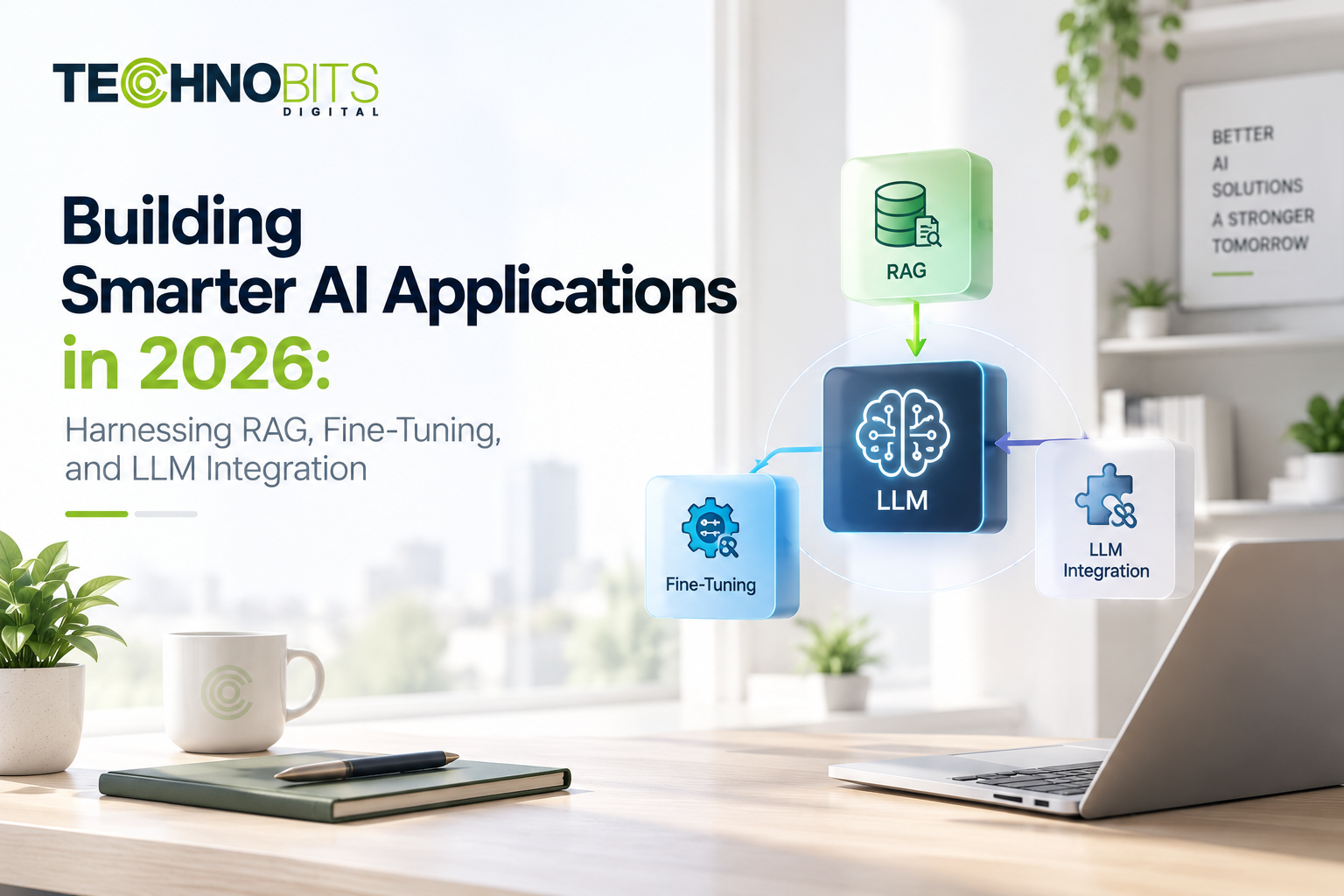
As we step into 2026, the technological landscape continues to evolve at a rapid pace. Businesses are increasingly adopting AI-powered applications to improve workflows, automate repetitive processes and create more intelligent digital experiences. Among the most promising advancements are Retrieval-Augmented Generation (RAG), fine-tuning techniques, and the integration of large language models (LLMs). These innovations are transforming how businesses build smarter AI applications, providing more personalized, efficient, and strategic solutions.
In Short: How Businesses Can Build Smarter AI Applications with RAG, Fine-Tuning, and LLM Integration in 2026
Businesses can build smarter AI applications by selecting the right combination of RAG, fine-tuning and LLM integration based on their data, workflow requirements and business objectives.
Understanding the Power of RAG
Retrieval-Augmented Generation (RAG) is an approach that combines the strengths of retrieval-based systems with the generative capabilities of AI models. This synergy allows businesses to tap into vast reservoirs of data while generating highly accurate and contextually relevant responses.
By leveraging RAG, businesses can:
Enhance accuracy: RAG allows AI applications to retrieve relevant information from approved data sources before generating responses. This can improve context awareness and reduce the risk of unsupported answers when implemented correctly.
Boost efficiency: With RAG, AI systems can quickly access and integrate information from various databases, reducing response times and enhancing user experience.
Improve personalization: By tailoring responses based on user-specific data, RAG helps businesses deliver more personalized customer experiences.
The Art and Science of Fine-Tuning AI Models
Fine-tuning is the process of adapting pre-trained AI models to specific tasks or industries. This method allows businesses to take advantage of existing AI architectures while tailoring them to meet unique business needs.
Key benefits of fine-tuning include:
Cost-efficiency: Fine-tuning adapts an existing AI model using task-specific examples so it can better perform certain specialised tasks, communication styles or domain-specific requirements.
Increased relevance: By focusing on task-specific data, fine-tuning ensures AI models are highly relevant to the business context.
Enhanced performance: Tailored models often perform better in specific scenarios compared to generalized AI systems.However, fine-tuning requires suitable training data, evaluation methods and ongoing maintenance.
Integrating Large Language Models (LLMs)
Large language models enable businesses to add natural-language capabilities to software applications, allowing users to interact with systems through conversational interfaces and automate information-based workflows. Integrating LLMs into business applications can drive significant improvements in communication, automation, and decision-making processes.
Advantages of LLM integration include:
Natural language processing: LLMs excel at understanding and generating human language, making them ideal for customer service, content creation, and translation services.
Scalability: These models can handle large volumes of data, making them suitable for businesses of all sizes.
Strategic insights: When connected with appropriate data sources, analytics systems and business applications, LLM-powered solutions can help users summarize information and support decision-making workflows.
Choosing the Right AI Approach for Your Business
Business Requirement | Recommended Approach |
|---|---|
Need AI answers from company documents | RAG |
Need domain-specific response style | Fine-tuning |
Need AI inside existing software | LLM Integration |
Need workflow automation | AI Agents + Integrations |
Need enterprise knowledge search | RAG + LLM |
Strategic Implementation for Business Success
Implementing these advanced AI techniques requires a strategic approach. At Technobits Digital, AI initiatives should be aligned with business goals, existing systems and operational requirements to create practical solutions.
Consider the following steps for effective implementation:
Identify objectives: Clearly define business goals and how AI can support them.
Choose the right tools: Select AI-powered solutions that align with your needs and resources.
Train your team: Invest in training to ensure your team can effectively utilize these advanced technologies.
Measure success: Establish metrics to evaluate the performance and impact of AI applications.
Iterate and improve: Continuously assess and refine AI strategies to adapt to evolving business needs.
Evaluate security and data requirements :
For enterprise AI, include:
data privacy;
access control;
permissions;
compliance.
How Technobits Digital Helps Businesses Build AI Solutions
Technobits Digital develops AI-powered software solutions that help businesses integrate intelligent capabilities into their existing digital systems.
Depending on business requirements, AI solutions may include:
LLM integrations
AI-powered applications
Custom software platforms
Workflow automation
API integrations
Enterprise digital solutions
The right AI architecture depends on business objectives, available data, security requirements and existing technology infrastructure.
Frequently Asked Questions
What is Retrieval-Augmented Generation (RAG)?
Retrieval-Augmented Generation (RAG) is an approach that connects AI models with external knowledge sources, allowing applications to retrieve relevant information before generating responses. This helps businesses build AI systems that can work with company-specific data, documents, and knowledge bases.
How can large language models benefit my business?
Large language models can help businesses improve how users interact with software applications, automate information-based workflows, support content and knowledge management, and enable natural-language experiences across digital platforms. The impact depends on the quality of data, implementation approach, and business requirements.
What are the benefits of fine-tuning AI models?
Fine-tuning allows businesses to adapt existing AI models for specific tasks, domains, or communication requirements. It can improve model behaviour for specialised use cases when suitable training data, evaluation methods, and ongoing maintenance processes are available.
Does every business need fine-tuning for AI applications?
No. Many business applications can achieve strong results using existing AI models combined with techniques such as RAG, system integrations, and proper data management. The right approach depends on the business objective, available data, security requirements, and expected outcomes.
Conclusion: Building Practical AI Applications for the Future
In 2026, successful AI adoption is not only about using the latest technologies. It is about selecting the right approach for the right business problem.
RAG, fine-tuning, and LLM integration each provide different capabilities that can help businesses build more intelligent applications, improve workflows, and create better digital experiences when implemented correctly.
The most effective AI solutions are built around reliable data, clear objectives, secure integrations, and measurable business requirements.
Technobits Digital helps businesses explore and develop AI-powered software solutions, including LLM integrations, custom AI applications, automation workflows, and intelligent digital platforms designed around specific business needs.
Ready to explore how AI can support your business processes? Contact Technobits Digital to discuss your AI application requirements.