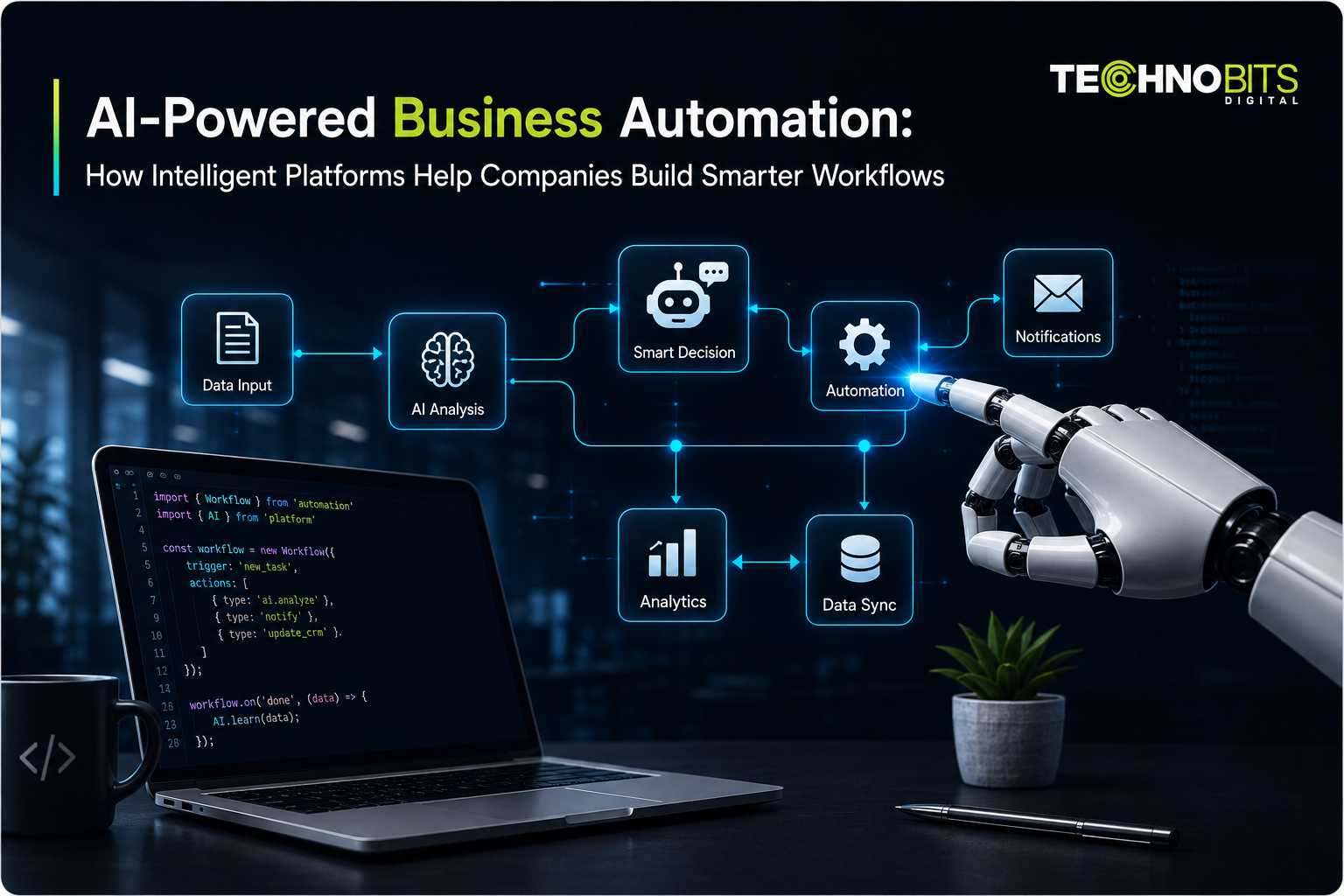
AI-Powered Business Automation: How Intelligent Platforms Help Companies Build Smarter Workflows
Businesses today use multiple tools to manage sales, customers, operations, communication and internal processes. While these systems help teams work efficiently, disconnected tools can create challenges such as duplicated work, limited visibility and manual coordination.
AI-powered business automation is changing how organisations approach workflows by helping teams connect information, automate repetitive activities and create more intelligent business processes.
However, successful automation is not about replacing people with AI. It is about using technology to support employees, reduce unnecessary manual effort and improve how businesses operate.
What Is AI-Powered Business Automation?
AI-powered business automation combines automation technologies with artificial intelligence capabilities to support business workflows.
Traditional automation usually follows predefined rules:
When a customer submits a form → create a record
When a payment is received → update status
When a task is completed → notify the next person
AI-powered automation can add capabilities such as:
Understanding unstructured information
Classifying requests
Summarising information
Identifying patterns
Supporting recommendations
Assisting employees with decisions
The level of automation depends on the business process, available data, system integrations and required controls.
Why Businesses Are Moving Toward Intelligent Platforms in 2026
Many organisations now operate with multiple applications:
CRM systems
ERP platforms
HR tools
Project management software
Communication platforms
Customer support systems
Reporting tools
When these systems operate separately, businesses may face:
Repeated data entry
Information gaps between teams
Delayed reporting
Manual follow-ups
Difficulty tracking workflows
Intelligent platforms aim to create better connections between people, processes and technology.
The focus is not simply adding more software, but creating a more connected operational environment.
Key Benefits of AI-Powered Business Automation
1. Reducing Repetitive Administrative Work
Many business teams spend significant time performing repetitive activities such as:
Data entry
Document processing
Status updates
Customer follow-ups
Report preparation
Automation can help reduce manual effort in selected workflows while allowing employees to focus on higher-value activities.
2. Improving Workflow Visibility
Businesses often struggle to understand where tasks, requests or approvals are delayed.
Connected platforms can provide better visibility through:
Centralised information
Workflow tracking
Status updates
Notifications
Reporting dashboards
Better visibility helps teams understand operational progress and identify areas for improvement.
3. Connecting Business Systems
A major part of modern automation is integration.
Businesses may need to connect:
Websites
CRM platforms
ERP systems
Payment systems
Customer portals
Internal applications
API integrations and connected platforms help information move between systems according to defined business requirements.
4. Supporting Better Customer Experiences
AI-powered workflows can help businesses respond faster and provide more consistent experiences.
Examples include:
Customer enquiry classification
Automated appointment workflows
Personalised communication support
Customer information retrieval
Faster internal response coordination
Human involvement remains important for complex decisions and customer relationships.
How Intelligent Platforms Are Changing Business Operations
The next generation of business software is moving beyond isolated applications.
Instead of using separate systems for every activity, companies are increasingly looking for platforms that connect:
People
Data
Processes
Applications
Business intelligence
A connected platform approach helps organisations create smoother workflows and improve operational visibility.
How Connected Business Platforms Help Organisations Build Smarter Workflows
Modern businesses require more than separate tools for managing daily operations. They need connected systems that help teams coordinate activities, maintain visibility and manage workflows more efficiently.
As businesses move toward digital transformation, platforms that bring together processes, information and team activities can help reduce operational complexity and improve workflow management.
Solutions such as TrueValue Platform and Siteflow represent this shift toward connected business operations by helping organisations explore structured workflows, process visibility and better coordination across different business activities.
Instead of managing every process through disconnected applications, businesses can benefit from connected workflow approaches that support:
Centralised process management
Improved operational visibility
Better team collaboration
Digital task coordination
Connected business workflows
For example, website interactions can become part of a wider operational process instead of remaining isolated customer touchpoints.
Possible workflow scenarios may include:
Website enquiry → internal workflow → team follow-up
Customer request → task assignment → progress tracking
Digital form submission → approval workflow
Customer information → connected business records
The exact approach depends on the organisation’s existing systems, workflow requirements, integration possibilities and business objectives.
Learn more about TrueValue Platform and Siteflow
AI Automation Does Not Mean Fully Autonomous Businesses
A common misunderstanding is that AI automation means businesses can operate without human involvement.
In reality, effective automation requires:
Clear business rules
Reliable data
Proper permissions
Security controls
Human review where required
Continuous improvement
Businesses should identify suitable processes for automation instead of attempting to automate every decision.
Important Considerations Before Implementing AI Automation
Before adopting AI-powered workflows, businesses should consider:
Define the Business Problem
Start with a clear workflow challenge instead of implementing AI without a specific objective.
Review Data Quality
AI systems depend on the quality and availability of business information.
Organisations should review:
Data accuracy
Data access
Information security
Data ownership
Plan Integrations Carefully
Automation works best when systems are connected properly.
Businesses should define:
Which systems need integration
What information should move
Who can access information
How errors will be handled
Maintain Security and Governance
Automation systems may interact with business information, so organisations should consider:
Access controls
Authentication
Monitoring
Data protection
Security reviews
How Technobits Digital Helps Businesses Implement Intelligent Solutions
Technobits Digital provides AI-powered digital services including AI development, automation, software solutions, LLM integration and digital transformation solutions.
The company helps businesses design and develop solutions around their specific operational requirements, including:
Custom software platforms
AI-powered workflows
System integrations
Business applications
Digital transformation solutions
The right automation approach depends on each organisation's processes, technology environment and business objectives.
Frequently Asked Questions
What is AI-powered business automation?
AI-powered business automation uses artificial intelligence with automation technologies to support workflows, analyse information and assist business processes.
Can AI automation replace employees?
AI automation is generally designed to support employees by reducing repetitive work. Human judgement, creativity and decision-making remain important for complex tasks.
Is AI automation suitable for small businesses?
Yes. Small businesses can start with focused automation opportunities such as customer enquiries, reporting, scheduling or repetitive administrative workflows.
What is the difference between automation and AI automation?
Traditional automation follows predefined rules, while AI automation can help analyse information, understand patterns and support more flexible workflows.
Can websites connect with business automation platforms?
Yes. Websites can connect with CRM systems, workflow platforms and business applications through suitable integrations depending on technical requirements.
Final Thoughts
AI-powered business automation is becoming an important part of digital transformation in 2026.
The businesses that gain the most value will not be those that automate everything. They will be those that identify the right processes, connect their systems and use AI responsibly.
With the right combination of software development, integrations and intelligent platforms, businesses can create workflows that are more connected, efficient and easier to manage.