Data Residency Is Not the Same as Digital Sovereignty: What Businesses Should Understand Before Choosing Cloud Infrastructure
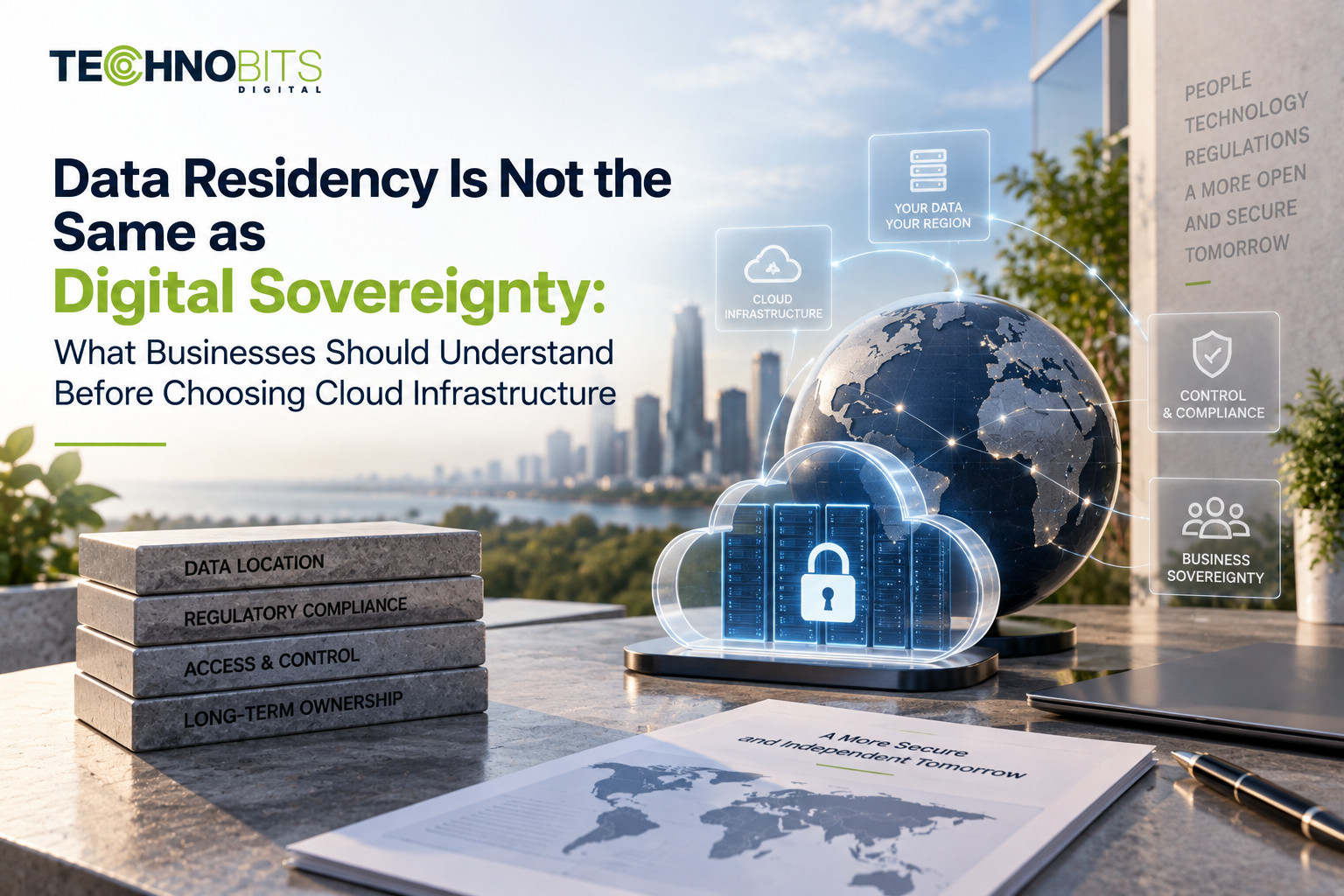
Choosing a cloud region is no longer only a technical decision.
Businesses increasingly need to consider where data is stored, which legal jurisdictions may apply, who can administer the infrastructure, how encryption keys are controlled, where backups are created and how easily workloads can move if business or regulatory requirements change.
This is where two terms are frequently confused: data residency and digital sovereignty.
Data residency generally concerns the geographic location in which data is stored or processed. Digital sovereignty is broader. It considers the level of control an organisation retains over its data, technology, operations, access, dependencies and legal exposure.
The distinction matters because selecting a cloud region in a particular country does not automatically answer every security, compliance or operational-control question.
For businesses planning new cloud infrastructure or modernising existing environments, the correct starting point is therefore not simply:
“Where should our data be hosted?”
It is:
“What level of control do we actually need over our data, infrastructure and technology dependencies?”
What Is the Difference Between Data Residency and Digital Sovereignty?
In cloud architecture discussions, data residency usually refers to requirements that data remain within an approved geographic region or country. AWS and Microsoft both describe residency primarily in terms of geographic storage or processing location.
Digital sovereignty goes further.
The European Commission's 2026 Cloud Sovereignty Framework assesses sovereignty across areas including legal and jurisdictional control, data and AI, operational control, supply-chain dependencies, technological autonomy, security and compliance.
A useful distinction is:
Question | Data Residency | Digital Sovereignty |
|---|---|---|
Where is data stored? | Central concern | One part of the assessment |
Where is data processed? | Often relevant | Relevant |
Who can access systems? | Not fully answered by location | Important |
Who manages encryption keys? | Separate question | Important |
Which laws or jurisdictions may apply? | Related | Central consideration |
Who operates the infrastructure? | Not necessarily addressed | Relevant |
Can workloads move to another provider? | Usually separate | Relevant to technology autonomy |
Are there external supply-chain dependencies? | Usually outside residency | Relevant |
How resilient is the platform if a provider or service becomes unavailable? | Separate issue | Relevant |
The practical lesson is simple:
Data residency can contribute to digital sovereignty, but it does not provide digital sovereignty by itself.
Microsoft's sovereign-cloud guidance similarly treats residency as one control among broader sovereignty measures involving encryption, operational oversight and other technical controls.
Why Choosing a Cloud Region Is Not Enough
A business may configure its primary database to remain in a selected region and still have unanswered questions about the rest of its architecture.
Consider a typical application involving:
Website → API → Database → Authentication → Analytics → Backup → Monitoring → Support tools
The primary database may be located in the selected region, while logs, backups, support information or connected services follow different infrastructure policies.
This is why cloud planning should examine the complete data flow rather than one database location.
Businesses should understand where relevant data may be:
stored, processed, replicated, backed up, logged, accessed administratively and transferred through connected services.
They should also review provider-specific documentation rather than assuming that selecting a region applies identically to every service. Microsoft, for example, documents residency commitments by product and geography rather than presenting cloud residency as one universal setting.
For organisations reviewing their wider infrastructure, Technobits Digital's Networking Services and Smart Infrastructure capabilities cover areas such as network architecture, infrastructure upgrades and network management.
Data Residency Does Not Automatically Mean Compliance
One of the most important mistakes to avoid is treating residency as a compliance certificate.
Keeping data inside a particular country or region may support an applicable requirement, but compliance usually depends on several additional factors.
These can include:
what information is being processed
why it is being processed
who can access it
how long it is retained
which third parties receive it
which safeguards apply
what contractual obligations exist
which jurisdiction and sector-specific rules apply
For example, EU rules governing international transfers of personal data provide several possible transfer mechanisms, including adequacy decisions, Standard Contractual Clauses and Binding Corporate Rules. Simply knowing the physical location of a server does not replace that broader assessment.
Cloud architecture should therefore support a business's legal and compliance decisions rather than being presented as proof of compliance itself.
Where cybersecurity and configuration risk also need assessment, Technobits Digital provides Cybersecurity Services including security audits, VAPT, SIEM, web-application penetration testing and network-security capabilities.
What Businesses Should Assess Before Choosing Cloud Infrastructure
Before selecting a cloud architecture, businesses should first classify the workload.
A public marketing website, an internal collaboration tool, a customer application and a system containing sensitive personal or financial information do not necessarily require identical controls.
A practical assessment should cover seven areas:
Data classification: What information does the system store or process, and how sensitive is it?
Residency requirements: Are there contractual, regulatory, customer or internal-policy requirements governing where information may be stored or processed?
Access and identity: Who can access production systems, data, backups and administrative interfaces?
Encryption and key management: Who controls the encryption keys, and what happens if access to those keys must be revoked or transferred?
Data flows and integrations: Which APIs, analytics services, SaaS platforms, AI services or external systems receive information?
Resilience and recovery: Where are backups and replicas located, and can recovery requirements be met without violating required data-location controls?
Portability and dependency: How difficult would it be to migrate applications, data and operational processes if the current provider no longer meets business requirements?
These questions are more useful than simply asking whether a provider has a data centre in a particular country.
Technobits Digital's technology stack publicly includes AWS, Microsoft Azure and Google Cloud alongside Docker and Kubernetes. The appropriate provider and architecture should still depend on the workload's technical, security, availability and governance requirements rather than on a universal preference for one platform.
Digital Sovereignty Also Includes Technology and Operational Control
The broader sovereignty discussion has become more concrete in 2026.
The European Commission's Cloud Sovereignty Framework now evaluates cloud services across strategic, legal, operational, supply-chain, technological, security and other dimensions instead of treating sovereignty purely as a data-location issue.
This creates useful questions even for businesses that are not subject to the Commission's procurement framework.
For example:
Can another organisation administer the infrastructure?
Which third parties are essential to keeping the service operational?
Can encryption keys remain under the customer's control?
Can data and workloads be moved without a major rebuild?
What happens when an external dependency becomes unavailable?
Is the organisation dependent on proprietary services that would make migration difficult?
None of these automatically means proprietary or global cloud services are unsuitable.
The objective should be to understand dependencies and make them deliberate.
A highly specialised managed service may provide substantial technical value while also increasing dependence on one provider. A more portable architecture may reduce dependency while introducing additional engineering and operational work.
There is no universally correct answer.
Avoid Turning Sovereignty Into Unnecessary Cloud Complexity
Businesses should also avoid the opposite mistake: demanding a highly complex sovereign architecture when the workload does not justify it.
Additional infrastructure controls can introduce:
greater engineering effort, more operational responsibility, additional monitoring, specialised security requirements and higher migration complexity.
The appropriate level of control should therefore follow the actual risk.
A lower-risk public workload may not require the same sovereignty model as a platform handling confidential information or workloads subject to specific contractual or regulatory requirements.
This risk-based approach is important because digital sovereignty is not the same as moving everything on-premises, and it does not automatically mean avoiding major cloud providers.
Hybrid, public-cloud, private-cloud and other architecture models can each be appropriate depending on the organisation's requirements.
Technobits Digital's Software Solutions practice includes custom software and API integration capabilities that may become relevant where applications need to interact with existing infrastructure or external systems.
Frequently Asked Questions
Is data residency the same as data sovereignty?
No. Data residency primarily addresses where data is stored or processed geographically. Data sovereignty is broader and can include legal jurisdiction, access control, operational control, technology dependencies, encryption, resilience and other considerations.
Does storing data in the correct country guarantee compliance?
No. Data location may be one compliance requirement, but compliance can also depend on the type of information, processing purpose, access controls, transfers, retention, contracts and applicable legislation. Organisations should assess the specific rules that apply to their jurisdiction, sector and workload.
Does digital sovereignty mean businesses must avoid public cloud?
No. Sovereignty is about required levels of control and dependency rather than a universal requirement to avoid public cloud. The European Commission's own 2026 sovereignty framework evaluates different levels of sovereignty instead of defining one architecture as suitable for every workload.
Should every business use sovereign cloud infrastructure?
No. Requirements should reflect the sensitivity of the workload, applicable regulations, contractual commitments, operational risk and business objectives. Adding sovereignty controls without a corresponding requirement can create unnecessary complexity.
What should businesses check before choosing a cloud provider?
Businesses should assess data location, service-specific residency terms, identity and administrative access, encryption-key ownership, backups, data transfers, integrations, disaster recovery, portability, security responsibilities and any applicable regulatory or contractual requirements.
Choosing Cloud Infrastructure Based on Requirements, Not Labels
Data residency is important, but it answers only part of the cloud-governance question.
A business can store information in the required geography while still having unresolved questions about privileged access, encryption, legal jurisdiction, backups, external dependencies and operational control.
That is why cloud decisions should begin with the workload and its requirements.
Businesses should understand:
what data they hold, where it moves, who controls it, which systems depend on it and what would happen if a provider or integration changed.
Only then should infrastructure teams decide which combination of cloud regions, network architecture, security controls and application design is appropriate.
Planning Cloud Infrastructure With Data Location or Control Requirements?
Choosing cloud infrastructure should begin with the workload, data flows, network dependencies and security requirements—not with a provider label alone.
Technobits Digital can support relevant parts of this assessment through Networking Services and IT Infrastructure Design, Cybersecurity Services and Software Solutions. You can also review the Technobits Digital technology stack to see the publicly listed cloud and infrastructure technologies.
For a project-specific discussion based on your current systems, requirements and infrastructure constraints:
Discuss Your Infrastructure Requirements with Technobits Digital