Confidential Computing in 2026: How Businesses Can Protect Sensitive Data While It Is Being Processed
Businesses have spent years improving how they protect data when it is stored and when it moves between systems.
Encryption at rest protects stored information. Encryption in transit protects information moving across networks.
But sensitive information often has to be decrypted before an application can actually process it.
That creates a third security question:
How do you reduce exposure while sensitive data is actively being used?
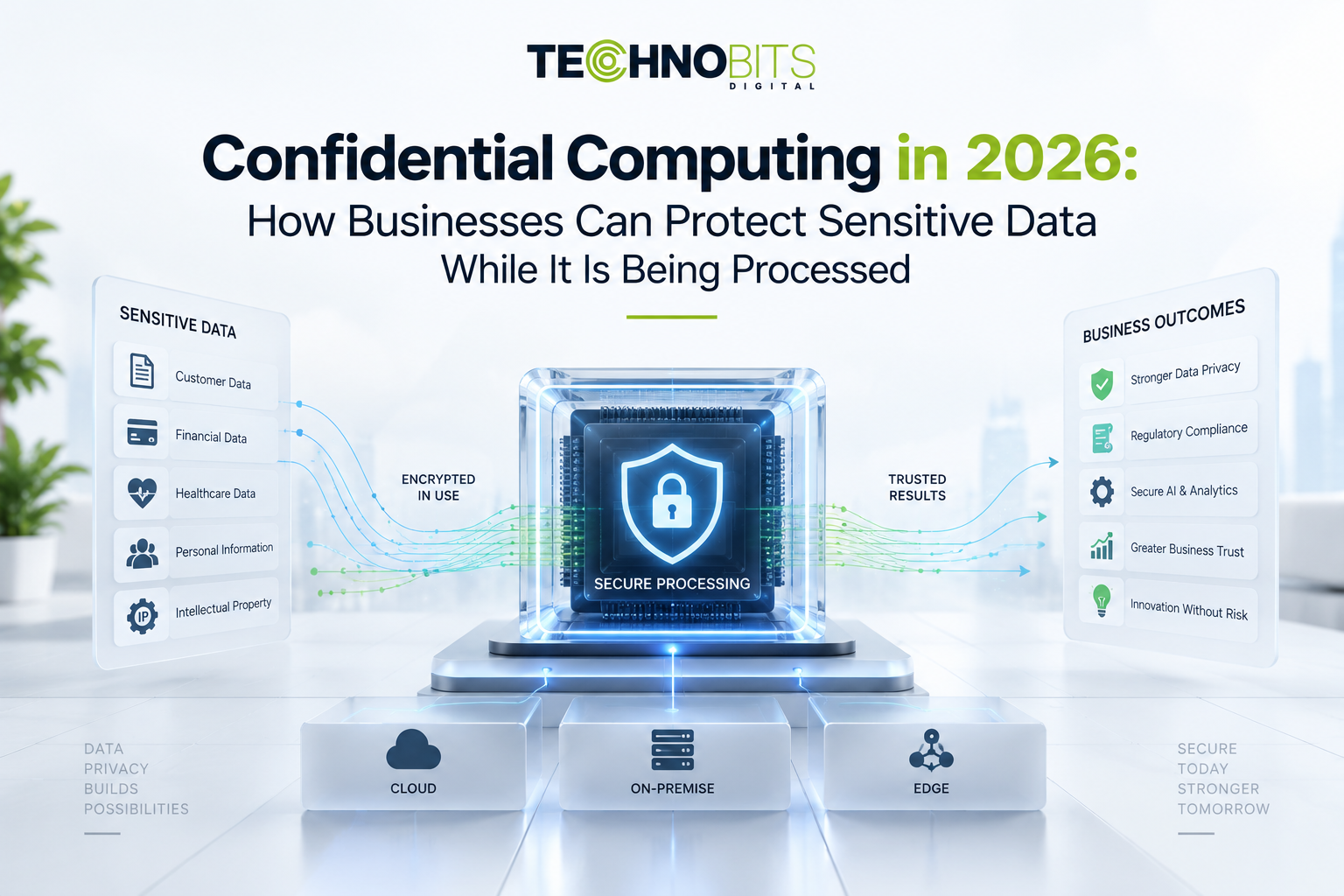
Confidential computing is designed to address that problem by processing data inside a hardware-based Trusted Execution Environment (TEE).
The Confidential Computing Consortium defines confidential computing as protecting data in use through computation inside a hardware-based, attested TEE. Microsoft and Google use the same industry definition in their current confidential-computing documentation.
For organisations working with sensitive customer information, AI workloads, financial data, intellectual property or shared cloud infrastructure, confidential computing can add another layer to a broader security architecture.
It should not, however, be treated as a replacement for encryption, access control, secure application development or cybersecurity monitoring.
What Is Confidential Computing?
Most data protection discussions cover three states:
Data at rest
Information stored in databases, disks, backups or object storage.
Data in transit
Information moving between devices, applications, APIs or cloud services.
Data in use
Information being actively processed by an application or computing workload.
Confidential computing focuses primarily on the third category.
A Trusted Execution Environment creates a hardware-backed isolated area where approved code and data can be processed with protections designed to reduce access from other privileged software or infrastructure layers.
A simplified model looks like:
Encrypted data → Trusted Execution Environment → Processing → Encrypted result
Google describes confidential computing as protecting data in use through hardware-based TEEs, complementing protections for data at rest and in transit.
This distinction matters because conventional encryption alone does not necessarily protect plaintext while an application is actively working with it.
Why Is Confidential Computing Relevant in 2026?
Confidential computing has moved beyond a purely experimental infrastructure concept.
Major cloud platforms now provide confidential-computing capabilities.
Microsoft Azure supports confidential VMs, confidential containers, attestation and several confidential services using technologies including AMD SEV-SNP and Intel TDX.
Google Cloud provides Confidential VMs, Confidential GKE, Confidential Space and attestation capabilities.
AWS uses capabilities within the Nitro System, Nitro Enclaves, memory encryption and attestation to support confidential-computing scenarios.
Gartner also identified confidential computing as a strategic 2026 technology trend, particularly around sensitive workloads and infrastructure that organisations do not fully control.
This does not mean every workload now requires a TEE.
It means businesses handling higher-risk information increasingly have another architecture option to evaluate.
Where Does Confidential Computing Fit Into Data Security?
Confidential computing is easiest to understand as an additional layer.
A stronger security architecture may include:
Storage encryption
→ protects stored information.
Transport encryption
→ protects data moving across networks.
Identity and access management
→ controls who or what can request access.
Application security
→ protects application logic, APIs and user interactions.
Confidential computing
→ adds protection around certain data while it is being processed.
Monitoring and incident response
→ helps detect and respond to abnormal activity.
The important word is additional.
Moving a workload into a TEE does not automatically fix:
Vulnerable application code
Weak passwords
Stolen user credentials
Excessive permissions
Insecure APIs
Poor key management
Malware on an end-user device
Incorrect business logic
Improper data collection
Confidential computing should therefore be considered within a defence-in-depth strategy.
Gartner's current 2026 research makes the same broader point: confidential computing can be important for particular regulated or confidential workloads, but it is not a security panacea.
Businesses reviewing these wider controls can also examine Technobits Digital's Cybersecurity Services, which sit within its publicly listed information-security portfolio.
How Does a Trusted Execution Environment Work?
The exact implementation differs between hardware and cloud platforms, but several concepts are common.
Hardware-Based Isolation
A TEE creates an execution boundary supported by hardware.
The objective is to make it more difficult for unauthorised infrastructure layers or privileged software outside the environment to inspect or modify the protected workload.
Memory Protection
Confidential-computing technologies can protect information while it is present in memory.
This matters because sensitive information often needs to exist in usable form while software processes it.
Attestation
Attestation allows another system to verify information about the trusted environment before providing it with sensitive data or cryptographic secrets.
Microsoft describes attestation as part of verifying the integrity and identity of confidential environments, while Google similarly provides attestation for confidential workloads.
A simplified workflow might therefore be:
Application requests sensitive data
→ Environment proves its expected state
→ Attestation is evaluated
→ Secrets/data are released
→ Processing occurs inside the TEE
This is different from simply trusting that a server has been configured correctly.
Which Business Workloads May Benefit From Confidential Computing?
The business case should start with the threat model, not with the technology.
Confidential computing may be worth evaluating when the organisation needs stronger protection for sensitive information while computation is occurring.
Potential scenarios include:
Sensitive AI and Machine Learning Workloads
AI systems may process:
Proprietary documents
Customer records
Model parameters
Prompts
Financial information
Internal intellectual property
Microsoft, Google and AWS now document confidential-computing options for AI or machine-learning workloads.
The Confidential Computing Consortium has also discussed confidential computing specifically in relation to agentic AI workloads in 2026.
That does not make every AI application a confidential-computing candidate. The sensitivity of the information and the actual threat model should determine the architecture.
Multi-Party Data Processing
Sometimes several organisations need to analyse combined information without broadly exposing their underlying datasets.
Confidential-computing environments can support architectures where an approved workload processes information from multiple parties under defined trust conditions.
Google's Confidential Space is explicitly designed for scenarios involving sensitive information contributed by multiple parties.
Regulated or Privacy-Sensitive Workloads
Financial information, healthcare information and other sensitive datasets may justify stronger runtime isolation depending on applicable requirements and risk.
However, using confidential computing does not by itself establish compliance with a regulation.
Compliance also depends on areas such as:
Data collection
Purpose
Retention
Access controls
Contracts
Governance
Logging
Incident handling
Organisational procedures
Avoid claims such as:
“Confidential computing makes an application GDPR/HIPAA/PCI compliant.”
That would be unjustified.
Confidential Computing Does Not Mean “Trust Nothing”
One of the easiest mistakes is interpreting confidential computing as complete isolation from every possible threat.
The protection boundary depends on:
The hardware
TEE implementation
Attestation policy
Application code
Key-management architecture
Cloud configuration
External services
User endpoints
For example, protecting processing inside a TEE does not stop an authorised application from returning sensitive information to an unauthorised user if the application's access-control logic is incorrect.
The application still requires normal software-engineering and security practices.
Technobits Digital's public Software Solutions offering includes custom software and API-oriented development, which is relevant where security requirements affect the surrounding application architecture.
What Are the Main Architecture Trade-Offs?
Confidential computing introduces useful controls, but it can also create new implementation considerations.
Security vs Complexity
Adding attestation, specialised compute types or enclave-specific architecture can increase operational complexity.
A lower-risk application may not justify it.
Portability vs Platform Features
Cloud providers offer different confidential-computing technologies and deployment models.
Building tightly around one provider's implementation may make certain security capabilities easier to use but can also create platform-specific dependencies.
Isolation vs Observability
Security teams still need enough telemetry to understand workload health and investigate incidents.
Monitoring must therefore be designed without undermining the confidentiality boundary the architecture is trying to establish.
Performance vs Protection
Some confidential environments may have hardware, memory, accelerator, networking or workload constraints.
These vary by platform and architecture.
Do not assume either:
“Confidential computing always slows applications significantly.”
or:
“Confidential computing has zero performance impact.”
Both are too broad.
Performance should be tested using the intended workload.
Where an organisation is evaluating infrastructure changes, Technobits Digital also publicly lists Cloud Architecture and infrastructure capabilities within its wider digital-services portfolio.
How Should Confidential Computing Be Tested?
Testing should cover more than whether the application starts successfully inside a confidential environment.
A practical test plan may include:
Functional Testing
Does the workload perform its intended business function?
Attestation Testing
Does the application correctly reject environments that fail the expected attestation policy?
Access-Control Testing
Can unauthorised identities retrieve data even if the underlying workload is confidential?
Failure Testing
What happens if:
Attestation fails?
Key release fails?
The confidential workload becomes unavailable?
A dependency times out?
Configuration changes unexpectedly?
Integration Testing
Do connected APIs, databases and services continue to behave correctly?
Performance Testing
What effect does the architecture have on realistic workloads?
Security Testing
Are the surrounding application, APIs, secrets, identities and infrastructure appropriately configured?
Technobits Digital's Testing & Analysis Services publicly include functional, performance and security-oriented testing capabilities.
Importantly, this does not mean Technobits currently advertises a dedicated confidential-computing testing service. The relevant testing scope would need to be defined for the particular architecture.
Confidential Computing and AI: A Growing 2026 Use Case
One reason confidential computing is receiving more attention is the growth of AI workloads involving information that organisations may not want exposed outside tightly controlled boundaries.
A possible AI architecture could involve:
Sensitive company data
→ Attested confidential environment
→ AI inference or processing
→ Controlled output
This can be useful where an organisation wants additional protection around:
Proprietary datasets
Confidential prompts
AI models
Sensitive inference
Cross-organisation analysis
Azure currently lists confidential GPU VMs and confidential inferencing capabilities among its confidential-computing portfolio, while Google and AWS also describe confidential-computing scenarios involving AI and machine learning.
Again, confidential computing does not make an AI system automatically private or secure.
The AI application still requires:
Appropriate data permissions
Model/provider assessment
Input validation
Output controls
Authentication
Logging
Testing
Human governance where required
When Might Confidential Computing Be Unnecessary?
This is an important question because the technology should not be recommended indiscriminately.
A business may not need confidential computing when:
The workload does not process materially sensitive information
Existing security boundaries adequately address the threat model
Runtime infrastructure access is not a relevant business risk
Architectural complexity outweighs the additional protection
The selected platform cannot support the required workload efficiently
A simpler security control can address the same risk more effectively
The correct question is therefore not:
“Should we use confidential computing because it is a 2026 technology trend?”
It is:
“What risk do we need to reduce, and does confidential computing materially address that risk?”
That is a much stronger architecture decision.
A Practical Confidential Computing Readiness Framework
Before adopting confidential computing, organisations can work through this sequence:
Identify sensitive data
Determine which information requires additional protection while being processed.Define the threat model
Identify the infrastructure, administrative or multi-party risks being addressed.Map the workload
Document applications, APIs, databases, external services and users involved.Evaluate platform options
Compare confidential VMs, containers, enclave approaches and relevant provider capabilities.Design attestation and key release
Decide how trusted workload state will be verified before sensitive material is released.Review surrounding controls
Assess identity, access management, application security, encryption and logging.Test the workload
Validate functionality, failure behaviour, performance, integrations and security assumptions.Plan operations
Establish monitoring, updates, incident ownership and recovery procedures.
This helps keep the technology connected to the original business risk.
Frequently Asked Questions
What is confidential computing?
Confidential computing is a security approach that protects data while it is being processed by running computation inside a hardware-based, attested Trusted Execution Environment.
How is confidential computing different from encryption?
Encryption generally protects data while stored or transmitted. Confidential computing adds controls intended to protect certain information while it is actively being processed. These approaches can complement each other rather than replace one another.
Does confidential computing make cloud computing completely secure?
No. It can reduce specific risks around data in use and infrastructure trust, but application vulnerabilities, weak credentials, insecure APIs, incorrect permissions and other risks still require separate controls.
Is confidential computing only for large enterprises?
No technology rule limits it to large enterprises. However, the additional architecture should be justified by the sensitivity of the workload, risk profile, operational capability and cost.
Can confidential computing protect AI data?
It can provide additional protection for appropriate AI workloads while data or models are being processed. Cloud providers currently offer confidential-computing technologies aimed at AI and machine-learning scenarios.
Does confidential computing guarantee regulatory compliance?
No. Confidential computing can support technical risk controls, but compliance depends on the applicable regulation and the organisation's complete technical, contractual and operational environment.
Do all cloud applications need confidential computing?
No. It is most useful when the protection of data in use addresses an identified threat or business requirement. Standard workloads may be adequately protected through existing cloud and application-security controls.
Planning a Cloud or Data-Security Architecture?
Protecting sensitive information may require more than choosing a new security product. The appropriate architecture depends on what data is being processed, where it runs, which systems can access it and which threats the organisation needs to address.
Technobits Digital can help assess relevant cloud architecture, software, infrastructure, testing and cybersecurity requirements based on the application's architecture and risk profile.