From AI Pilots to Production: What It Takes to Deploy AI Systems Safely and Reliably
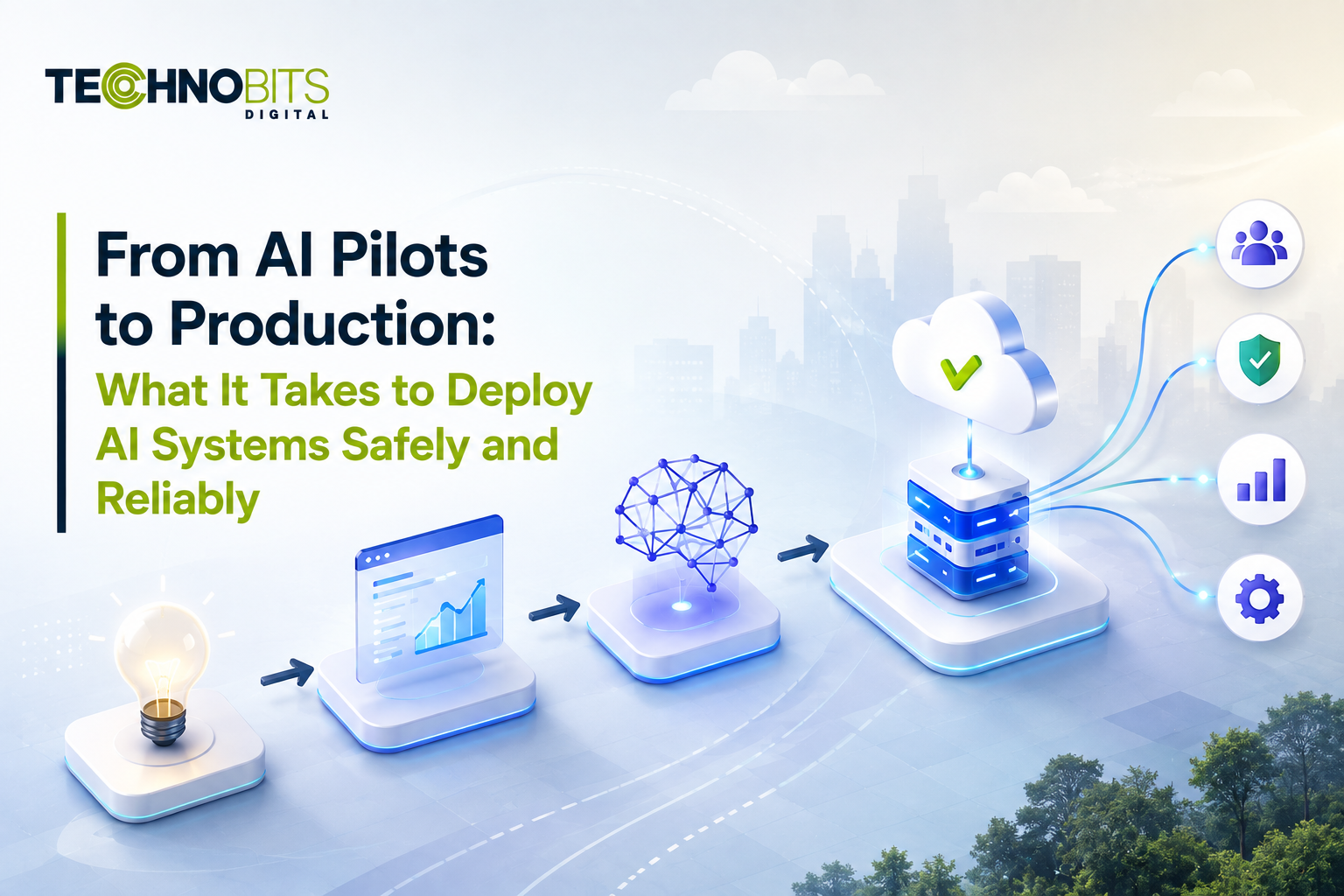
AI projects often begin with a promising prototype: a chatbot answers questions, a model summarises documents, an AI assistant generates content, or an application demonstrates a useful workflow.
Moving from that prototype to a reliable production system is a different challenge.
A production AI system needs more than a capable model. It needs suitable data, reliable integrations, evaluation methods, security controls, monitoring, clear ownership and an operating process for handling failures and changes.
Recent industry discussion is increasingly focused on this shift from AI experimentation to operational deployment. The challenge is not simply proving that an AI system can work in a controlled demonstration, but determining whether it can work consistently within the environment where people will actually use it.
What Does It Mean to Move an AI System From Pilot to Production?
Moving an AI system to production means taking it from an experimental or limited environment into a real operating environment where users, data, integrations and operational requirements must be handled consistently.
A pilot may demonstrate that a model can perform a task.
A production system needs to answer additional questions:
Is the output reliable enough for the intended use?
What data does the system require?
What happens when the model produces an incorrect result?
How is performance measured?
Who owns the system?
How are security and access controls managed?
How are changes evaluated?
What happens when a model, API or integration becomes unavailable?
NIST's AI Risk Management Framework recommends managing AI risks across the lifecycle through the functions Govern, Map, Measure and Manage, rather than treating risk as a one-time deployment activity.
Why AI Pilots Can Struggle in Production
A prototype usually operates within controlled conditions.
Production environments are less predictable.
An AI application may need to deal with:
Larger and changing data volumes
Different user behaviours
Incomplete information
Existing software systems
Authentication and permissions
Higher request volumes
Security threats
Changing model behaviour
Operational failures
Ongoing maintenance
An AI workflow that performs well during a demonstration may therefore require additional engineering before it is suitable for wider use.
The problem is often not the AI model alone. Data integration, system architecture, evaluation, security and operational processes can determine whether a pilot can become a dependable application.
1. Start With a Clearly Defined Use Case
Before scaling an AI pilot, define exactly what the system is expected to do.
A useful definition should include:
Target users
Intended workflow
Inputs
Expected outputs
Required integrations
Acceptable error conditions
Human involvement
Security requirements
Success criteria
For example, an AI system that summarises internal documents has different requirements from one that recommends actions or changes records in another application.
The level of risk should influence the level of testing, monitoring and human oversight required.
2. Make Sure the Data Is Ready
AI systems depend heavily on the quality and availability of their input data.
Before moving into production, teams should review:
Data accuracy
Data completeness
Data freshness
Data access permissions
Data sources
Duplicate information
Data formats
Retention requirements
Poor data can affect AI output even when the underlying model performs as expected.
NIST's generative AI profile highlights the importance of identifying and managing risks across the AI lifecycle, including risks associated with data and the context in which AI systems are deployed.
3. Choose the Right Model and Architecture
Production AI does not necessarily require the largest or most expensive model.
Model selection should consider:
Required capabilities
Accuracy requirements
Latency
Cost
Context requirements
Data sensitivity
Integration requirements
Deployment environment
Depending on the use case, an application might use a hosted model, a self-managed model, retrieval-augmented generation, a smaller specialised model or a combination of approaches.
The architecture should be selected around the application's actual requirements rather than the popularity of a particular model.
4. Connect AI to the Systems It Needs
A production AI application often needs to interact with other systems.
Examples include:
Websites
Mobile applications
CRM systems
Databases
Internal APIs
Document repositories
Customer-support platforms
Cloud services
The integration layer should define what information can be accessed and what actions can be performed.
For example, an AI assistant may be allowed to retrieve information from an approved knowledge base but require additional validation before changing a record in a production system.
This makes API design, authentication, permissions and error handling important parts of AI deployment.
For organisations requiring application and system integration work, Technobits Digital provides software and web-development capabilities that can support connected digital systems.
5. Evaluate the AI System Before Production
A successful demonstration is not enough to establish production readiness.
AI systems should be evaluated against representative scenarios and measurable criteria.
Depending on the application, teams may evaluate:
Accuracy
Relevance
Grounding
Response consistency
Safety
Latency
Failure rates
Cost
Tool-use behaviour
User experience
Google Cloud's guidance on generative AI evaluation emphasises measuring quality, safety and performance rather than relying on informal judgement of model responses.
NIST also recommends testing AI systems before deployment and regularly while they are in operation, with documented evaluation and monitoring.
6. Test Failure Scenarios, Not Only Successful Scenarios
A production system needs to behave appropriately when things go wrong.
Testing should consider scenarios such as:
Invalid input
Missing information
Incorrect model output
API failure
Authentication failure
Timeout
Service outage
Unexpected user behaviour
Excessive requests
Incorrect tool use
For higher-risk systems, teams may also need security testing and adversarial evaluation.
The objective is not to prove that an AI system can never fail. The objective is to understand how it fails and ensure that failures are handled appropriately.
7. Build Security Into the Architecture
AI security should not be treated as a final checklist before launch.
Depending on the system, teams may need to consider:
Authentication
Authorisation
Data access
Prompt injection
Sensitive information exposure
Model and API security
Dependency risks
Tool permissions
Logging
Monitoring
OWASP's 2026 agentic-AI resources highlight emerging risks including prompt injection, tool misuse, privilege escalation, supply-chain risks and other threats affecting systems that can take actions through tools.
For AI applications that interact with external systems, security boundaries should be defined before those capabilities are enabled.
Explore Technobits Digital's Cybersecurity Services for security assessment, VAPT, SIEM and related cybersecurity capabilities.
8. Define Human Oversight
Not every AI workflow needs the same level of human involvement.
Low-risk tasks may be suitable for greater automation.
Higher-impact actions may require review or approval.
For example:
Lower-risk workflow
AI → Generate summary → Human reviews when needed
Higher-risk workflow
AI → Recommend action → Validate → Human approval → Execute
Human oversight should be based on the potential impact of an incorrect result.
NIST's AI RMF emphasises clear accountability, risk management processes and ongoing monitoring throughout the AI lifecycle.
9. Monitor AI Systems After Deployment
Production deployment is not the end of AI evaluation.
The system should be monitored for changes in:
Output quality
Error rates
User behaviour
Data patterns
Latency
API failures
Model performance
Security events
Resource usage
Cost
A model or AI workflow that performs well at launch may behave differently as its surrounding environment changes.
NIST recommends monitoring AI functionality and behaviour in production and maintaining processes for incident response, recovery and change management.
10. Plan for Model and Dependency Changes
AI systems often depend on external models, APIs, libraries or infrastructure.
Those dependencies can change over time.
Before updating a production AI system, teams should consider:
Model version changes
API changes
Dependency updates
Prompt changes
Retrieval-data changes
Infrastructure changes
Changes in cost or latency
A useful practice is to evaluate significant changes in a controlled environment before applying them broadly.
This helps reduce the risk of introducing unexpected changes into production behaviour.
11. Build an Operational Process Around the AI System
Production AI requires ownership beyond the development team.
Teams should define:
System owner
Technical owner
Security responsibilities
Monitoring responsibilities
Incident process
Change-management process
User-support process
Review schedule
NIST's framework explicitly addresses organisational accountability, roles and responsibilities, ongoing monitoring and lifecycle management.
This helps turn an AI prototype into an operating system that can actually be maintained.
12. Measure the Right Outcomes
AI projects should be evaluated against the purpose for which they were built.
Depending on the use case, useful measures may include:
Task completion rate
Response quality
Error rate
Processing time
User satisfaction
Human-review rate
System availability
Cost per task
Security incidents
Avoid using a single metric to represent the entire performance of an AI system.
For example, a system that produces fast responses is not necessarily successful if those responses are inaccurate or require significant human correction.
AI Production Readiness Checklist
Before moving an AI system from pilot to production, ask:
Is the use case clearly defined?
Are the intended users identified?
Is the data suitable for the application?
Are access permissions defined?
Has the model been evaluated against representative scenarios?
Have failure cases been tested?
Are security risks assessed?
Are external APIs and dependencies documented?
Is human oversight defined where appropriate?
Are production monitoring mechanisms available?
Is there an incident-response process?
Is there an owner responsible for the system?
Is there a process for model and dependency updates?
Are performance, quality and cost being measured?
A pilot does not need every possible production capability on day one, but the team should understand which controls are necessary for the specific use case before expanding deployment.
From Prototype to Production: A Practical Lifecycle
A practical AI development lifecycle can be viewed as:
Discover → Design → Build → Evaluate → Secure → Deploy → Monitor → Improve
Discover
Define the problem, users, data and expected outcome.
Design
Choose the architecture, model approach, integrations and security boundaries.
Build
Develop the AI application and its supporting infrastructure.
Evaluate
Test quality, reliability, safety and relevant performance characteristics.
Secure
Validate authentication, access controls, data handling and application security.
Deploy
Release the system in a controlled production environment.
Monitor
Track system behaviour, quality, security and operational performance.
Improve
Use measured results and feedback to make controlled changes.
This lifecycle aligns with the broader principle in NIST's AI RMF that AI risk management should continue across the lifecycle rather than being treated as a one-time activity.
How Technobits Digital Can Support AI Projects
Technobits Digital currently provides AI Development, Cloud Architecture, LLM Integration, Automation, Software Solutions, Cybersecurity, Testing & Analysis, Web Development and Mobile App Development as part of its wider technology services.
These capabilities can be relevant at different stages of an AI project.
AI Development
For designing and developing AI-enabled applications and workflows, explore AI Development Services.
Cloud and Infrastructure
AI applications may require appropriate cloud architecture, infrastructure and deployment planning. Explore Cloud Architecture Services.
Software and Web Development
AI systems often need application interfaces, APIs and supporting software. See Web Development Services and Software Solutions.
Mobile AI Applications
Where AI capabilities are part of a mobile product, Technobits Digital provides Android, iOS and React Native development. Explore Mobile App Development Services.
Testing and Quality Assurance
AI-enabled applications need appropriate testing before and after deployment. Technobits Digital's QA offering includes automated regression testing, manual functional and exploratory testing, performance testing and security testing. Explore Testing & Analysis Services.
Cybersecurity
Where AI applications interact with sensitive information, APIs or production systems, security assessment can be an important part of the deployment process. Explore Cybersecurity Services.
Frequently Asked Questions
What does it mean to move an AI pilot into production?
It means taking an experimental AI system into a real operating environment where it must handle actual users, data, integrations, security requirements, monitoring and ongoing maintenance.
Why do AI pilots struggle to reach production?
Common challenges include unclear use cases, poor data quality, integration complexity, insufficient evaluation, security concerns and the lack of operational ownership. Recent industry analysis continues to highlight the gap between AI experimentation and production deployment.
How should an AI system be tested before production?
Testing should be based on the intended use case and may include quality evaluation, representative test scenarios, failure testing, security testing, integration testing and performance assessment.
Does an AI model need to be perfect before deployment?
No. Production readiness depends on whether the system's measured performance and limitations are acceptable for its intended use and risk level. High-impact applications may require substantially stronger controls and evaluation.
Should every AI system have human approval?
No. The appropriate level of human involvement depends on the potential impact and reversibility of the system's actions. Higher-impact decisions or irreversible actions may require additional review.
How should AI systems be monitored after deployment?
Monitoring can include output quality, errors, latency, system availability, security events, data changes, resource usage and other metrics relevant to the application's purpose.
Can a pilot use the same architecture as the production system?
Sometimes, but not always. A prototype may use simplified infrastructure or limited data. Production architecture usually needs additional attention to security, reliability, scalability, monitoring and maintenance.
Final Thoughts
Moving an AI system from pilot to production is an engineering and operational challenge, not simply a model-selection exercise.
A production-ready AI system needs a clearly defined use case, suitable data, appropriate architecture, measurable evaluation, security controls, operational ownership and ongoing monitoring.
The right approach also depends on the risk and complexity of the application. A low-risk internal assistant and an AI system connected to sensitive production systems should not be treated as identical deployments.
The goal is not to deploy AI as quickly as possible. It is to build an AI system that can be evaluated, monitored, secured and improved throughout its lifecycle.
Ready to move an AI project beyond the prototype?
Contact Technobits Digital to discuss your AI development, LLM integration, cloud architecture, testing, cybersecurity or software-development requirements.