Agentic AI Security: How Developers Can Build Safer AI Systems That Use Tools and Take Actions
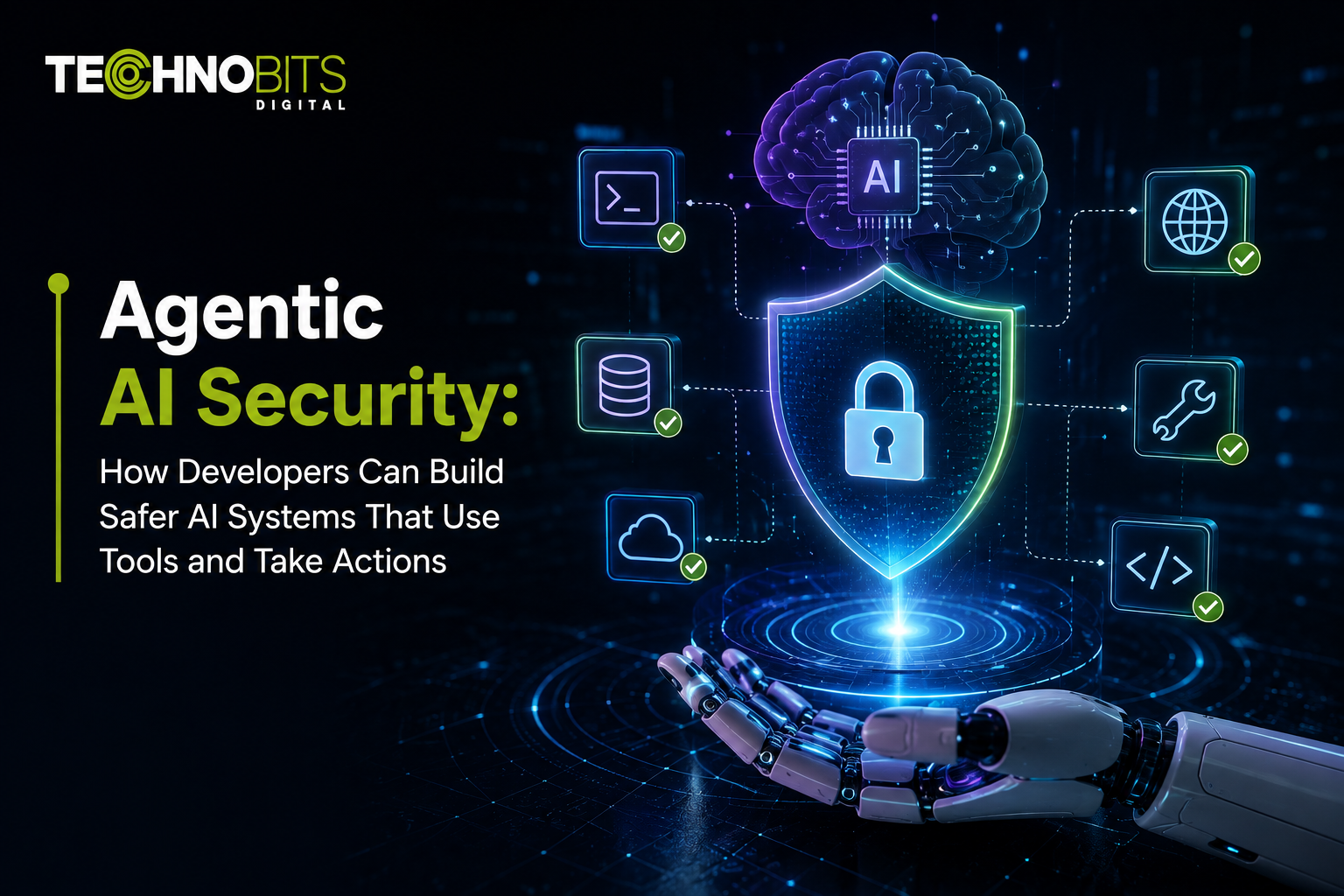
AI systems are moving beyond applications that only generate text or answer questions. Modern AI agents can be designed to plan tasks, use external tools, access information and perform actions as part of a workflow.
This creates new opportunities for software development, but it also introduces a different security challenge.
An AI agent may have access to APIs, databases, files, applications or other tools. If that access is not properly controlled, a manipulated instruction or unexpected model behaviour could result in actions that the developer did not intend.
For this reason, security needs to be considered as part of the architecture and development lifecycle of agentic AI applications rather than added only after deployment.
What Is Agentic AI Security?
Agentic AI security refers to the practices used to protect AI agents, their tools, data, identities and surrounding systems from misuse, manipulation and unintended actions.
Unlike a conventional application that generally follows explicitly programmed logic, an agentic system may use an AI model to determine which action to take within a defined set of capabilities.
An agent could potentially:
Retrieve information from an approved database
Call an API
Create or update a record
Read a document
Execute a permitted function
Coordinate multiple steps in a workflow
The security question therefore becomes more than:
“Is the AI model secure?”
It also becomes:
“What can the agent access, what can it do, and what happens if its behaviour is manipulated?”
OWASP's Agentic AI security guidance identifies areas including agent goals, tool use, identity and privileges, supply-chain risks, code execution and other agent-specific threats.
Why Agentic AI Creates a Different Security Challenge
An AI agent can sit between a user, an AI model and multiple external systems.
A simplified architecture might look like:
User → AI Agent → AI Model → Tools/APIs → Business Systems
Each connection can introduce an additional security consideration.
For example, an agent might be allowed to read customer information but should not be allowed to modify financial records without additional authorization.
Similarly, an agent may need access to a calendar API but should not automatically receive unrestricted access to an entire account.
Security therefore needs to consider the complete agent workflow rather than only the model itself.
1. Control What the Agent Is Allowed to Do
One of the most important principles is to give an agent only the permissions it actually needs.
Instead of allowing an agent unrestricted access to multiple systems, developers can define specific capabilities.
For example:
Customer-support agent
May:
Search approved customer information
Retrieve product documentation
Create a support ticket
Should not automatically:
Delete customer records
Change financial information
Issue refunds without approval
Access unrelated internal systems
This approach follows the principle of limiting access according to actual requirements.
OWASP specifically identifies identity and privilege abuse as a major agentic application risk.
2. Protect Against Prompt Injection
Prompt injection occurs when an attacker attempts to influence an AI system through instructions contained in user input or external content.
With an ordinary chatbot, this may cause an undesirable response.
With a tool-enabled agent, the consequences can be more serious because the manipulated instruction may influence an action.
For example, an agent could retrieve information from an external document that contains instructions designed to change how the agent behaves.
Developers should therefore avoid treating model-generated instructions as inherently trusted.
Security controls should exist outside the model wherever possible.
Recent research into agentic AI security continues to identify prompt injection and related perception-layer attacks as important areas of concern.
3. Treat Tools and APIs as Security Boundaries
Tools give agents their ability to interact with external systems.
Examples include:
Database tools
File systems
Web APIs
Payment services
Email systems
CRM systems
Internal applications
Every tool should have a clearly defined purpose and permission boundary.
Developers should consider:
Which agent can call the tool
What parameters are accepted
What data the tool can access
What actions the tool can perform
What happens when a request fails
Whether the action requires human approval
An AI agent should not be trusted simply because the request originated from the model.
The application should validate important actions independently.
4. Use Least-Privilege Access
Least privilege means giving an identity only the access required for its intended task.
This principle is particularly important for agentic applications because an agent may be able to interact with multiple services.
For example, an agent that only needs to read product information should not automatically receive write access to the underlying database.
Where possible:
Separate read and write permissions
Use scoped credentials
Restrict API capabilities
Limit access to specific resources
Expire temporary permissions
Require additional authorization for sensitive actions
Recent research on agent security has highlighted capability-based access and least-privilege enforcement as important architectural controls.
5. Protect Credentials and Secrets
Agents may interact with services that require credentials or authentication tokens.
Developers should avoid embedding secrets directly into prompts, source code or model context.
Instead, sensitive credentials should be handled through appropriate application and infrastructure security controls.
Examples include:
Secret-management systems
Short-lived credentials
Scoped access tokens
Server-side authentication
Access logging
Credential rotation
The agent should receive only the minimum information necessary to complete an authorised action.
6. Validate Agent Actions Before Execution
An important security principle is to separate what the AI suggests from what the application allows.
For low-risk actions, an application may be able to execute an approved operation automatically.
For high-impact actions, additional validation or human approval may be appropriate.
For example:
Low risk
Agent → Create internal task → Execute
Higher risk
Agent → Request financial transaction → Validate → Human approval → Execute
This approach reduces the possibility that an unexpected model output directly becomes an irreversible action.
7. Add Human Approval Where Risk Requires It
Not every agent action needs manual approval.
However, human review can be appropriate for actions involving:
Financial transactions
Sensitive customer information
Account permissions
Irreversible changes
Legal or regulatory decisions
Deletion of important information
The approval process should be based on the potential impact of the action rather than simply whether AI is involved.
Human oversight should complement technical controls rather than replace them.
8. Secure Agent Memory and Context
Some agentic applications maintain information between interactions.
Depending on the architecture, this could include:
Conversation history
User preferences
Retrieved documents
Task state
Previous actions
Developers need to consider whether this information can be manipulated, accessed by the wrong user or retained longer than necessary.
Security controls should include appropriate:
Access restrictions
Data separation
Validation
Retention policies
Monitoring
Memory should not automatically be treated as trusted information.
9. Protect Against Tool Misuse
Tool misuse occurs when an agent uses an available capability in an unintended or unsafe way.
For example, a tool designed to update a customer record may become risky if the agent can manipulate arbitrary database fields without sufficient validation.
Developers should therefore validate:
Input parameters
Resource identifiers
User permissions
Action scope
Expected output
Error conditions
OWASP identifies tool misuse and exploitation as one of the major risks in agentic applications.
10. Consider the Agent Supply Chain
Agentic applications may depend on more than one component.
A system could include:
AI models
External APIs
Plugins or tools
Open-source libraries
Model-context protocols
Third-party services
Agent frameworks
Each dependency can introduce additional security considerations.
Developers should understand what components their agent depends on and keep dependencies reviewed and maintained.
OWASP's Agentic AI guidance specifically includes supply-chain vulnerabilities among the risks that developers need to consider.
11. Prevent Unexpected Code Execution
Some agentic systems can interact with development environments, scripts or other execution tools.
This can create significant risk if an attacker manages to influence the agent into executing unintended commands.
Where code execution is required, developers should consider:
Sandboxing
Restricted environments
Command allowlists
Resource limits
Network restrictions
File-system isolation
Logging
Approval controls
Recent research has specifically examined the risks created when agentic systems can interact with code execution environments and external tools.
12. Log and Monitor Agent Activity
Agentic systems can make multiple decisions and tool calls during a single workflow.
Monitoring can help developers understand:
Which tools were called
Which resources were accessed
What actions were attempted
Which requests were denied
Where failures occurred
When unusual behaviour appeared
Useful logs should provide enough context for investigation without unnecessarily exposing sensitive information.
Monitoring is particularly important when agents interact with production systems.
13. Test Agentic Applications Before Production
Traditional application testing remains important, but agentic systems introduce additional scenarios that need consideration.
Testing can include:
Functional Testing
Does the agent complete the intended workflow?
Permission Testing
Can the agent access resources outside its assigned scope?
Prompt-Injection Testing
Does malicious or unexpected input influence agent behaviour?
Tool-Use Testing
Can the agent misuse available tools?
Authentication Testing
Are identity and authorization controls enforced correctly?
Failure Testing
What happens when a tool, API or model becomes unavailable?
Security Testing
Can the surrounding application be exploited through the agent's inputs, outputs or tool interactions?
Agentic security guidance from OWASP recommends considering threats throughout the design, development and deployment lifecycle.
Agentic AI Security Checklist
Before deploying an agent that can access tools or external systems, developers should ask:
What can the agent access?
Which actions can it perform?
Are permissions limited to what is required?
Are sensitive actions independently validated?
Can users or external content influence agent behaviour?
Are tool inputs validated?
Are credentials protected?
Is agent memory appropriately controlled?
Are dependencies reviewed?
Is code execution isolated where required?
Are agent actions logged?
Is unusual behaviour monitored?
Have prompt-injection scenarios been tested?
Is human approval required for high-impact actions?
A security review should be adapted to the specific architecture rather than relying on a generic checklist alone.
How Agentic AI Security Fits Into Software Development
Agent security should not be treated as a separate task performed immediately before launch.
It can be considered across the development lifecycle:
Design → Threat Modelling → Development → Testing → Security Validation → Deployment → Monitoring
This approach allows developers to identify architectural risks before the system becomes difficult to change.
It also helps security and development teams work together instead of treating AI security as an isolated responsibility.
How Technobits Digital Can Support AI and Cybersecurity Projects
Technobits Digital publicly provides AI Development, LLM Integration, Automation, Software Solutions and Cybersecurity services. Its cybersecurity offering includes IT Security Audits, VAPT, SIEM, Web Application Penetration Testing and Firewall Protection and Network Security.
For projects involving AI-enabled applications, the relevant approach depends on the architecture and security requirements.
Technobits' existing technical capabilities can be relevant across different stages, including:
AI and software development
Web application development
API and system integration
Security assessment
Vulnerability assessment
Penetration testing
Software quality assurance
For application security requirements, explore Technobits Digital's Cybersecurity Services.
For vulnerability assessment and penetration testing requirements, see IT Security Audits and VAPT.
For software quality and security testing, explore Testing & Quality Assurance.
For AI-enabled software projects, explore AI Development.
Frequently Asked Questions
What is agentic AI security?
Agentic AI security is the practice of protecting AI agents, their tools, data, identities and surrounding applications against manipulation, misuse and unintended actions.
Why is agentic AI different from a normal chatbot?
A chatbot may primarily generate responses, while an agent can be configured to use tools and perform actions. This additional capability creates security considerations around permissions, tool access and action validation.
What is prompt injection in an AI agent?
Prompt injection is an attempt to influence an AI system through instructions contained in user input or external content. In a tool-enabled agent, successful manipulation may influence actions as well as generated text.
Can AI agents be completely secure?
No security architecture can guarantee that an AI system will never be attacked or behave unexpectedly. Security should instead focus on reducing risk through appropriate permissions, validation, monitoring, testing and governance.
Should AI agents have access to production systems?
Only when there is a justified requirement and appropriate security controls. Access should be limited to the resources and actions necessary for the agent's intended purpose.
Does VAPT apply to AI-powered applications?
VAPT can be relevant to the application, APIs, infrastructure and other components within the defined testing scope. AI-specific threats may require additional testing approaches beyond conventional vulnerability assessment and penetration testing.
Should every AI-agent action require human approval?
No. Approval requirements should be based on the risk and impact of the action. Low-risk operations may be automated, while high-impact or irreversible actions may require additional validation or human approval.
Final Thoughts
Agentic AI can make software systems more capable by allowing them to use tools, access information and perform multi-step tasks.
Those capabilities also expand the security boundary.
Building safer agentic applications requires more than securing the underlying AI model. Developers need to consider identity, permissions, tool access, prompt injection, data protection, memory, dependencies, code execution, monitoring and testing.
The most practical approach is to design security controls around what an agent is actually allowed to access and do.
AI agents should be treated as software systems with defined capabilities and security boundaries—not as trusted autonomous users.
Building or securing an AI-enabled application?
Contact Technobits Digital to discuss your AI development, application security, VAPT, penetration testing or software quality requirements.