How Recent Digital Solutions Acquisitions Demand Smarter iOS App Development Strategies
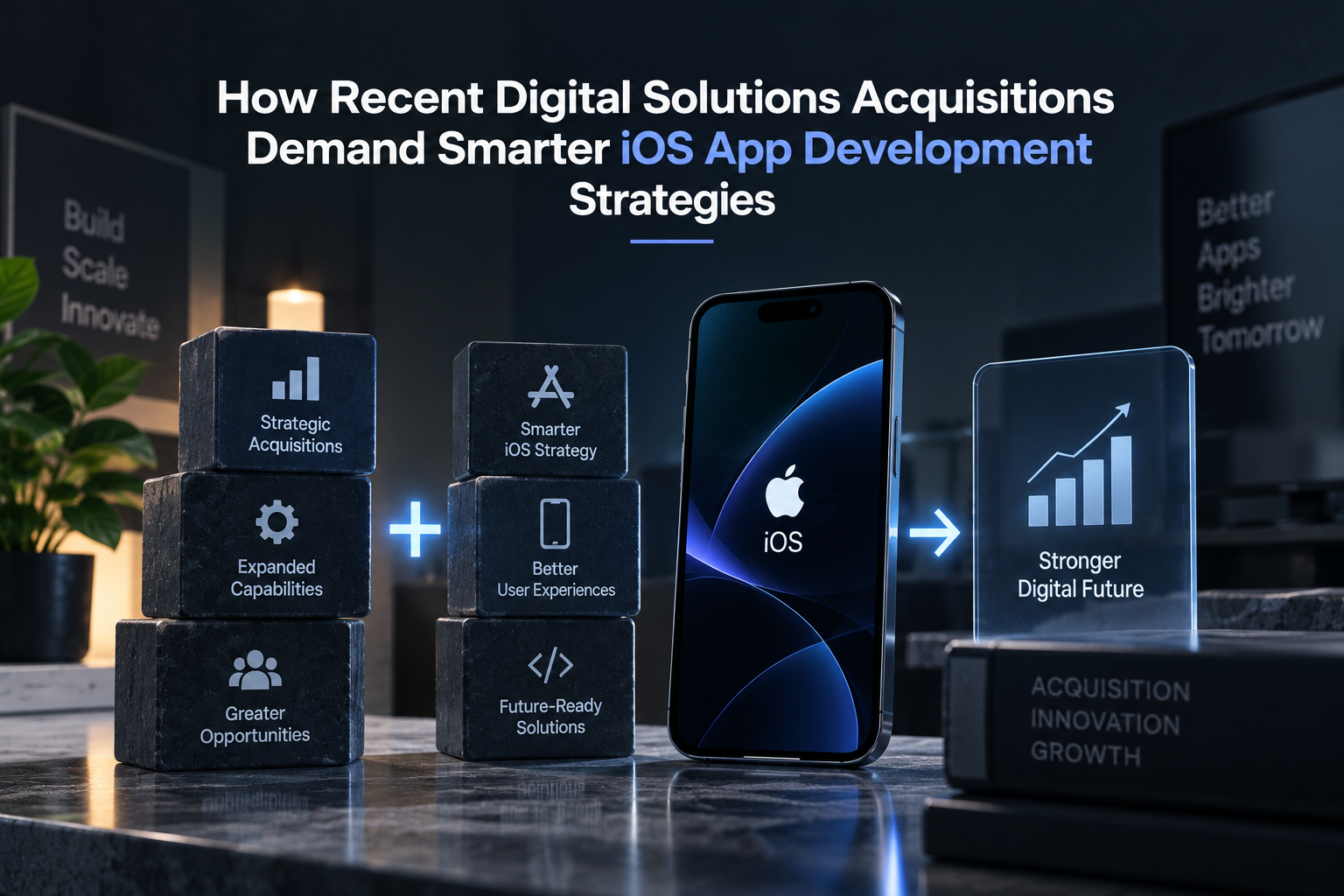
Recent acquisitions across digital solutions are changing what buyers should expect from iOS App Development. When consultancies, cloud specialists, design studios, data firms and automation providers consolidate, the commercial promise is usually broader delivery under one operating model. The engineering challenge is harder: an iOS product must connect reliably with APIs, identity platforms, analytics, cloud services, content systems and operational workflows that may have been created by different teams.
For founders, CTOs and product leaders, the practical response is not to select the largest supplier or add more features to the roadmap. It is to evaluate whether the delivery model preserves platform expertise while integrating the wider technology stack. Smarter iOS App Development requires explicit architecture ownership, testable interfaces, controlled use of AI, measurable release quality and a support structure that works across offices and time zones. Acquisitions can expand capability, but organisational scale does not automatically produce a coherent mobile product.
What Digital-Solutions Acquisitions Change in iOS Product Planning
An acquisition can combine mobile engineering with cloud, cybersecurity, experience design, data or marketing capabilities. That breadth may support a more complete product, particularly when an application needs account management, payments, personalisation, content delivery or business-system integration. Buyers should nevertheless distinguish capability listed on an organisation chart from capability available to the product team. Ask who will own Swift development, backend contracts, release engineering, security review and production support. If those responsibilities sit in separate acquired units, the provider needs a defined operating model for resolving architectural disagreements and cross-team dependencies.
The most important evaluation point is the boundary between the iOS client and the services it consumes. A polished SwiftUI interface cannot compensate for unstable APIs, inconsistent identity rules or poorly modelled data. Mobile and backend teams should agree on versioned API contracts, authentication flows, error structures, pagination, rate limits and backward-compatibility policies before feature work accelerates. Where the application must connect customer, finance or operational platforms, dedicated system integration services may be as important as the client implementation itself.
Acquisitions also affect ownership of product knowledge. Requirements may originate with a design practice, move to a mobile squad, pass through a platform team and end with a managed-support function. Every handover can remove context about why a workflow exists or which edge cases matter. A stronger model keeps a shared decision record covering user journeys, architecture choices, privacy assumptions, API dependencies and release criteria. Product documentation should be treated as part of delivery, not as a retrospective exercise after acquired teams have already made incompatible decisions.
Global multi-office support deserves similar scrutiny. Distributed coverage can help maintain development momentum and respond to incidents across regions, but only when repositories, environments and decision rights are shared. Look for one backlog, consistent engineering standards, named technical ownership and an escalation path that does not depend on finding the original developer. Multi-office capacity is useful when work can move between teams without fragmenting accountability; otherwise, it adds coordination overhead to every iOS release.
Where Acquisition-Driven iOS Delivery Breaks Across the Full Stack
The first common failure is treating the app as an isolated interface. Teams may approve screens before validating whether the backend can provide the required data, latency or permissions. Consider an account dashboard that combines orders, support cases and subscription status. If each source uses different identifiers and refresh rules, the app needs more than three API calls. It needs an aggregation strategy, predictable failure behaviour, caching rules and a clear source of truth. Full-stack expertise matters because mobile experience problems frequently originate in service design rather than UIKit or SwiftUI code.
The second failure appears when consolidation produces overlapping tools. One acquired team may use GitHub Actions, another Jenkins, and a third a cloud-specific pipeline. Analytics, crash reporting and feature-flag platforms may also be duplicated. Immediate standardisation is not always sensible, but leaving every tool in place creates fragmented access control and inconsistent release evidence. Teams should inventory the build, signing, testing, observability and distribution toolchain, then decide which components are retained, migrated or retired. That decision should account for Apple certificate management, provisioning profiles, TestFlight groups, secrets storage and App Store Connect permissions.
Quality can also become distributed without becoming coordinated. Designers validate visual behaviour, mobile developers run unit tests, platform teams test APIs and support staff inspect production incidents, yet nobody owns the complete customer journey. A release strategy should combine XCTest or Swift Testing coverage, API contract tests, accessibility checks, device and operating-system coverage, network-condition testing and monitored beta distribution. Independent custom software testing can help assess critical workflows that cross the application, backend and integrated systems rather than checking screens in isolation.
Security responsibilities are particularly vulnerable during supplier consolidation. Authentication may belong to a cloud group, local storage to the iOS team, API authorisation to backend engineers and incident monitoring to a security operation. The product still needs one threat model. Reviews should cover Keychain usage, token expiry and refresh, biometric re-authentication, certificate handling, sensitive logging, deep links, universal links and data retained in caches or backups. Broader AI cyber defence may support monitoring and analysis, but it does not replace secure mobile architecture or human review of high-impact findings.
Which iOS Architecture and Delivery Trade-offs Should Guide the Decision?
The native-versus-shared-code decision should follow product constraints rather than acquisition narratives. Native Swift development offers direct access to Apple frameworks, platform conventions and new operating-system capabilities. A cross-platform approach may reduce duplicated implementation when iOS and Android experiences share substantial logic. However, shared code can introduce framework dependencies, platform abstraction and specialised debugging requirements. If the product relies heavily on widgets, App Intents, HealthKit, advanced background execution or highly tailored accessibility behaviour, native implementation may provide clearer control.
Organisations planning parallel Android App Development should identify what actually needs to be shared. API schemas, domain rules, design tokens, analytics definitions and acceptance criteria can remain consistent without forcing both clients into one UI framework. Conversely, calculation engines or offline synchronisation logic may justify a shared Product if the team can maintain platform interoperability. The relevant question is not how much code can be reused, but whether reuse reduces total maintenance without weakening the experience expected on each platform.
AI-accelerated delivery requires the same discipline. Code assistants can draft test cases, explain unfamiliar modules, propose refactors and generate routine mappings between network and domain models. They can also reproduce insecure patterns, invent framework methods or overlook Apple-specific lifecycle behaviour. AI output should therefore move through the same pull-request, static-analysis, test and review controls as human-written code. If intelligent features are part of the product itself, AI mobile app development also requires decisions about model hosting, response latency, data boundaries, fallback behaviour and the cost of inference.
A useful supplier assessment should make the trade-offs visible rather than promise every desirable outcome at once. Review the proposed approach in this order:
Define platform requirements: identify Apple-specific capabilities, supported devices, minimum operating-system versions and accessibility expectations.
Map system dependencies: document APIs, identity providers, payment services, data platforms and administrative systems.
Choose ownership boundaries: name the teams responsible for client code, backend services, security, release approval and production incidents.
Test delivery assumptions: build a thin vertical slice that crosses the interface, API, authentication and telemetry layers.
Plan operational continuity: specify monitoring, rollback, feature flags, App Store releases and post-release support.
How Technobits Digital Connects iOS Engineering with the Wider Product Stack
Technobits Digital approaches mobile delivery as a product-engineering engagement rather than a detached screen-building exercise. Discovery should connect commercial goals with user journeys, data flows, system constraints and operating responsibilities. That creates an actionable architecture for the iOS client and the services behind it. Depending on the product, the work may include Swift or SwiftUI implementation, API design, identity integration, cloud-connected workflows, analytics events, release automation and observability. The purpose of full-stack expertise is to resolve dependencies before they become mobile defects.
The engagement can begin with an existing application as well as a new build. For an inherited codebase, the initial assessment should examine dependency health, architecture boundaries, crash patterns, test coverage, build reproducibility and App Store configuration. It should also identify whether performance problems originate in rendering, networking, persistence or backend response behaviour. Where an ageing application is tightly coupled to legacy services, intelligent software development can support the surrounding service and workflow changes needed for a maintainable mobile roadmap.
AI-accelerated delivery is most useful when applied to bounded tasks with reviewable outputs. It may support code exploration, acceptance-test drafting, documentation updates and analysis of recurring defects. It should not independently decide authentication architecture, privacy controls or release readiness. Technobits Digital can place AI-assisted work inside repository permissions, review policies and quality gates, allowing speed improvements to be evaluated without weakening engineering accountability. The delivery plan should state where AI is used, what data it can access and who approves the resulting artefacts.
For global multi-office support, the operating model should remain visible to the buyer. Useful controls include a shared backlog, common coding conventions, documented architecture decisions, protected branches, environment ownership and a named escalation route. A follow-the-sun structure may support continuity, but each handover needs current technical context and an explicit owner. The following evidence can help buyers distinguish genuine integrated delivery from a collection of loosely connected acquired capabilities:
A dependency map covering the app, APIs, identity, cloud resources and third-party services.
A release process that includes code signing, TestFlight validation, App Store submission and rollback planning.
Traceability from product requirements to implementation, automated checks and release acceptance.
A security model covering device storage, network transport, permissions and backend authorisation.
A support model defining incident severity, escalation ownership and responsibility across offices.
Frequently Asked Questions About Acquisition-Aware iOS Development
Why do digital-solutions acquisitions affect an iOS project?
They change the capabilities, tools and organisational boundaries surrounding delivery. An acquired provider may offer stronger cloud, data, design or security expertise, which can help an iOS product connect with a broader technology estate. The risk is that those capabilities remain operationally separate. Buyers should verify how the combined organisation assigns architecture ownership, shares repositories, manages dependencies and supports production rather than assuming corporate integration has already created engineering integration.
Should a business change development partners after its supplier is acquired?
Not automatically. Evaluate whether named engineers, delivery practices, commercial terms, intellectual-property arrangements and support responsibilities have changed. Review repository access, build pipelines, certificates, third-party accounts and documentation so that your organisation retains operational visibility. If the new structure introduces unclear ownership or repeated handovers, request a remediation plan before expanding the roadmap. Continuity should be judged through delivery evidence rather than the acquisition announcement.
Can AI materially accelerate iOS App Development?
AI can reduce time spent on repetitive implementation, code explanation, documentation and initial test generation. Its value depends on codebase quality, task selection and review controls. Outputs still need compilation, automated tests, static analysis and inspection by engineers who understand Apple frameworks. For product-facing AI, teams must also test latency, model errors, privacy boundaries and fallback behaviour. Acceleration is useful only when it does not create a larger verification or maintenance burden.
What quality controls should be required before an App Store release?
Release evidence should cover unit and integration tests, API contract checks, critical user journeys, accessibility, supported devices, degraded networks, privacy disclosures and telemetry. Teams should validate signing, entitlements, push notifications, universal links and production configuration separately from development environments. Broader quality assurance should include backend and operational behaviour because a successful App Store review does not demonstrate that the complete service is reliable.
What does full-stack expertise mean for a mobile engagement?
It means the team can reason across the iOS client, service interfaces, databases, identity, cloud configuration, deployment and monitoring. It does not require one engineer to perform every role. It requires coordinated specialists using shared architecture decisions and acceptance criteria. This is especially important for offline workflows, real-time updates, payments and account recovery, where failures span multiple system layers and cannot be corrected entirely within the application.
What Must You Define Before Commissioning the Next iOS Build?
Before selecting a delivery model, define the business workflow, supported Apple devices, minimum operating-system version, platform-specific capabilities and systems of record. Document which data may be stored on the device, how users authenticate, what must work offline and which incidents require immediate response. You should also identify who owns App Store Connect, certificates, source repositories, cloud accounts and third-party service contracts. These decisions protect product continuity if teams or suppliers change after an acquisition.
Technobits Digital can assess the application architecture, integration boundaries, delivery toolchain and support model, then help frame an implementation path suited to a new product, modernisation programme or inherited iOS codebase. The assessment can also identify where AI-assisted engineering is appropriate and where platform, security or quality decisions require direct specialist review.
Have an iOS project in mind? Let’s discuss your requirements and define the right development approach.