Vietnam Airlines’ AI Partnership Shows Why Intelligent Software Needs Integration OwnershipVietnam Airlines’ Latest AWS Partnership: What Businesses Can Learn About AI, Cloud and System Integration
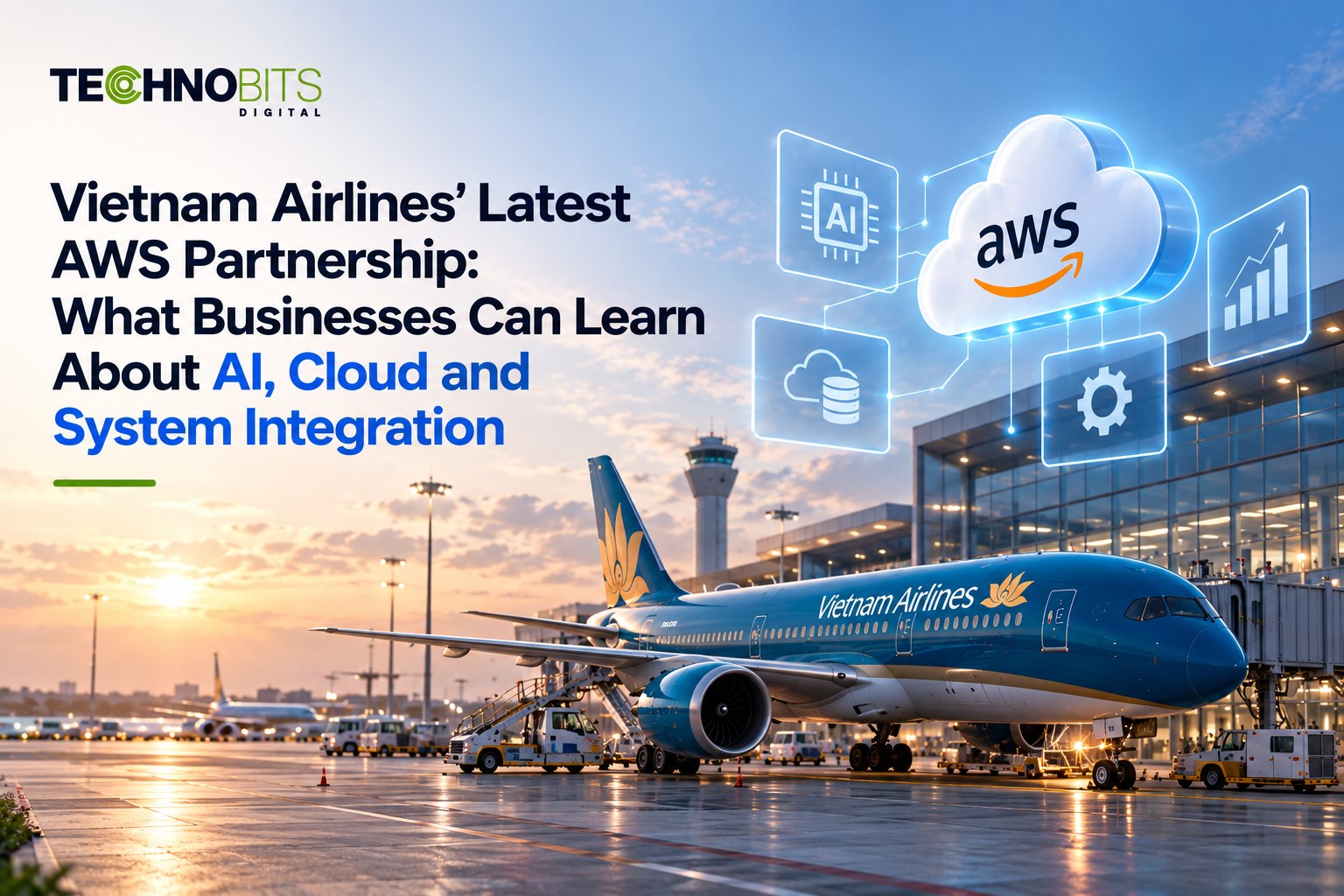
On September 24, 2026, Vietnam Airlines announced a new cooperation agreement with Amazon Web Services covering areas including artificial intelligence, cloud computing, enterprise data platforms, IT-system modernisation and cybersecurity. The airline said the parties will evaluate AI and generative AI applications across areas such as passenger care, commerce, flight operations, maintenance, enterprise management and data analysis.
For other businesses, the useful lesson is not to copy an airline technology programme. It is to recognise that production AI rarely operates as an isolated model. AI applications typically depend on data, APIs, identity, software systems, security controls and operational workflows working together.
For founders, CTOs and operations leaders, this ownership matters more than access to a particular model. AI-accelerated delivery can shorten prototyping, code generation, document analysis and test creation, but it does not resolve fragmented data, ambiguous API contracts or unclear production responsibility. An organisation may have a capable AI supplier, an experienced application team and established enterprise platforms, yet still produce an unreliable service if nobody owns the boundaries between them. Full-stack expertise becomes commercially relevant because an intelligent feature is only useful when its data, interface, security, monitoring and fallback processes work together.
What Should Technology Owners Evaluate in an Airline-Scale AI Partnership?
Begin by identifying the operational decision the software is intended to support. An airline might apply AI to customer enquiries, disruption communication, maintenance analysis, demand forecasting, crew support or internal knowledge retrieval. These are materially different systems. A customer assistant requires controlled access to booking information and approved policy content, whereas predictive maintenance may depend on aircraft records, sensor history and engineering review. Before discussing model choice, document the source systems, authorised users, permitted actions and consequences of an incorrect output. That scope reveals whether the proposed solution is a recommendation tool, an automated workflow or an interface to a regulated operational process.
Next, evaluate the proposed integration architecture rather than viewing AI as a self-contained product. The model may need an API gateway, retrieval layer, event stream, identity service, audit store and orchestration logic. If personal or commercially sensitive information is involved, the design must also define data minimisation, retention and access boundaries. Technobits Digital’s Intelligent Software perspective treats model functionality as one component within a wider product stack. This avoids the common mistake of testing an assistant against sample prompts while leaving production data contracts, latency requirements and exception handling unresolved.
Ownership should be visible in the operating model. Ask who approves an integration contract, who responds when a source system changes and who can suspend an automated action. The accountable owner does not need to write every connector, but must have authority across vendors and internal teams. That person or function should maintain the architecture map, interface catalogue, data classifications, service objectives and escalation path. In a multi-office organisation, ownership also needs time-zone coverage and consistent change control. Global support is valuable only when each office works from the same runbooks, release records and incident priorities rather than creating parallel interpretations of the system.
Where Intelligent Airline Software Breaks Across Models, APIs and Operations
The first failure point is frequently data meaning rather than model intelligence. A field called “status” can refer to a reservation, payment, flight segment, baggage item or support case. If teams connect systems without a canonical definition, the AI layer may retrieve technically valid but operationally misleading information. Similar problems occur when timestamps use different zones, passenger names follow inconsistent formats or historical records contain codes that current services no longer recognise. Integration ownership should establish schemas, validation rules, lineage and version policies before generated output is presented to customers or employees.
The second failure point is an incomplete transaction boundary. A conversational interface may recognise that a traveller wants to change a flight, but recognising intent is not the same as executing an authorised change. The workflow may require fare validation, payment, inventory confirmation, notification and an auditable reservation update. If an AI service calls these steps independently, partial completion can leave the customer charged without a confirmed transaction or create conflicting records. Appropriate System Integration Services should therefore define idempotency, rollback behaviour, timeout handling and reconciliation. High-impact actions may also require deterministic business rules and human confirmation rather than unconstrained model execution.
A third breakdown occurs when AI-accelerated delivery produces code faster than teams can review the surrounding assumptions. Generated connectors may compile while mishandling authentication renewal, rate limits, null values or vendor-specific error responses. Generated test cases may reproduce the same mistaken interpretation embedded in the generated implementation. Acceleration is useful for scaffolding, mapping repetitive fields and drafting test fixtures, but production approval still requires architecture review and domain-informed verification. AI Quality Assurance can support broader scenario generation, while accountable engineers must decide which scenarios represent realistic operational risk.
Map the complete request path. Record every user channel, API, model, datastore and external platform involved in producing or acting on an answer.
Define system-of-record authority. Specify which platform is authoritative for bookings, customer identity, operational status, payment and policy content.
Classify permitted AI actions. Separate information retrieval, recommendations, workflow preparation and irreversible transactions.
Design failure behaviour. Establish retries, queues, fallbacks, human escalation and customer messaging for unavailable or conflicting systems.
Assign production accountability. Name the team that coordinates incidents crossing application, cloud, model and third-party boundaries.
Which Ownership Model and Architecture Trade-offs Should Guide the Decision?
A centralised integration team can standardise API gateways, identity patterns, observability and data contracts. This model is useful when several products depend on the same enterprise platforms. Its risk is becoming a delivery bottleneck if every small change requires central approval. A federated model gives product teams more autonomy, but it can create duplicated connectors and inconsistent security controls. A practical compromise is platform ownership with product-level implementation: a central team defines approved patterns and shared services, while product teams own their workflows within those boundaries. The appropriate choice depends on organisational scale, system criticality and the maturity of existing engineering governance.
Buyers must also choose between direct point-to-point integrations and an intermediary integration layer. Direct calls may be suitable for a narrowly scoped prototype with few stable dependencies. As the number of channels and systems grows, point-to-point connections become harder to version, monitor and replace. API management, event-driven messaging or integration middleware can reduce coupling, but each adds operational cost and skills requirements. The decision should be based on change frequency, transaction criticality, latency and recoverability rather than an assumption that more infrastructure is automatically safer.
Decision area | Lower-complexity option | More governed option | Key trade-off |
|---|---|---|---|
Model access | Application calls one hosted model directly | Model gateway with routing and policy controls | Initial simplicity versus provider control and observability |
Data retrieval | Prompt includes manually selected context | Permission-aware retrieval from governed sources | Fast experimentation versus current, traceable information |
System communication | Point-to-point APIs | Managed APIs and event messaging | Fewer components versus resilience and replaceability |
Action approval | Automated execution | Risk-based human approval | Speed versus control over consequential actions |
Support | Individual vendor escalation | Shared incident ownership and runbooks | Supplier specialisation versus coordinated recovery |
Model capability, cost and response speed must be considered together. A larger model may improve performance on complex language tasks while increasing latency and operational expense. A smaller model may be sufficient for classification, routing or extraction when constrained by reliable rules. Some workflows can combine models: a lightweight service classifies the request, retrieval supplies approved context and a more capable model handles only complex reasoning. Whatever the design, testing should include ordinary requests, ambiguous language, stale data, adversarial instructions and unavailable dependencies. Custom Software Testing helps evaluate workflows against business-specific conditions rather than relying only on generic model benchmarks.
What Should an Integrated AI Implementation Include?
Technobits Digital can begin with a technical discovery process that traces the proposed AI capability from interface to system of record. This includes identifying data sources, API dependencies, user roles, model boundaries, business rules and production support responsibilities. The output should distinguish what already exists from what must be engineered. It should also identify assumptions requiring validation, such as whether a legacy platform exposes suitable APIs or whether customer permissions can be enforced at retrieval time. This architecture-led approach gives owners a basis for estimating complexity without treating the model demonstration as evidence that the production system is complete.
Full-stack expertise is important because intelligent experiences often cross web, mobile, backend and infrastructure layers. A passenger-facing or workforce-facing feature may require interface changes, orchestration services, secure data access, analytics and operational dashboards. Where the use case extends to mobile channels, AI Mobile Apps work should account for device permissions, intermittent connectivity, application release cycles and backend compatibility. Integration ownership then provides a single technical thread across these components, even when separate specialists implement them.
Delivery governance should pair accelerated engineering with explicit quality gates. AI can assist with code scaffolding, API documentation, migration scripts and regression-test generation, but generated artefacts should enter the same review process as human-authored work. Static analysis, dependency review, contract tests, integration environments and release approval remain necessary. For systems handling sensitive operational or customer information, IT Security Audits may help identify access-control gaps, exposed secrets, weak configurations and undocumented data paths. Security review should cover the entire request path, not merely the model endpoint.
For distributed teams, shared observability, common severity definitions, documented ownership and clear escalation procedures are important. The teams involved need common observability, severity definitions, ownership records and escalation procedures. Logs should correlate a request across the user interface, orchestration service, model call and downstream transaction without exposing sensitive prompt content unnecessarily. Alerts should distinguish model-quality concerns from infrastructure faults and source-system failures. Where continuous security monitoring is appropriate, SIEM Services can support central event analysis. The objective is coordinated diagnosis: operations should know whether to engage application engineering, integration owners, security personnel or an external platform provider.
Frequently Asked Questions About Intelligent Software Integration Ownership
What does integration ownership mean for an AI system?
It means assigning authority and accountability for the connections between models, applications, data sources and operational workflows. The owner maintains interface standards, resolves cross-team dependencies and coordinates production incidents. This is broader than API development. It includes data definitions, identity, change management, monitoring, fallback behaviour and supplier escalation. Individual components can still have separate owners, but one function must understand how their combined behaviour affects the service delivered to users.
Why is an airline partnership relevant to owners outside aviation?
Airlines make the integration problem easy to see because their customer channels depend on many operational systems and time-sensitive events. Retailers, logistics firms, healthcare providers, financial-service businesses and multi-site operators face comparable patterns. Their AI features may depend on inventory, customer records, policy libraries, payment systems or workforce tools. The transferable lesson is that model accuracy alone cannot compensate for stale source data, unauthorised access or incomplete transactions.
Does AI-accelerated delivery reduce the need for full-stack engineers?
No. It can reduce time spent on repetitive implementation and assist with documentation or test creation, depending on the task. Full-stack engineers are still needed to assess generated code, define interfaces, manage state and connect user experiences with backend services. Domain specialists must also validate business rules. Acceleration changes where engineering time is spent; it does not remove responsibility for architecture, security or production reliability.
Should one supplier own every part of the intelligent software stack?
Not necessarily. A business may use different providers for models, cloud services, enterprise applications and product engineering. The important requirement is a clear responsibility model. Contracts and operating procedures should identify who diagnoses cross-platform faults, who approves interface changes and who communicates during incidents. Without that coordination, suppliers may each confirm that their component is functioning while the end-to-end workflow remains unavailable.
What should be tested before an AI workflow reaches production?
Testing should cover authorised access, factual grounding, data freshness, API failure, rate limits, timeouts, duplicate requests, malformed inputs and human escalation. Teams should also test prompt injection, attempts to retrieve restricted information and actions initiated from ambiguous language. For transaction workflows, verify idempotency, reconciliation and rollback. Production monitoring should then check technical health and workflow outcomes because a successful model response does not prove that the downstream business action completed correctly.
Confirm the business decision and permitted degree of automation.
Document systems of record, data classifications and integration contracts.
Define human approval for high-impact or irreversible actions.
Set model, application and infrastructure monitoring responsibilities.
Establish release, rollback and multi-office incident procedures.
Planning an AI or System Integration Project?
AI applications often depend on more than model selection. Existing software, APIs, cloud infrastructure, data access, security controls and operational workflows all affect whether an AI capability can function reliably in production.
Technobits Digital provides Software Solutions, application development, Testing & Analysis and Cybersecurity Services that may support different parts of an integrated software project.