Visibility Without Conversion Burns Budget: When Marketing Managers Should Reset Pay-Per-Click Advertising Before Scaling Spend
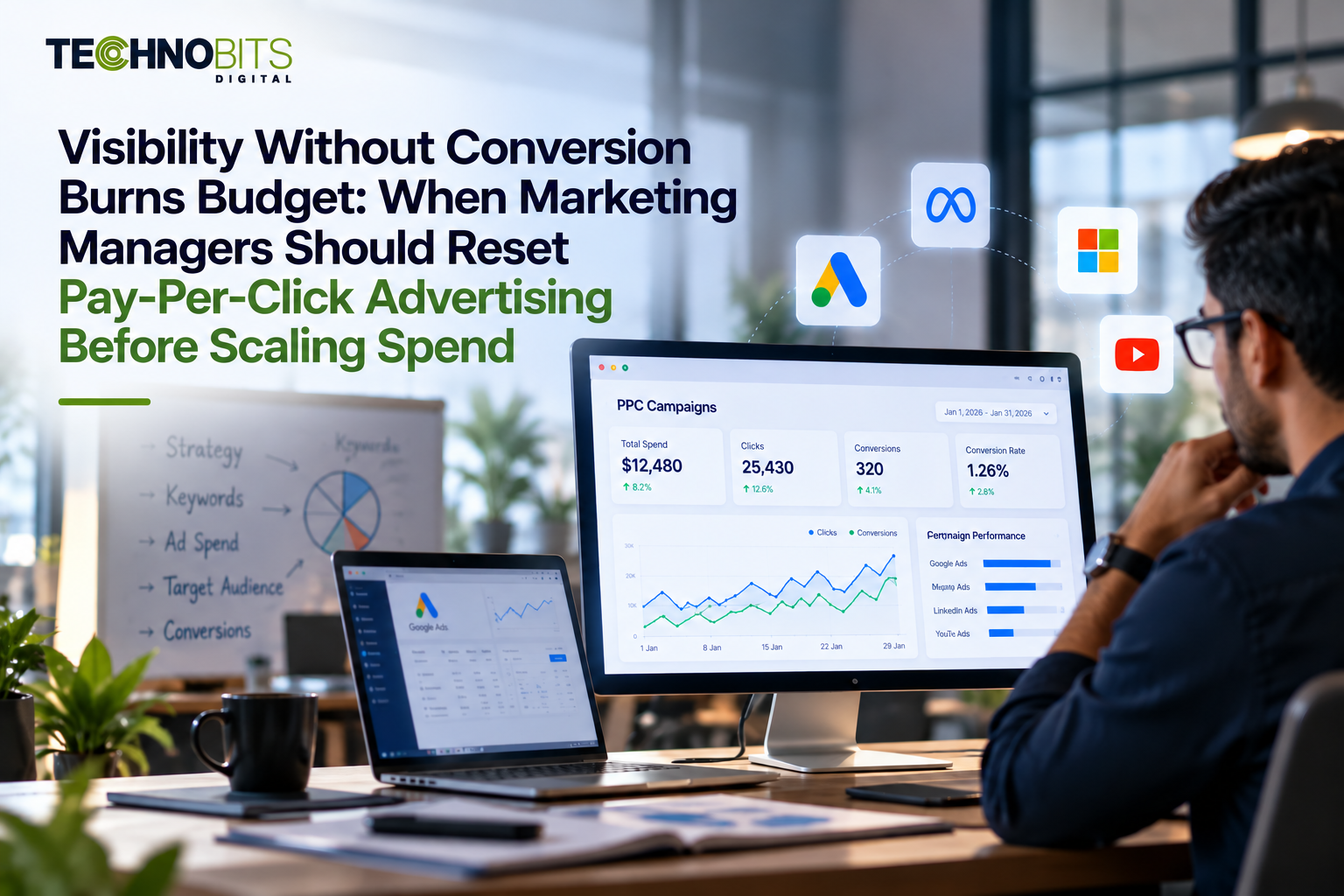
High impressions and rising click volume do not justify a larger advertising budget when qualified users fail to complete valuable actions. Marketing managers should reset a campaign before scaling when search terms do not reflect buyer intent, conversion tracking cannot be trusted, landing pages contradict the advertisement, or downstream sales data shows that recorded leads have little commercial value. More spend applied to those conditions usually buys additional uncertainty rather than dependable growth.
Effective Pay-Per-Click Advertising for online visibility requires more than bid management. The campaign is part of a conversion system connecting audience selection, advertisements, landing-page software, analytics, consent controls, customer relationship management platforms and sales follow-up. A reset should therefore diagnose the complete path from impression to qualified opportunity. Pausing weak segments while preserving useful data is often more rational than either stopping every campaign or increasing budgets across the account.
What Should Marketing Managers Evaluate Before Scaling PPC Visibility?
Begin by separating visibility metrics from business outcomes. Impressions indicate that a platform found opportunities to display an advertisement; they do not prove that the audience recognised the offer or had purchase intent. Click-through rate adds information about message relevance, but an appealing advertisement can still attract researchers, job seekers, existing customers or people outside the service area. Cost per click describes media efficiency, not commercial quality. Your primary measurement hierarchy should progress from qualified session to meaningful action, accepted lead, sales opportunity and completed transaction where the buying cycle permits that attribution.
Next, audit what the platform calls a conversion. Accounts frequently optimise towards page views, button clicks, chat openings or forms submitted without validation. These actions may be useful diagnostic events, but treating all of them as primary conversions can teach automated bidding to pursue cheap activity instead of valuable demand. Define one primary action for each campaign objective, assign secondary status to supporting interactions and remove duplicate events fired through both a tag manager and application code. Compare advertising-platform totals with analytics, backend and CRM records rather than expecting exact equality between systems with different attribution rules.
Managers should also evaluate whether the campaign has enough clean evidence to support expansion. Review performance by search term, geography, device, hour, audience, landing page and offer rather than relying on an account-wide average. A profitable brand campaign can conceal weak generic targeting, while one high-value transaction can distort a small sample. Before approving more spend, document:
The commercial action that each campaign is expected to produce.
The definition of a qualified lead and the reasons sales teams reject enquiries.
The attribution window and source of truth used for budget decisions.
The segments that may scale independently without subsidising weaker traffic.
The acceptable delay between advertising cost, lead validation and realised revenue.
Where PPC Conversion Paths Break Between the Search Query and Sales System
The first failure point is often targeting architecture. Broad matching can expose an offer to related queries that carry materially different intent, particularly when automated bidding has ambiguous conversion signals. A software consultancy bidding for “application development” might appear for tutorials, salaries, courses or consumer app builders. Search-term reviews, negative-keyword governance and tightly defined intent groups remain necessary even when machine learning controls auctions. Dedicated keyword optimisation should map queries to problems, buying stages and suitable pages instead of placing every variation into one campaign with one generic message.
The second break occurs when the landing experience fails to continue the promise made in the advertisement. A user searching for a specific integration service should not arrive on a broad corporate homepage and then navigate through several menus. The destination needs a matching proposition, evidence appropriate to the decision, a clear next action and usable performance on mobile connections. Slow rendering, intrusive consent interfaces, broken validation, inaccessible controls and hidden form errors all reduce completion. When page templates or publishing workflows prevent rapid correction, the issue may require CMS website development rather than another round of bid adjustments.
The third break is behind the visible form. A successful submission may not reach the CRM because of an API error, spam filter, webhook timeout or incorrect field mapping. Telephone calls may remain unattributed, and offline sales outcomes may never return to the advertising platform. Global campaigns add currency, language, time-zone and regional routing concerns: a valid enquiry can lose value if it reaches an unattended queue. Full-stack expertise matters because campaign optimisation depends on browser events, server-side processing, integrations and operational ownership working together. Structured system integration services can help connect those components without assuming that the advertising interface is the complete system.
Which Reset Criteria and Scaling Trade-offs Should Guide the Budget Decision?
A reset is appropriate when the account cannot answer basic questions about intent, measurement or commercial quality. It does not necessarily mean deleting campaign history or rebuilding every asset. Historical search terms, auction patterns and validated customer journeys may remain useful. The objective is to isolate unreliable elements and create a controlled baseline. Managers should distinguish an execution fault, such as a broken form, from an economic problem, such as acquisition costs exceeding the contribution available from a sale. One can be repaired technically; the other may require a different offer, audience or channel mix.
Use a staged decision process rather than one account-level threshold:
Verify primary conversion events in the browser, tag manager, analytics platform and destination system.
Reconcile recorded leads with accepted leads, opportunities and transactions where data is available.
Separate brand, generic, competitor, remarketing and experimental traffic so that their economics are visible.
Remove irrelevant queries, placements, locations and audience expansion that cannot support the campaign objective.
Align each retained intent group with a specific advertisement, landing page and follow-up route.
Run controlled tests before raising budgets, changing bidding strategy and replacing creative simultaneously.
The central trade-off is speed against interpretability. Aggressive automation can explore more auctions, but it also acts on the signals supplied to it. If low-quality form fills are marked as successful conversions, an algorithm may become highly efficient at finding more of them. Manual controls provide diagnostic clarity but can restrict useful exploration and demand more operational attention. AI-accelerated delivery can assist with query clustering, advertisement variants, anomaly detection and test documentation; human review must still verify factual claims, commercial fit and exclusion rules. Automation should shorten analysis and production, not decide what constitutes customer value.
Scaling also changes the traffic mix. Additional budget may move a campaign beyond the highest-intent auctions into more expensive or less qualified demand. Forecasts based on the existing average cost per acquisition can therefore be misleading. Establish marginal measures: how the next budget increment affects qualified lead cost, opportunity value and capacity for follow-up. If sales teams cannot respond promptly or operations cannot service more customers, media efficiency alone is insufficient. In some cases, coordinated search engine marketing can balance paid acquisition with organic demand capture instead of making PPC carry the entire visibility objective.
How Should the PPC Reset Be Implemented Across Campaigns, Pages and Data?
Start the reset with a measurement specification rather than new advertisements. List every tracked event, where it fires, whether it is primary or diagnostic, which identifiers pass between systems and how consent affects collection. Test real journeys across devices and browsers, including unsuccessful submissions and interrupted payment flows. Server logs and CRM timestamps can reveal failures that a platform dashboard cannot. For complex forms, portals or commerce journeys, custom software testing can examine validation, redirects, event duplication and integration behaviour alongside the visible interface.
Rebuild campaign structure around decisions you may need to make later. Separate materially different services, locations and intent levels when they require distinct budgets, landing pages or qualification rules. Write advertisements that state the offer precisely enough to deter unsuitable clicks; maximising click-through rate is not the only objective. Landing pages should answer the query, explain scope, address material objections and make the next step explicit. Supporting content development and distribution can provide comparison pages, technical explainers and case-specific resources for prospects who are not ready to submit a form on their first visit.
Then operate the relaunch as a sequence of controlled changes. Establish a baseline with corrected tracking, preserve campaign annotations and record why exclusions or budget shifts were made. Avoid judging a test solely by early clicks, but do not wait for statistical formality when a severe defect or obviously irrelevant search pattern is visible. Review lead samples with sales and operations teams, because campaign managers cannot infer qualification from platform events alone. Global multi-office support can assist when campaigns span regions, provided ownership, escalation routes, local review and handover procedures are explicit rather than distributed informally across time zones.
How Technobits Digital Connects PPC Delivery with the Wider Conversion Stack
Technobits Digital approaches a paid-search reset as a combined marketing and technology assessment. The work can cover account structure, search intent, advertisement-to-page continuity, event configuration, application behaviour and integration with operational systems. This model is relevant when an advertising agency owns media while internal developers own the website and a separate vendor administers the CRM. Without shared acceptance criteria, each component may appear functional while leads disappear at the boundaries. A defined owner should coordinate diagnosis, remediation, release checks and post-launch monitoring across the stack.
AI-accelerated delivery may support labour-intensive parts of the workflow, including grouping search terms, identifying tracking anomalies, comparing advertisement variants and drafting test cases. Outputs require review against the actual offer, brand constraints and conversion evidence. Technobits combines that assisted workflow with full-stack expertise so that recommendations can address code, CMS configuration, APIs and data flows where necessary. If social platforms form part of the acquisition mix, separate social media PPC services should use channel-appropriate audience and creative logic while sharing consistent qualification and measurement definitions.
The practical aim is not to make every campaign depend on a large engineering programme. Many corrections are configuration changes. Others expose technical debt that should be prioritised according to lost data, customer friction and implementation risk. A cross-functional assessment can identify which fixes belong in the advertising account, which require content or design, and which should enter the software backlog. That distinction gives marketing managers a defensible scaling plan rather than an open-ended request for more spend based on impressions and clicks.
Frequently Asked Questions About Resetting PPC Before Scaling
When should a marketing manager pause a PPC campaign?
Pause affected campaigns or segments when tracking is materially unreliable, destinations are broken, advertisements misrepresent the offer, or traffic is clearly irrelevant. A complete account shutdown may be unnecessary if brand or high-intent campaigns continue producing validated outcomes. Preserve data and document the reason for each pause so that relaunch decisions remain traceable.
Does a low conversion rate always mean the advertising is failing?
No. Conversion rate can fall because of poor targeting, weak message alignment, page defects, difficult forms, plans friction or delayed attribution. It can also decline when a campaign expands into broader demand. Diagnose the journey by segment and compare frontend events with backend outcomes before assigning the problem exclusively to media management.
Should automated bidding be disabled during a reset?
Not automatically. Automated bidding may remain useful when it receives sufficient, trustworthy conversion signals. If primary events are duplicated or dominated by low-value actions, temporarily using tighter controls can make diagnosis easier. The correct choice depends on account history, conversion volume, commercial objectives and the severity of the measurement defect.
How long should managers wait before increasing spend?
There is no universal period. The decision should depend on buying-cycle length, conversion volume, attribution delay and the stability of qualified outcomes. Managers need enough evidence to understand marginal performance, not merely an arbitrary number of days. Expensive or long-cycle services usually require sales-stage evidence beyond initial form submissions.
Can AI fix an underperforming PPC account?
AI can accelerate analysis, variation production and pattern detection, but it cannot independently define a commercially valuable conversion or repair organisational handoffs. Poor source data may cause automated systems to repeat the wrong behaviour at greater scale. Human owners must set objectives, validate recommendations and verify the complete customer journey.
Getting PPC Traffic but Not Enough Qualified Conversions?
Increasing spend is not always the first step. Search intent, campaign structure, landing-page experience, conversion tracking and downstream lead validation can all affect paid-search performance.
Technobits Digital provides SEO & SEM, PPC, Social PPC and related web-development capabilities that may support different parts of the conversion journey.