
Before Automating Search Marketing With AI: What Businesses Need to Prepare First
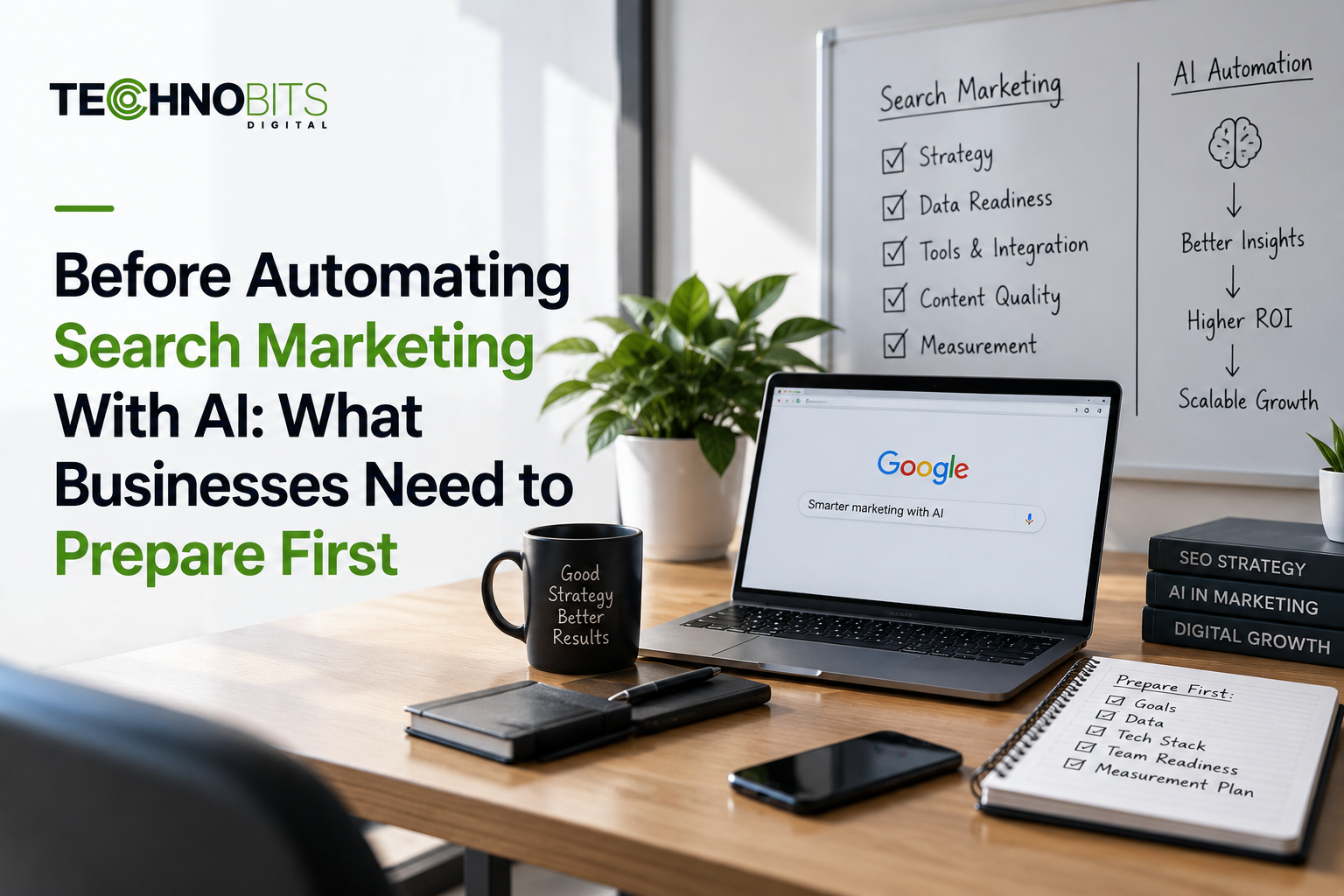
AI-driven search engine marketing should begin only when your commercial goals, website experience, conversion tracking and operational capacity are ready to work as one system. Launch too early and automated bidding may optimise against incomplete events, generated content may target the wrong intent, and campaign demand may reach a website that cannot convert it. Launch too late and you may miss useful query data, delay content validation or continue making budget decisions manually when automation could support faster testing.
For founders, CTOs and operations leaders, timing is therefore an architecture and governance decision rather than a marketing calendar choice. You need agreement on what constitutes a valuable conversion, which customer segments matter, how paid and organic search will interact, and where human approval remains mandatory. Effective search engine marketing also depends on data moving reliably between advertising platforms, analytics, the website, customer relationship management software and downstream sales systems. AI can accelerate analysis, campaign production and optimisation, but it cannot resolve conflicting commercial priorities by itself.
What Must Be Ready Before AI-Driven Search Engine Marketing Begins?
Start by defining the business event that the system should optimise. A form submission is not automatically a qualified lead, and an online purchase is not necessarily profitable after fulfilment costs, cancellations and returns. If advertising platforms receive only superficial conversion signals, automated bidding can pursue volume while reducing commercial quality. Your event model should distinguish actions such as product views, account creation, booked consultations, approved opportunities, completed purchases and repeat orders. Where appropriate, qualified or completed events can be returned from the CRM to the advertising platform. This gives optimisation systems a more meaningful signal than page visits or button clicks. Consent requirements, retention settings and access controls should be agreed before customer data begins moving across platforms.
Search intent must also be connected to the customer journey. Informational queries, comparison searches and transaction-ready terms require different pages, offers and measurement expectations. An AI system can cluster thousands of queries, identify semantic relationships and draft variations, but a commercial owner must decide which intent is worth serving. A software consultancy may want to separate searches for technical education from searches indicating an active implementation requirement. An online retailer may distinguish category discovery, product comparison, branded demand and post-purchase support. Structured keyword optimisation should map these intents to suitable pages rather than forcing every query towards the same landing page.
Platform readiness is the third gate. Inspect page speed, mobile behaviour, crawlability, structured data, accessibility, form reliability and content-management permissions before scaling acquisition. If campaign teams cannot publish or revise landing pages without unpredictable development delays, AI-accelerated delivery will remain constrained by the release process. A suitable CMS website architecture can support controlled page templates, reusable components, metadata management and editorial approval. However, template flexibility must not permit uncontrolled duplication or thin location pages. The search programme needs a clear relationship between content production, technical deployment and quality review.
A practical readiness checklist
Commercial definition: target products, customer segments, territories, margins and lead acceptance rules are documented.
Measurement design: primary and secondary conversions have owners, event specifications and validation procedures.
Website capacity: landing pages load reliably, support mobile users and explain the offer without depending on advertising copy.
Data governance: consent, access, retention and platform-sharing decisions are approved.
Operational follow-through: sales, fulfilment or customer service teams can respond to the demand campaigns may generate.
Where AI-Accelerated Search Programmes Lose Timing Alignment
One common failure occurs when paid campaigns, organic content and website releases operate on separate schedules. The advertising team launches around a product announcement, the content team publishes supporting articles several weeks later, and engineering releases the intended landing experience after demand has already peaked. AI increases production speed but can amplify this coordination problem by generating more assets than teams can review or deploy. A shared release plan should connect campaign activation, indexable content, product availability, analytics validation and sales enablement. The right date is not simply when advertisements are ready; it is when the complete path from query to operational response has been tested.
Another problem is allowing algorithms to learn from unstable or poorly labelled data. Tracking changes, consent-banner updates, duplicate tags and CRM field revisions can alter reported performance without any real change in customer behaviour. Automated bidding may then respond to instrumentation noise as if it were market evidence. Before increasing spend, compare platform conversions with analytics events, backend transactions and CRM records. Test event deduplication across browser-side and server-side implementations. If offline conversions are imported, verify identifiers, timestamps, currency handling and attribution windows. System integration services may support the connection between marketing platforms and operational software, but integration logic still requires an accountable data owner.
Content automation introduces a different timing risk. Publishing a large group of AI-assisted pages before subject-matter review can create overlapping intent, unsupported claims and internal competition between URLs. Search systems do not reward output volume by default; content must provide a useful answer and fit within a coherent site structure. Generated briefs and drafts should pass through factual review, brand review, originality checks, link validation and technical publishing controls. The same discipline applies to advertisement copy. AI can produce variants quickly, yet regulatory language, plans statements, geographic availability and product capabilities require human confirmation. Fast output should shorten preparation cycles, not remove accountability.
Premature scaling is especially expensive in pay-per-click advertising. A business may increase budgets after seeing early conversions without checking lead quality, incrementality or the delay between initial enquiry and revenue. Search demand can also change because of seasonality, competitor activity, product announcements or brand publicity. Decision-makers should establish a learning period based on conversion volume and sales-cycle characteristics rather than expecting immediate certainty from the algorithm. When evidence is sparse, tightly scoped experiments are usually more informative than broad automation across every market, device and audience.
Decision Criteria for Automation Scope, Channel Sequence and Control
The first trade-off is between narrow activation and broad data collection. A tightly defined launch may use a limited set of high-intent queries, selected locations and one conversion objective. This makes message quality and operational follow-up easier to inspect, but it can constrain the amount of data available to automated systems. A broader launch may discover unanticipated demand patterns, although it also increases exposure to irrelevant queries and ambiguous conversions. The appropriate scope depends on search volume, sales-cycle complexity, budget tolerance and the reliability of your measurement architecture. Businesses with low-frequency, high-value transactions often need stronger offline conversion feedback than retailers with frequent online purchases.
The second trade-off concerns channel sequence. Paid search can provide query and message feedback quickly, while organic visibility generally depends on crawling, indexing, content quality, authority and continuing technical maintenance. Running both as disconnected programmes wastes useful evidence. Paid query reports can expose terminology customers actually use; organic landing pages can improve relevance and provide durable educational coverage; conversion data can inform which themes deserve deeper investment. An integrated AI search and SEO/SEM approach should still preserve channel-specific evaluation. Paid attribution does not prove that an organic page will rank, and organic traffic does not show that every related query warrants advertising spend.
Decision | Earlier activation may suit | Delay or restrict activation when |
|---|---|---|
Automated bidding | Conversions are validated and reflect commercial value | Events are duplicated, sparse or disconnected from lead quality |
AI-assisted content | Editorial standards, reviewers and page ownership are established | Subject-matter claims cannot be verified before publication |
Campaign expansion | Landing pages and operational teams can absorb additional demand | Fulfilment, sales response or website performance is unstable |
Multi-market rollout | Local offers, language and tracking rules are defined | One global campaign is being used as a substitute for localisation |
The final trade-off is speed versus control. AI-accelerated delivery can reduce repetitive work in query classification, copy variation, reporting summaries and test preparation. Full-stack expertise remains necessary because campaign outcomes are affected by front-end performance, backend events, APIs, data models and CRM workflows. Establish approval thresholds according to risk. Low-risk keyword grouping may run with sampled review, while budget increases, claim changes and new data-sharing configurations should require named approval. Quality assurance should cover the complete conversion path, including advertisements, landing pages, forms, confirmation messages, analytics events and CRM creation—not merely whether a page renders.
How Should Technobits Digital Structure Search Marketing Implementation
A practical implementation begins with discovery across marketing, product, engineering and operations. Technobits Digital can help evaluate search marketing requirements across campaign strategy, website experience, analytics implementation, system integrations and quality controls. The appropriate approach depends on existing technology, business goals and operational requirements. The objective is not to add AI to every task. It is to determine where machine-supported classification, generation or optimisation can reduce repetitive work without weakening decision quality. Stakeholders should leave discovery with an agreed conversion hierarchy, target journeys, measurement gaps and an initial experiment boundary. For a multi-office organisation, this stage must also identify who controls global standards and which decisions remain with regional teams.
Implementation should proceed through controlled stages rather than a single platform switch. First, validate tracking in a non-production or low-risk context where possible. Next, create landing-page and campaign variants against explicit hypotheses, such as whether a technical comparison page attracts stronger opportunities than a general service page. Then activate a constrained campaign and review search terms, user behaviour, conversion quality and operational feedback. Only after those signals are credible should automation receive wider budget or audience freedom. This sequence supports AI-accelerated delivery while keeping humans responsible for commercial interpretation.
Map the search-to-revenue workflow: document queries, advertisements, pages, events, CRM stages and fulfilment outcomes.
Repair measurement dependencies: remove duplicate events, clarify attribution use and validate data transfers.
Define automation boundaries: specify which tasks AI can propose, execute or only summarise.
Run a bounded experiment: restrict market, intent, offer and budget variables so results remain interpretable.
Review commercial quality: combine platform reporting with sales acceptance, transaction or retention evidence.
Expand deliberately: introduce additional queries, regions or campaign types only when the operating model can support them.
Global multi-office support introduces timezone, localisation and governance requirements that should be designed into the workflow. A central team might own event definitions, account security, naming conventions and reporting logic, while regional owners approve language, offers, exclusions and operating hours. Shared dashboards need consistent currency, timezone and market labels so results are not combined incorrectly. Access should follow job responsibilities rather than broad account sharing. This operating model allows distributed teams to move quickly without allowing regional campaign changes to corrupt global measurement or brand controls.
What Should Business Owners Ask About AI Search Timing?
Should AI-driven search engine marketing start before a website redesign?
It can start before a redesign if the current website supports accurate tracking, relevant landing pages and dependable conversions. A restricted campaign may reveal useful intent and message evidence for the redesign. However, increasing acquisition while forms fail, mobile performance is poor or product information is inaccurate creates misleading performance data. Treat pre-redesign activity as controlled research, not automatic justification for scaling.
How much conversion data is required before automated bidding?
There is no universal threshold that fits every platform, market and transaction type. The more important questions are whether events are accurate, sufficiently frequent for the selected strategy and representative of business value. Sparse data may require simpler bidding controls, longer evaluation periods or imported offline outcomes. Platform recommendations should be examined alongside your sales cycle, margins and tolerance for exploration.
Can AI replace keyword research and campaign management?
AI can classify queries, identify patterns, draft variants and summarise performance more quickly than manual processing alone. It cannot independently decide which customer segments fit your strategy, whether a claim is supportable or whether a lead is commercially desirable. Experienced review remains important for negative keywords, search intent, landing-page alignment, budget changes and anomalous behaviour.
How should paid search and organic search be timed together?
Coordinate them around shared customer journeys, but do not expect identical delivery cycles. Paid campaigns can test messages and demand sooner, whereas organic pages need technical accessibility, useful content and time for search systems to process them. Publish foundational pages before major campaigns where possible, use paid evidence to refine content priorities, and avoid changing both channels so extensively that you cannot interpret the results.
Can AI improve search marketing without accurate conversion tracking?
No. AI-driven optimisation depends on the quality of the signals it receives. If conversions are incomplete, duplicated or disconnected from actual business outcomes, automated systems may optimise toward the wrong behaviours. Businesses should validate tracking, attribution and conversion definitions before increasing automation.
Planning an AI-Assisted Search Marketing Strategy?
AI automation works best when campaigns, website experience, analytics, CRM data and operational processes are aligned.
Technobits Digital can help assess your search marketing, website, analytics and integration requirements to identify where AI-assisted workflows may provide practical value.