When AI Cyber Defense Solutions Fail: What Marketing Managers Need to Understand About Risk Management
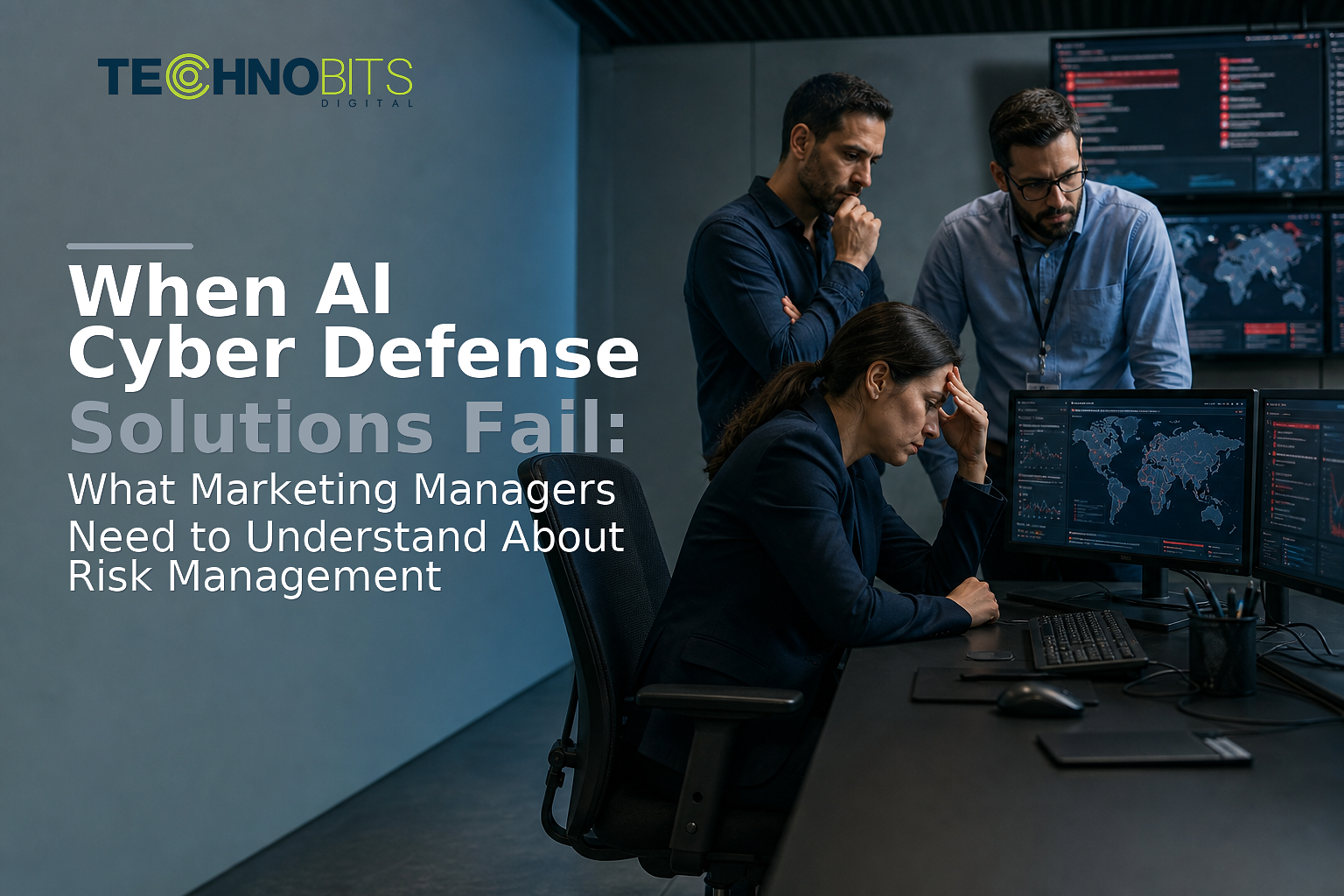
AI Cyber Defense can fail even when the underlying model is technically capable. The failure often occurs because the system receives incomplete telemetry, applies weak identity context, produces more alerts than analysts can investigate, or automates containment without sufficient business rules. For marketing managers, the resulting exposure is not confined to the security team. Compromised advertising accounts, manipulated website content, stolen customer data, fraudulent campaign redirects and inaccessible content platforms can interrupt revenue activity and damage customer trust.
Risk management therefore requires more than purchasing an AI-labelled security product. You need to understand which marketing assets are monitored, how the system reaches decisions, who validates high-impact alerts and what happens when automation makes the wrong call. A credible AI Cyber Defense assessment should connect security controls with websites, customer relationship systems, advertising platforms, analytics tools, content repositories and the external agencies that access them. AI can accelerate detection and investigation, but accountability for risk acceptance and incident response remains with people.
What Should Marketing Leaders Evaluate Before Trusting AI Security Decisions?
Begin with an inventory of the marketing attack surface rather than a product feature list. Typical assets include the corporate website, content management system, e-commerce platform, analytics tags, customer data platform, email automation service, social accounts, domain registrar and advertising accounts. Document administrators, service accounts, third-party integrations, authentication methods and the data available to each system. An AI tool cannot recognise abnormal behaviour reliably if relevant identity, endpoint, application and cloud events are absent. A login may appear legitimate in an advertising platform while endpoint telemetry shows that the user’s laptop was compromised shortly beforehand.
Next, determine what the solution actually means by AI. Some products apply machine learning to behavioural baselines, while others use language models to summarise incidents, generate investigation queries or recommend response actions. These functions carry different risks. Behavioural analytics may generate false positives when a campaign team changes working hours or launches in a new country. A generative assistant may produce a plausible but unsupported explanation of an alert. Automated response may disable an account or block an integration that supports a live campaign. Your evaluation should distinguish detection, prioritisation, explanation and enforcement rather than treating them as one capability.
You also need measurable decision boundaries. Identify which actions can run automatically, which require analyst approval and which must involve the asset owner. Quarantining an infected workstation may be appropriate for automated execution, while suspending a content management administrator during a major product launch may require human confirmation. Define the evidence needed for each decision, the acceptable interruption, the escalation contact and the recovery procedure. An IT security audit can help establish whether identities, permissions, configurations and logging are sufficient before AI-driven controls are permitted to act.
Where AI Cyber Defence Breaks Across Marketing Systems and Workflows
Visibility gaps are a common technical cause of failure. Security platforms may receive network and endpoint events but have limited information from marketing software delivered as a service. If audit logging is disabled, retained for too short a period or unavailable under the current subscription, investigators may not see who exported a customer list or changed a redirect. Tag managers, plug-ins and application programming interfaces create further blind spots because they can alter customer-facing behaviour without modifying the core website. Effective monitoring must cover identities, configuration changes, API tokens, privileged actions and data movement across the complete marketing stack.
Poorly tuned automation creates a different problem: the defence mechanism can become an operational incident. A model may interpret a sudden increase in form submissions as bot activity and block genuine campaign traffic. Geographic anomaly rules may challenge travelling executives or international agencies. Automated credential rotation may break integrations between a website, CRM and email platform. These outcomes are not arguments against automation; they show why response playbooks need business context, dependency mapping and rollback procedures. System integration engineering becomes relevant because security controls must account for how tokens, webhooks, databases and third-party services exchange information.
Human and governance failures remain important even when detection performs as intended. Alerts can sit unreviewed because ownership is unclear, severity labels do not reflect commercial impact or the security provider lacks access to the application team. Marketing personnel may also bypass controls when secure access processes are too slow for campaign deadlines. Establish an operating model that answers:
Who owns each website, domain, advertising account and customer-data integration?
Who can approve containment during business hours and outside them?
Which agencies and contractors retain privileged access?
How are false positives recorded and used to adjust detection logic?
Who communicates with customers, executives and suppliers after an incident?
A SIEM service can centralise and correlate security events, but centralisation alone does not resolve weak ownership. The event pipeline must map technical identifiers to recognisable assets and accountable teams. For example, an alert concerning an unfamiliar cloud resource is difficult for a marketing manager to assess; an alert identifying the affected campaign microsite, data types, integration owner and active launch window supports a faster business decision.
Decision Criteria for Detection Accuracy, Automation and Operational Cost
Product comparisons should begin with coverage and evidence quality. Ask whether the platform can ingest logs from your identity provider, endpoint estate, cloud environment, website infrastructure and critical marketing services. Confirm how it handles encrypted traffic, remote work, unmanaged agency devices and short-lived cloud resources. More data is not automatically better: duplicate, low-quality or poorly normalised events can increase processing costs and alert noise. Evaluate whether detections cite the source events, explain contributing signals and preserve enough evidence for an analyst to reproduce the conclusion.
The main trade-off is usually between response speed and the risk of harmful intervention. Full automation may reduce the time an attacker remains active, but false positives can interrupt campaigns or lock out legitimate administrators. Human approval adds control but can delay containment outside staffed hours. A tiered model is often more defensible: collect evidence automatically, enrich and prioritise the alert, execute low-impact controls and require approval for actions affecting revenue systems or customer access. Supporting firewall and network security should follow the same policy rather than applying broad blocking rules without application context.
Cost analysis must include more than software licensing. Data ingestion, log retention, connectors, analyst review, model tuning, incident exercises and integration maintenance all affect ownership. You should also examine vendor dependence, data residency, model transparency and the ability to export alerts and evidence if the platform changes. The following criteria can support a structured evaluation:
Decision area | Questions to ask | Trade-off to manage |
|---|---|---|
Telemetry coverage | Are identity, cloud, endpoint, website and marketing-platform events available? | Broader visibility increases data volume and integration work. |
Detection logic | Can analysts inspect the signals behind a risk score? | Complex models may improve correlation while reducing explainability. |
Automated response | Which actions require approval, and how are they reversed? | Faster containment may create greater operational interruption. |
Operating model | Who investigates alerts and owns each affected asset? | Extended coverage requires staffing or managed support. |
Data governance | Where are logs processed, retained and exported? | Longer retention supports investigation but increases cost and exposure. |
How Should AI Defence Be Implemented Across the Full Technology Stack?
Implementation should proceed as a controlled engineering programme, not as a single product activation. Start with high-value user journeys and assets: website publishing, administrator login, domain changes, customer-data exports, payment-related integrations and advertising-account access. For each one, map the identity flow, infrastructure dependency, expected behaviour and credible misuse case. Prioritise missing multi-factor authentication, excessive permissions, dormant accounts and unavailable audit logs before training behavioural models on an unreliable environment.
A practical sequence is:
Inventory marketing assets, owners, integrations and privileged identities.
Classify customer, campaign and operational data by sensitivity and business use.
Connect and validate telemetry from identity, endpoint, network, cloud and applications.
Establish baseline detections and test them against representative working patterns.
Define approval thresholds, containment actions, exceptions and rollback procedures.
Run incident simulations involving security, marketing, engineering and communications.
Review false positives, missed detections and architecture changes on a continuing basis.
AI-accelerated delivery can support connector configuration, detection-query drafting, alert summarisation and test-case generation. Those efficiencies require engineering review because generated rules may use unavailable fields, misunderstand vendor schemas or encode assumptions that do not match your environment. Detection content should be version controlled, peer reviewed and tested before release. Custom software testing can extend beyond functional checks to validate authentication controls, integration failures, malicious inputs and recovery behaviour across connected web and application services.
Full-stack expertise matters because marketing exposure crosses interface, application, API, database, cloud and network boundaries. A suspicious website change might originate from a stolen CMS account, a vulnerable plug-in, an exposed deployment token or a compromised developer workstation. Treating only the visible page misses the underlying control path. Global multi-office support can help coordinate incidents across regions and time zones, but buyers should still define handover procedures, escalation authority, local system ownership and a shared evidence record. Distributed coverage is useful only when every office follows the same severity model and response playbook.
What Should Marketing Managers Ask About AI Cyber Defence
Can an AI security platform replace a security operations team?
No. It may correlate events, prioritise alerts and automate defined response steps, but people must validate ambiguous findings, assess business impact and manage exceptions. Human review is especially important when containment could interrupt websites, customer communications, advertising accounts or partner access. The appropriate staffing model depends on system complexity, operating hours, incident tolerance and the maturity of existing controls.
Why does AI generate false positives during marketing campaigns?
Campaign activity often departs from historical baselines. Traffic may increase rapidly, teams may work outside normal hours, agencies may connect from new locations and automation platforms may perform large batches of API calls. A model can classify these changes as suspicious without campaign context. Change calendars, approved agency identities, asset ownership and temporary exceptions can improve interpretation, although exceptions should expire automatically and remain visible to security reviewers.
Should marketing control the response to a compromised platform?
Marketing should own commercial priorities and customer communications for its assets, but technical containment should follow an agreed cross-functional plan. Security personnel assess indicators and attacker activity; engineering teams understand application dependencies; legal and privacy specialists determine notification duties; marketing evaluates campaign and customer impact. Decision rights should be documented before an incident rather than negotiated while accounts or websites are unavailable.
How can a business test whether automated defence actions are safe?
Use staged exercises in a non-production environment where possible. Simulate account takeover, malicious content changes, suspicious exports and abnormal API activity, then observe detection, escalation, containment and rollback. Production tests require strict safeguards and approved windows. Quality assurance can help formalise scenarios, expected results, failure conditions and evidence capture so that security behaviour is evaluated alongside application functionality.
What Must Be Defined Before Approving an AI Security Programme
Before committing to a platform or implementation, define the protected assets, critical marketing journeys, available telemetry, data-retention requirements and acceptable automated actions. Record who owns each decision, how incidents are escalated and how disconnected services will be restored. You should also establish how model performance will be reviewed. Useful operational measures include alert investigation time, false-positive patterns, telemetry gaps, unsuccessful response actions and repeated incidents associated with the same identity or integration.
Need to Protect Your Marketing Technology Stack?
Marketing security depends on more than a single AI detection tool. Websites, advertising accounts, customer systems, integrations, identities and third-party access all need appropriate controls and clear incident ownership.
Technobits Digital can help assess relevant cybersecurity, SIEM, security-audit, application-security and integration requirements based on your current technology stack and risk profile.