Before Funding an AI Mobile App: Who Owns the Data, Testing, and Updates After Launch?
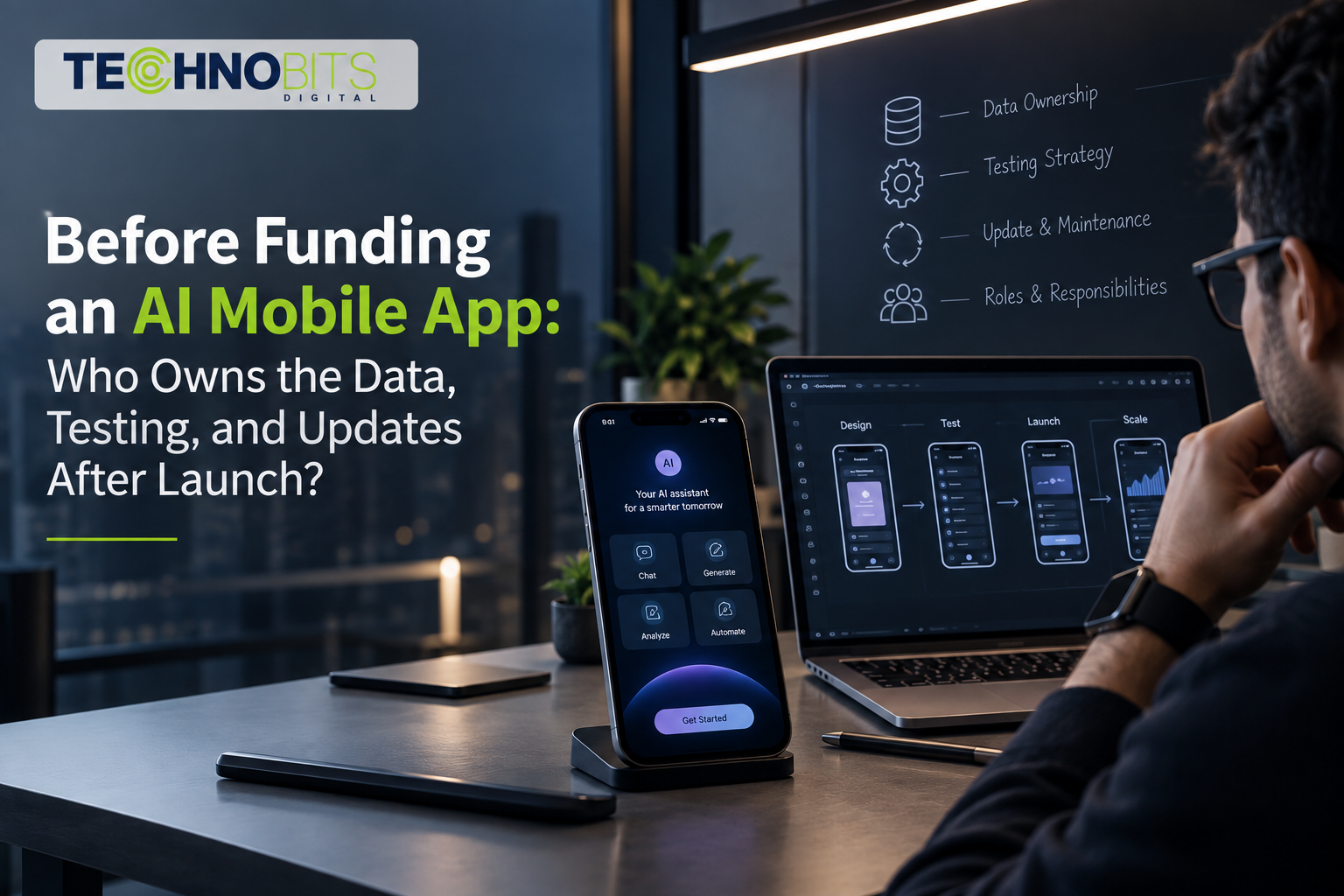
Funding an AI mobile app should include funding its post-launch operating model. Before approving development, you need written ownership for customer data, training and evaluation datasets, source code, model configurations, cloud accounts, app-store records, automated tests and release decisions. If those responsibilities remain with an individual developer or supplier account, your business may pay for an application without controlling the assets required to operate, audit or improve it.
AI mobile app development ownership is therefore broader than intellectual property. It determines who can access production data, investigate an inaccurate model response, replace an AI provider, approve an operating-system update and respond when an app-store policy changes. AI-accelerated delivery can shorten parts of design, coding and test generation, but it does not settle these commercial and technical questions. Founders and CTOs should define them before signing a build contract, not during the first production incident.
What Ownership Must Be Defined Before an AI Mobile App Is Funded?
Start with an asset register that separates business information from technical implementation. Business-owned assets normally include customer records, transaction histories, uploaded files, behavioural events, support conversations and any proprietary material used to evaluate or customise the AI. Technical assets include source repositories, build scripts, infrastructure definitions, API specifications, prompt templates, retrieval indexes, test suites and deployment credentials. The agreement should state where each asset is stored, who can export it and what happens to copies held by a supplier when the engagement ends. A statement that “the client owns the app” is not enough if the client cannot access the repository, reproduce a production build or retrieve its data in a usable format.
AI introduces a second ownership layer: the model may be externally licensed even when the application code belongs to you. Document whether the app uses a hosted model API, an open-weight model, a mobile-optimised on-device model or a combination of services. Identify who owns prompts, system instructions, retrieval content, embeddings, fine-tuning artefacts and human evaluation records. Provider terms should also be checked for data retention, model-training use, regional processing and deletion controls. For an AI mobile app development engagement, these dependencies should appear in the architecture and supplier register rather than being hidden inside a single software-development line item.
Platform control matters just as much as code ownership. The business should normally control its Apple and Google developer accounts, domain names, cloud tenancy, analytics properties, notification certificates and production secrets. Developers can receive role-based access without becoming the permanent account owner. Native platform decisions should also be documented separately: Android app development must account for device fragmentation, permission changes and target API requirements, while iOS app development depends on signing identities, provisioning, privacy declarations and App Store review. If these records sit only in a contractor’s personal account, changing suppliers can become an operational recovery exercise.
Finally, assign decision ownership rather than only asset ownership. A product owner should approve intended AI behaviour and acceptable user outcomes. Engineering should own implementation integrity, observability and rollback procedures. A data owner should authorise collection, retention and reuse. Quality specialists should define release evidence, while security and operations leaders should control access and incident handling. Smaller businesses may assign several roles to one person, but the decisions still need distinct names. A simple responsibility matrix can expose gaps before development begins:
Asset or decision | Business accountability | Delivery responsibility | Required evidence |
|---|---|---|---|
Customer and operational data | Data owner | Backend and platform team | Data map, retention rules and export procedure |
AI behaviour | Product owner | AI and application engineers | Evaluation set, acceptance thresholds and escalation rules |
Mobile release | Product or technology leader | Mobile engineering and QA | Test report, approvals and rollback plan |
Production access | Technology or security owner | Platform operations | Access register, audit logs and recovery process |
Where Post-Launch Data, Testing and Update Control Breaks Down
Data control commonly fails when the mobile interface is treated as the whole product. A user request may travel from the device to an API gateway, identity service, application database, vector store, AI provider, analytics platform and customer-support system. Each component may keep logs or derived records. Deleting a customer account from the primary database does not necessarily remove prompt traces, cached responses, exported support tickets or embeddings. Before launch, map each data flow, its purpose, retention period, storage region and deletion mechanism. That map should include development and test environments because copied production data can create exposure even when the live platform is properly governed.
Testing breaks down when teams validate screens but not AI behaviour. Conventional mobile checks remain essential: installation, authentication, offline states, accessibility, battery use, network interruption, API failure and compatibility across supported operating-system versions. AI functions require additional evaluation for factual accuracy, unsafe output, prompt injection, irrelevant retrieval, inconsistent formatting and inappropriate use of personal information. A credible custom software testing plan combines deterministic checks with scenario-based evaluations. For example, a financial document assistant should be tested with missing pages, contradictory documents, ambiguous questions, unsupported requests and attempts to make the model ignore its governing instructions.
Update ownership often remains vague until an external dependency changes. Mobile operating systems deprecate APIs, device vendors alter background behaviour, app stores revise submission rules and AI providers release new model versions. Even an apparently compatible model upgrade can change tone, latency, output structure or tool-selection behaviour. Your release policy should specify who monitors dependencies, who assesses impact and who has authority to postpone or reverse an update. Production observability should track application crashes, API errors, model refusals, response latency, token or inference consumption and user-reported quality issues. Without versioned prompts, model identifiers and release records, the team may be unable to explain why behaviour changed.
Which Commercial and Architecture Trade-Offs Should Shape Ownership?
The first trade-off is speed versus portability. A hosted AI API can reduce initial infrastructure work and provide access to managed capabilities, but the application may become dependent on provider-specific message formats, tool-calling conventions, safety controls and plans structures. A portability layer can standardise requests and logging across providers, although it introduces code that your team must maintain. On-device inference can support lower network dependence and stronger local processing for suitable use cases, but model size, battery consumption, device capability and update distribution become constraints. The correct option depends on the sensitivity of the data, required response time, expected request volume and the business cost of provider change.
The second trade-off concerns AI-accelerated delivery. Coding assistants can produce interface scaffolding, test cases, documentation and routine integration code more quickly, but generated output still needs architectural review and traceable acceptance. Your contract should clarify whether generated code becomes part of the delivered source, which tools may receive proprietary material and how third-party package licences are checked. Code-review rules should apply regardless of whether a person or tool drafted the implementation. For higher-risk functions, quality assurance should assess requirements coverage, while AI quality assurance should examine model outputs, evaluation drift and adversarial scenarios.
The third trade-off is supplier convenience versus operational independence. A delivery partner may manage cloud resources and releases during development, but the business should decide which capabilities must be transferable on exit. Full independence requires documentation, reproducible builds, accessible repositories, infrastructure definitions and named support procedures. It may cost more than accepting a supplier-managed environment, yet it reduces dependence on undocumented knowledge. Conversely, forcing every capability in-house can create an operating burden that a small team cannot support. Evaluate the intended model explicitly:
Business-operated: your internal team controls deployment, monitoring and incident response after handover.
Partner-operated: the supplier maintains the platform under defined access, service and exit arrangements.
Shared operation: the business owns accounts and approvals while the partner performs agreed engineering and support tasks.
Transition model: the partner operates early releases while documentation, access and knowledge transfer prepare an internal team.
Commercial evaluation should then connect ownership to total operating responsibility. Ask who pays for model usage, vector storage, observability, notification services, app-store memberships and device testing. Define how defects are distinguished from enhancements and how mandatory platform updates are prioritised. An inexpensive initial build can become difficult to maintain if it lacks automated deployment, modular interfaces or testable AI boundaries. The funding decision should cover not only feature production but also the engineering controls needed to run the application after the first release.
How Should Technobits Digital Structure the Build and Handover?
A practical engagement begins with discovery across product, data, architecture and operations. Technobits Digital can map the mobile journey from user action through backend services and AI processing, identifying where personal, commercial or regulated information moves. Full-stack expertise matters because an AI feature rarely exists only inside the mobile client. It may depend on identity, business rules, databases, integrations, model gateways, administrative interfaces and monitoring services. Where an app must exchange records with existing platforms, system integration services can address API contracts, event flows, error handling and reconciliation rather than relying on fragile point-to-point connections.
The delivery plan should establish business-controlled environments and an auditable release path. A suitable workflow normally includes separate development, test and production configurations; protected source branches; automated build checks; secret management; versioned database changes; and documented app-store submission procedures. AI components should add version-controlled prompts, model settings, retrieval configurations and evaluation datasets. Automated tests can provide rapid feedback, but release approval should include human review of high-impact scenarios. The resulting evidence should show what was tested, which versions were used, which defects remain accepted and how the previous stable release can be restored.
Post-launch support must be designed around observable responsibilities. Technobits Digital’s global multi-office support model may support coordination across engineering and operational windows, but the engagement still needs named communication channels, severity definitions, access rules and escalation ownership. Monitoring should distinguish mobile failures from backend, integration and model failures. A slow answer, for instance, could result from device connectivity, an overloaded API, retrieval latency or the AI provider. Diagnostic logs need enough correlation to trace the request without recording unnecessary customer content. Security review may also include IT security audits where access, infrastructure and application controls require structured assessment.
Document the product owner, data owner, technical owner and release approver.
Create an inventory of repositories, accounts, models, integrations and third-party services.
Define acceptable AI behaviour using representative and adversarial evaluation scenarios.
Build repeatable deployment, rollback and app-store release procedures.
Transfer documentation, credentials and operational knowledge according to the agreed support model.
Review model, platform and dependency changes through a controlled update process.
What Should Business Owners Ask About AI App Ownership?
Should the business own every component used by the application?
No. Many applications depend on licensed frameworks, cloud services, operating-system components and external AI models. The important distinction is between ownership and control. You should know which assets are owned, licensed or supplier-managed; whether data can be exported; whether the app can be rebuilt; and what happens if a service becomes unavailable. Contract schedules should list material third-party dependencies and the operational consequences of replacing them.
Who owns data produced from model interactions?
The answer depends on contracts, privacy obligations and provider terms. User prompts, model responses, embeddings, feedback labels and evaluation records may have different treatment. Your organisation should define the business purpose for each category, restrict access and document retention. Do not assume that owning customer records automatically settles rights over derived datasets or permits their use for model improvement.
Can automated testing approve an AI mobile release?
Automated tests can verify repeatable conditions such as API schemas, permission rules, crash paths and known model-evaluation cases. They cannot determine every contextual or reputational risk. High-impact workflows need human review, particularly where output can influence financial, health, employment, safety or sensitive customer decisions. Release authority should remain with a named person who can interpret both technical evidence and business consequences.
Who is responsible when an AI provider changes its model?
The contract should assign monitoring to a technical owner and acceptance to the product or business owner. The team should test changed models against a stable evaluation set before production adoption. If a provider retires a version, the architecture should define migration, fallback or feature-restriction options. Automatic upgrades without regression evidence can introduce behaviour changes that ordinary mobile interface tests will not detect.
What must be delivered if the development relationship ends?
An exit package should cover current source code, build instructions, infrastructure configuration, database schemas, API documentation, test assets, model and prompt versions, dependency records, app-store access, operational procedures and unresolved defects. It should also explain data return or deletion obligations. Credentials should be transferred through secure mechanisms and then rotated rather than copied into documents or email.
What Must Be Agreed Before Approving the AI Mobile App Budget?
Before you fund the build, define the business outcome, supported user journeys, prohibited AI behaviours, data boundaries and release authority. Confirm which accounts the business will own, which services will be licensed and which operational activities remain with a delivery partner. The budget should include evaluation design, device coverage, security controls, observability, app-store maintenance and dependency updates—not merely interface development and model integration.
Technobits Digital can assess the proposed mobile architecture, ownership boundaries, full-stack dependencies, AI evaluation approach and post-launch operating model. That assessment can help convert a feature proposal into a build and handover plan with explicit responsibilities, without assuming that every organisation needs the same technology stack or support arrangement.
Planning an AI Mobile App?
Before approving development, define who will control the data, source code, model configuration, developer accounts, testing evidence and post-launch updates.
Technobits Digital can help assess the relevant mobile development, software integration, testing and security requirements based on your application's architecture and intended use.