
Low Engagement Persists After Content Volume Rises: Which Decisions Should Marketing Managers Hand to AI Growth Marketing?
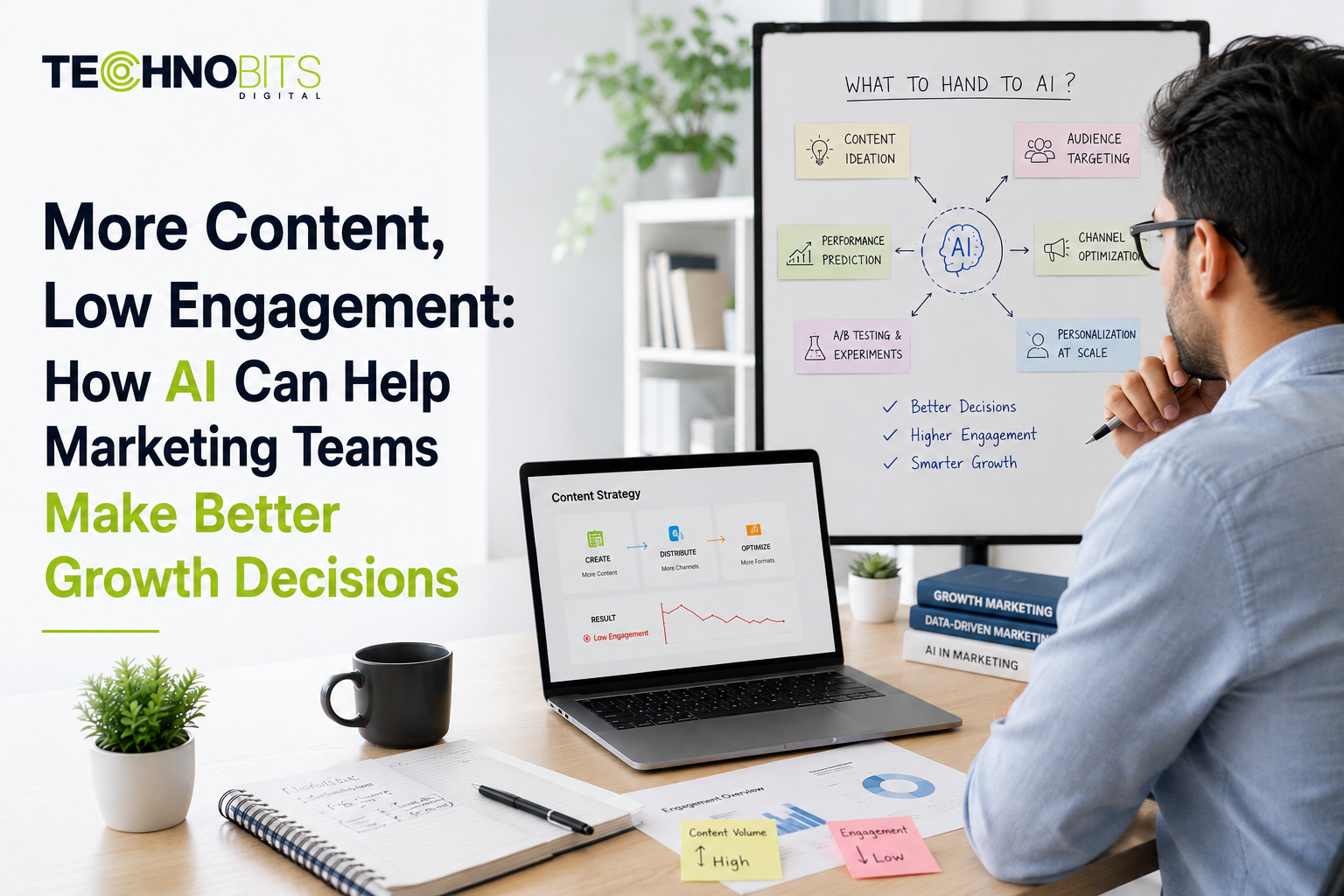
When publishing volume rises but meaningful engagement does not, the next decision should not be “produce even more”. Marketing managers should use AI to classify audience intent, identify content fatigue, detect distribution gaps, prioritise experiments and recommend channel-specific variants. They should retain human control over positioning, brand judgement, customer promises, budget thresholds and any response carrying reputational or regulatory risk. This division makes AI Growth Marketing for low engagement a decision system rather than a faster content generator.
Low engagement can mean weak click-through rates, limited qualified website sessions, short content consumption, declining saves or shares, low email response, poor trial progression or conversations that never reach sales. These signals do not all describe the same problem. Increasing output without separating acquisition, message, format, audience and conversion variables produces more data but little evidence. The practical task is to connect marketing platforms, website analytics, search data and customer records so that AI can compare decisions against commercial outcomes rather than superficial activity.
Still scoping the build?Request a technology consultation to talk through the requirement.
Diagnose Whether Content Volume, Audience Fit or Measurement Is Suppressing Engagement
Begin by defining engagement for each stage of the journey. An awareness video may be evaluated through completion rate, qualified profile visits and assisted website sessions. A product-comparison page should be assessed through relevant search queries, feature exploration, return visits and movement towards an enquiry or trial. A customer email may need reply rate, account activation or renewal-related actions. Combining these into one engagement score can obscure intent because a video view and a sales-qualified enquiry carry different business meaning. Your measurement model should therefore record event name, user or account segment, content asset, channel, campaign, journey stage and the next commercially relevant action.
Instrumentation must be checked before an AI system interprets performance. Duplicate analytics events can inflate interaction counts, consent settings may change the observable audience, and inconsistent campaign parameters can fragment one initiative across multiple reports. Social platforms also define views and engagement differently, while customer relationship management records may use another attribution window. Create a tracking specification covering event triggers, naming conventions, source fields, identity resolution and exclusions for internal traffic. If marketing, analytics and engineering teams cannot reproduce the same conversion path, an AI recommendation engine will learn from conflicting labels and may promote channels that only appear effective.
Once the measurement layer is credible, segment the problem. Compare new and returning visitors, decision-makers and practitioners, branded and non-branded search, paid and organic acquisition, mobile and desktop sessions, geographic markets, and early-stage versus purchase-stage content. Keyword optimisation can expose a mismatch between the terms attracting visitors and the questions your offer actually answers. Meanwhile, community management can reveal recurring objections or vocabulary that campaign dashboards miss. AI can cluster these observations, but a marketing manager must decide which audience and commercial objective deserve priority.
Assign Pattern Detection and Experiment Prioritisation to AI, Not Brand Accountability
AI is most useful when a marketing decision involves many repeatable comparisons. It can classify comments by topic, group search queries by intent, score content against a controlled message framework, identify unusual performance changes and generate hypotheses for underperforming segments. For example, if technical buyers repeatedly reach an architecture article but rarely open the associated product page, AI can compare page sequence, query intent, device, referral source and call-to-action exposure. The output should be a testable proposition such as “offer an implementation checklist before a sales request”, not an unsupported instruction to rewrite the entire campaign.
Managers should retain decisions that require commercial context or accountability. AI should not independently change product positioning, approve an unverified performance claim, respond to a sensitive customer complaint, redefine an ideal customer profile or move substantial media budget between markets. Those choices depend on contractual commitments, competitive strategy, cultural context and the organisation’s tolerance for risk. Human approval is also appropriate when a model cannot show the evidence behind a recommendation. An AI-generated probability or ranking can inform judgement, but it does not establish why an audience behaved in a particular way.
Marketing decision | Suitable AI role | Human responsibility |
|---|---|---|
Audience and intent analysis | Cluster queries, comments, behaviours and CRM notes | Approve target segments and exclusions |
Content prioritisation | Rank gaps using demand, engagement and journey data | Set product narrative and editorial value |
Creative experimentation | Generate controlled headline, format and visual variants | Review accuracy, brand fit and usage rights |
Distribution timing | Recommend channel, frequency and publication windows | Set fatigue limits and market constraints |
Paid media allocation | Surface marginal cost and conversion patterns | Approve budgets, bids and commercial thresholds |
Community responses | Classify urgency and draft routine replies | Handle escalations, complaints and sensitive issues |
For an AI-assisted growth marketing workflow, a well-designed implementation should make recommendations traceable to supporting inputs and use defined approval routes for consequential actions. It should not become an opaque publishing queue. Connect each proposed action to a measurable hypothesis: the affected audience, the content change, the expected behavioural signal, the evaluation period and the stopping rule. If the result cannot be traced back to source data and a business question, it is automation without dependable decision support.
Build an AI Growth Workflow Around Evidence, Experiments and Feedback
A practical implementation starts with a decision inventory rather than a model selection exercise. List recurring choices such as which topic enters production, which asset receives paid distribution, which audience sees a variant, when a campaign is paused and which community issue needs escalation. For every decision, record available data, decision frequency, consequence of error and required approver. High-frequency, reversible choices are often strong automation candidates. Infrequent decisions affecting plans, market positioning or customer trust should remain closely supervised even if AI prepares the evidence.
Establish a baseline: record engagement and downstream conversion by audience, asset, channel and journey stage before changing production.
Select one decision: test topic prioritisation, distribution timing or creative variation rather than automating the full marketing operation.
Create an evaluation set: use representative historical examples, edge cases and known poor recommendations.
Define guardrails: specify prohibited claims, excluded audiences, budget limits, tone requirements and mandatory approvals.
Run a controlled experiment: compare the AI-assisted process with the existing workflow using equivalent segments where practical.
Review downstream quality: examine qualified actions, sales acceptance and retention signals, not only platform engagement.
The supporting architecture commonly includes channel APIs, a web analytics platform, a customer data or CRM layer, a warehouse, an orchestration service and a reporting interface. Retrieval can supply the AI system with product facts, approved terminology and current campaign rules. Structured outputs should capture recommendation type, evidence references, affected segment, confidence, owner and approval status. Full-stack expertise matters because a useful marketing recommendation may require changes across tracking code, website components, data pipelines, campaign tools and sales integrations. System integration services can help align these components when disconnected platforms prevent reliable attribution.
AI-accelerated delivery should shorten analysis and controlled iteration, not remove quality checks. A model can draft several content treatments while content development and distribution specialists assess whether each treatment answers the intended question and fits the channel. Similarly, automated testing can verify links, event payloads, content fields and audience rules before release. Version prompts, scoring logic, templates and data transformations so that a weak recommendation can be investigated and rolled back. Marketing operations become more dependable when campaign changes are treated as traceable releases rather than informal edits.
Control Model Bias, Content Fatigue and False Attribution Before Scaling
Historical data can preserve yesterday’s audience and channel preferences. If previous campaigns concentrated on one market or format, a recommendation model may repeatedly favour that pattern because it has more observations, not because it represents the strongest future opportunity. Popular posts can create another feedback loop: higher initial distribution produces more engagement, which causes the system to recommend more of the same. Counter this with minimum exploration budgets, segment-level evaluation and explicit diversity constraints across topics, formats and funnel stages. Managers should inspect who receives less exposure as well as who appears to perform well.
Generative variation can also accelerate fatigue. Changing a headline, image and opening sentence does not create a new proposition if every asset repeats the same claim. Track semantic similarity, publication frequency and audience overlap alongside conventional engagement. A social media strategy should define the distinct role of educational material, product evidence, customer support, category commentary and conversion campaigns. AI may recommend the mix, but editorial owners should decide when repetition supports memory and when it reduces trust or causes audiences to ignore the brand.
Do not optimise solely for likes, impressions or inexpensive clicks when qualified actions are the objective.
Do not train recommendations on personally identifiable or restricted data without an approved purpose and access controls.
Do not let generated copy introduce product capabilities, prices or customer claims absent from approved sources.
Do not allow one platform’s attribution model to become the organisation’s sole account of performance.
Do not scale an experiment until tracking, audience allocation and downstream conversion quality have been reviewed.
Attribution remains a limitation even with a well-designed system. A prospect may read an organic article, see a social post, return through branded search and later respond to an email. Platform reports may each claim influence, while privacy controls and cross-device behaviour leave gaps. AI can estimate relationships and identify recurring paths, but it cannot convert incomplete observational data into certainty. Use incrementality tests, holdout groups and controlled geographic or audience comparisons where feasible. For paid acquisition, pay-per-click advertising should be evaluated against lead quality, sales progression and contribution logic rather than platform-reported conversions alone.
Use Engagement Questions That Expose Whether AI Is Improving the Decision
Should AI decide which content topics are produced?
AI can rank candidate topics using search demand, customer questions, content gaps, engagement history and relevance to the buying journey. It should not make the final editorial choice without considering product direction and organisational knowledge. A low-volume technical question may be commercially valuable if it is asked by buyers close to implementation, while a high-volume trend may attract readers who will never need the service. Require topic recommendations to state the intended audience, evidence source, journey role, competing content and proposed next action. This makes the decision reviewable and prevents search volume or social popularity from dominating the plan.
Can AI determine why engagement declined?
AI can identify correlations, anomalies and likely contributors, but it cannot establish causation from dashboards alone. A decline may follow an algorithm update, audience saturation, weaker distribution, seasonality, slower page performance, an altered consent configuration or a shift in campaign mix. Ask the system to present competing explanations and the evidence required to distinguish them. Marketing managers can then commission a controlled test, inspect platform changes or ask engineering to validate tracking and website behaviour. A diagnosis is stronger when independent signals agree, such as lower qualified search visibility, reduced content completion and fewer CRM opportunities from the same segment.
When is an AI growth system ready to expand across markets?
Expansion should follow repeatable governance, not one successful campaign. Confirm that taxonomies, event definitions and CRM stages mean the same thing across offices; otherwise, the model will compare incompatible outcomes. Local teams must review language, cultural references, channel conventions and legal constraints. Global multi-office support can help maintain one technical framework while preserving market-level approvals and reporting. The system should also tolerate unavailable data and regional platform differences rather than filling gaps with assumptions. Scale first to a market with comparable audiences and infrastructure, then compare recommendation quality, operational effort and downstream commercial relevance before extending the workflow again.
What Must Be Defined Before Funding an AI Growth Marketing System?
Before commissioning a build, define the engagement problem in operational terms: which audience is under-engaged, on which channel, at what journey stage and relative to which desired action. Document current data sources, tracking gaps, campaign approval rules, content ownership and the consequences of an incorrect recommendation. You should also decide whether the first release will prioritise analysis, recommendation, content assistance or controlled execution. Combining all four at once makes it difficult to determine which component improved or weakened performance.
Technobits Digital can assess the measurement layer, channel integrations, content workflow and decision boundaries needed for an AI-assisted marketing operation. That assessment may combine marketing strategy with analytics engineering, website implementation, automation and quality assurance. This is where a digital-solutions partner differs from a standalone content tool: the engagement problem may sit in campaign logic, but it may also require event instrumentation, CRM mapping, API integration or conversion-interface changes. The appropriate scope depends on the evidence available and the decisions your team is prepared to delegate.
Technobits Digital provides digital marketing, software, integration and AI-related capabilities that may support different parts of an AI-assisted marketing workflow. Depending on the requirement, a project may involve analytics implementation, system integration, website changes, content workflows or controlled automation.A planning engagement should establish a bounded first use case, evaluation criteria, human approval model and integration requirements before automation expands. This creates a practical basis for deciding whether AI can improve engagement decisions without increasing content noise or weakening accountability.
Want to Understand Why Marketing Engagement Is Staying Low?
Increasing content volume is not always the answer. The first step is understanding whether the problem sits in audience targeting, content relevance, distribution, measurement, conversion tracking or the connections between marketing systems.
Technobits Digital can help assess the relevant marketing, analytics and technology requirements and identify where AI-assisted analysis or automation may be appropriate.
Discuss Your Digital Marketing Requirements
Planning an AI Product or Feature?
Before expanding an AI build, define the workflow, test the critical assumptions and determine what the production system actually needs across data, model integration, software architecture, security and evaluation.
Technobits Digital can help assess the technical requirements and determine whether the appropriate next step is a focused prototype, integration project or production-oriented AI application.