
How Search Engine Metrics Mask Engagement Issues—and the Cost of Ignoring AI Search & Optimization
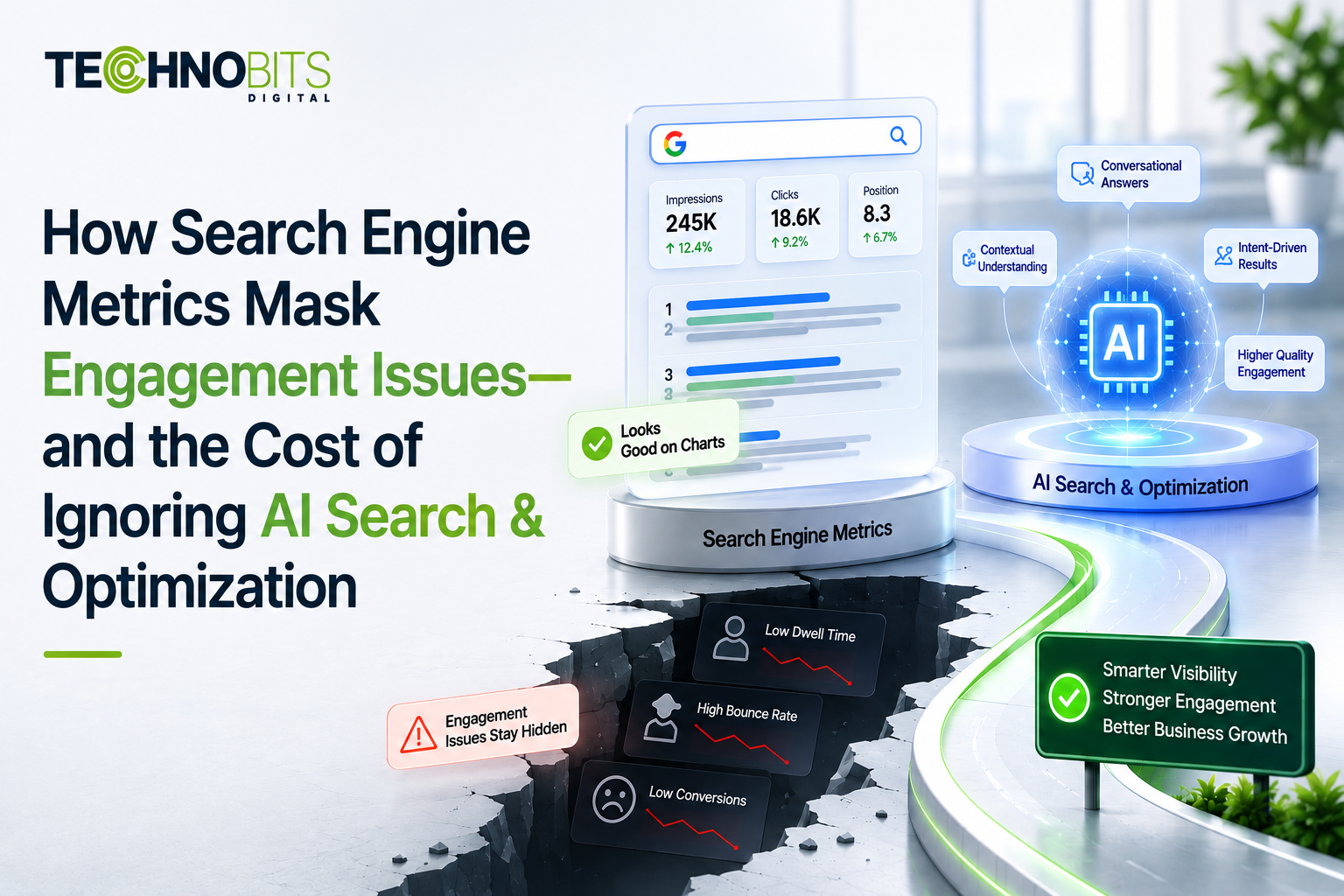
High impressions, improving rankings and stable organic sessions can coexist with weak commercial engagement. A page may rank for a broad informational query while attracting visitors who never examine the product, return to the site or progress towards an enquiry. At the same time, prospects may receive their answer inside an AI-generated search summary without producing a conventional click. If your reporting stops at rankings, traffic and aggregate conversions, these behaviours remain largely invisible.
AI Search & Optimization addresses this measurement gap by connecting conventional search performance with answer-engine visibility, content usefulness, on-site behaviour and commercial progression. It does not make established SEO irrelevant. Technical accessibility, crawlability, authority and relevant keywords still matter. The difference is that search now includes generated answers, conversational follow-up questions and citations assembled from multiple sources. Founders and technology leaders therefore need to measure whether their content is understood, referenced and useful—not merely whether a blue link appears on a results page.
Still scoping the build?Request Consultation to talk through the requirement.
Why Rankings and Organic Sessions Can Conceal Weak Engagement
Traditional search metrics describe acquisition more reliably than they describe satisfaction. Impressions show that a result was eligible to appear. Average position approximates where it appeared across queries and contexts. Organic sessions record a visit, but not whether the visitor found the expected answer. Even click-through rate can be misleading when branded queries, navigational searches and high-intent product terms are combined with broad educational traffic. A rising aggregate can obscure declining performance among the queries that matter commercially.
Engagement must be interpreted against page purpose. A technical definition page may satisfy intent in one short visit, making a low session duration unsurprising. A software comparison page should produce different signals: specification views, architecture-document visits, plans exploration, return sessions or contact progression. Measuring both pages against a universal engagement threshold creates false alarms on one page and false confidence on the other. Your analytics model needs an explicit purpose, audience and expected next action for every important content type.
Search summaries create another blind spot because a user can consume your information without entering your website. A search platform may synthesise an answer, display attributed sources and satisfy the query within its own interface. This can reduce clicks even when your material contributes to discovery. Conversely, an AI citation does not automatically indicate commercial influence. A useful measurement framework must separate source visibility, attributed mentions, referred sessions and subsequent pipeline activity rather than treating every appearance as equivalent value.
Where AI Search Changes the Discovery and Evaluation Journey
Conventional search often presents a list of pages for the user to evaluate. AI-assisted search can perform some of that evaluation first: summarising alternatives, comparing capabilities, extracting definitions and answering follow-up questions from the initial prompt. A buyer researching data integration, for example, may ask an engine to compare event-driven and batch architectures, identify operational trade-offs and suggest vendor-evaluation questions. The eventual website visit occurs later and may arrive with considerably more specific intent.
This shift changes the role of content architecture. Isolated keyword pages are less useful when a system must determine whether your organisation has coherent expertise across a topic. Clear entity descriptions, consistent service terminology, linked technical explanations, structured headings and evidence-supported claims can make content easier for both people and machines to interpret. Technobits Digital’s SEO & Analytics and AI Search & Visibility capabilities can support this broader approach to search discovery and measurement.
Search optimisation should consequently account for several discovery surfaces without assuming that they behave identically. Conventional search results, featured extracts, local results, shopping interfaces and generative answers apply different selection and presentation mechanisms. Model outputs may also vary by prompt wording, location, freshness and available sources. Rather than promising a fixed AI ranking, teams should test whether important topics are represented accurately, whether the brand is attributed appropriately and whether the cited destination supports the next buyer decision.
Which Reporting Mistakes Hide Search Engagement Problems?
The first mistake is reporting averages without segmentation. Brand and non-brand queries, existing customers and new prospects, desktop and mobile users, and informational and transactional pages should not be evaluated as one population. A strong branded click-through rate can compensate numerically for weak discovery among new buyers. Similarly, a surge in low-intent traffic can make sessions look healthy while qualified actions decline. Segmenting by intent, audience, landing-page type and conversion stage exposes these differences.
The second mistake is equating content production with search coverage. Publishing many near-duplicate articles can create keyword overlap, inconsistent definitions and unclear canonical authority. AI systems may encounter several pages that answer the same question differently, while users move between them without finding a decisive explanation. A better content development and distribution programme maps each page to a distinct user decision, maintains terminology and connects supporting explanations to a clearly authoritative resource.
The third mistake is instrumenting only the final conversion. Enterprise and technical purchases rarely move from first visit to enquiry in one session. Architecture-document downloads, integration-page views, repeated visits, comparison-page interactions and visits from target accounts may all indicate evaluation. These are not substitutes for revenue, but they provide diagnostic evidence. Your event model should preserve the sequence of actions so analysts can examine which search entry points contribute to meaningful progression instead of assigning all value to the final click.
Metric substitution: treating impressions or AI mentions as evidence of buyer engagement.
Intent mixing: combining support, recruitment, brand and purchase-related searches.
Uncontrolled attribution: crediting the last session while ignoring earlier search-assisted research.
Content duplication: creating several weak pages where one authoritative technical resource is needed.
Unverified AI monitoring: assuming a small set of manually tested prompts represents wider visibility.
How to Build an Engagement Model for Search and AI Answers
Begin with decisions rather than dashboards. For each priority topic, define who is searching, what they are trying to resolve and what credible progression looks like. A CTO evaluating system integration might move from an architecture article to an API capability page and then to a technical consultation. An operations leader may begin with an automation problem, examine workflow constraints and return later through a branded search. These paths require different content and cannot be assessed through one conversion rate.
Inventory search entry points. Group landing pages by user intent, product area, buying stage and target audience.
Define page-level outcomes. Specify whether the page should answer, compare, qualify, route or convert.
Implement behavioural events. Record meaningful actions such as specification expansion, internal search, form starts and qualified navigation.
Monitor AI answer presence. Test a governed set of representative prompts and record citations, accuracy, message consistency and destination pages.
Connect acquisition to progression. Analyse assisted journeys, return visits and CRM-qualified outcomes rather than only last-click conversions.
Run controlled improvements. Change one meaningful variable at a time and retain annotations for releases, campaigns and measurement updates.
The instrumentation layer may span consent management, analytics, search-console data, server-side events, content metadata and CRM records. A CMS website development review can determine whether templates expose consistent authorship, dates, canonical URLs, service entities and reusable structured content. Where multiple platforms hold fragmented customer signals, system integration services may support a more traceable flow between site behaviour, marketing systems and sales qualification.
Once the data foundation is credible, AI can assist with classification and pattern detection. It may group long-tail queries by intent, identify pages with traffic but weak progression, compare questions against existing coverage or flag inconsistent brand descriptions. Human review remains necessary because models can misclassify ambiguous searches and infer causation from correlation. AI-accelerated delivery is most useful when it shortens data preparation, analysis and test prioritisation without allowing automated outputs to redefine commercial objectives.
Which Metrics Should Replace a Traffic-Only Search Dashboard?
No single metric replaces organic traffic. The practical solution is a layered scorecard that distinguishes discoverability, answer visibility, engagement quality and business progression. This prevents a fall in clicks from being labelled a failure before the team checks AI citations, search intent and qualified outcomes. It also prevents rising traffic from being celebrated when visitors are entering through irrelevant topics or leaving before reaching a useful next step.
Measurement layer | Useful indicators | Decision supported |
|---|---|---|
Search discoverability | Qualified impressions, non-brand query coverage, indexation and relevant ranking distribution | Whether priority audiences can find the content |
AI answer visibility | Prompt coverage, citation frequency, attributed mentions, answer accuracy and cited destination | Whether answer engines understand and reference the organisation appropriately |
On-site usefulness | Task completion, relevant navigation, content depth, return visits and internal search refinement | Whether the destination resolves the visitor’s question |
Commercial progression | Qualified form starts, consultation requests, account engagement and CRM-stage movement | Whether search contributes to buyer evaluation |
Content integrity | Factual consistency, freshness, duplicate intent, broken links and structured-data validity | Whether the information remains reliable and machine-readable |
These indicators should retain denominators and context. Ten attributed citations across ten tested prompts means something different from ten across several hundred. A high form-start rate is not healthy if technical errors prevent completion. Search changes should also be annotated alongside site releases, tracking updates and campaigns. Quality assurance can help test analytics events, responsive behaviour, forms and template changes before measurement errors are mistaken for audience behaviour.
What Trade-offs Should Leaders Expect From AI Search Optimisation?
AI answer visibility is less directly controllable than on-site optimisation. Search providers decide how answers are generated, which sources are cited and when a generated response appears. Results may change without a modification to your website. Prompt tracking therefore provides sampled observations rather than a complete census. Leaders should treat it as directional evidence, document the tested prompts and avoid converting volatile observations into rigid performance commitments.
There is also a trade-off between concise extractability and complete technical context. Direct definitions, descriptive headings and structured comparisons help answer systems locate information, but oversimplifying an architecture or security issue can mislead buyers. A strong page gives a clear answer first, then preserves assumptions, exceptions and implementation detail. Unsupported claims should not be added merely because competitors repeat them. Original documentation, transparent scope and consistent terminology provide a more defensible foundation.
Measurement itself introduces privacy and governance decisions. Combining behavioural analytics, account data and CRM records can improve journey analysis, but collection must remain proportionate to purpose and compatible with applicable consent and retention requirements. Teams should define access controls, data ownership and deletion procedures before expanding instrumentation. IT security audits may help identify unnecessary collection, exposed integrations or weak permissions around the systems used for search and engagement reporting.
How Should Full-Stack Delivery Connect Search Evidence to Website Changes?
Search recommendations often fail at the implementation boundary. Marketing identifies a content gap, but the CMS cannot represent the required relationships. Analytics specifies an event, but front-end components emit inconsistent values. A template adds structured data, but deployment introduces invalid markup or performance regressions. Full-stack expertise matters because discovery, content modelling, interface behaviour, application logic, data integration and testing must support the same measurement plan.
A practical delivery backlog distinguishes content edits from engineering work. Content teams can clarify definitions, remove duplication and align pages with user decisions. Developers may need to improve rendering, template metadata, internal-search logging, consent-aware events or integration with downstream systems. Keyword optimisation can then operate within a broader intent model rather than becoming a mechanical exercise in phrase placement. Each release should include acceptance criteria for discoverability, usability and measurement.
For organisations operating across markets or product teams, global multi-office support may assist with coordinated discovery, implementation and review across working hours. That operating model still requires one accountable backlog, shared analytics definitions and controlled deployment practices. Distributed activity without common specifications can produce conflicting page structures and reports. Technobits Digital’s technology-consulting perspective is to connect commercial search questions with the web, software, AI and integration work needed to test them, rather than separating recommendations from implementation reality.
What Do Technology Leaders Ask Before Expanding AI Search Investment?
Does lower organic traffic always mean search performance has deteriorated?
No. Clicks may decline because a search interface answers more questions directly, because the query mix has changed or because low-value pages have lost visibility. Examine qualified non-brand coverage, AI citations, landing-page intent, engagement and commercial progression before reaching a conclusion. A decline is concerning when relevant discovery and buyer actions weaken together, not merely when aggregate sessions fall.
Does optimising for AI search replace conventional SEO?
No. For Google Search, optimisation for AI Overviews and AI Mode still builds on established SEO fundamentals. Technical accessibility, useful content, internal linking, page experience and clear site structure remain important. AI-search measurement can add visibility into how content is represented in generative experiences, but it is not a replacement for SEO.
How often should generative search prompts be tested?
Testing frequency should match decision cadence and volatility. Priority commercial prompts may warrant scheduled monitoring, while exploratory questions can be reviewed around content releases or market changes. Keep the prompt wording, location, date, interface and observed sources so comparisons remain interpretable. Automated collection may support scale, but sampled outputs still require human validation for factual accuracy and commercial relevance.
What is the earliest useful implementation?
Start with one commercially important topic cluster and one defined audience. Establish the relevant conventional queries, representative conversational prompts, current landing pages, expected user actions and downstream qualification signals. Repair obvious tracking and content-structure issues before expanding. This bounded scope allows the team to test the measurement model and delivery workflow without rebuilding the entire website around assumptions about AI visibility.
What Must Be Defined Before Funding an AI Search Programme?
Before committing engineering and content capacity, define the priority audiences, decisions they are researching, markets in scope and evidence of meaningful progression. Document which systems own search, website, consent and CRM data. Agree on how AI citations will be sampled, what constitutes an accurate mention and which outcomes remain directional rather than attributable. These decisions create a usable technical brief instead of a broad instruction to “optimise for AI”.
Technobits Digital can assess the search journey, content architecture, analytics implementation and integration constraints as one technology problem. The next step may involve measurement repair, CMS changes, content restructuring, AI-search monitoring or a staged combination of these activities. The scope should follow the evidence and the commercial decision your team needs to improve.
Want a Clearer View of Your Search Performance?
Rankings and traffic alone may not show whether search is contributing to meaningful engagement. A useful review should connect search visibility, content structure, analytics, AI-search observations and downstream user actions.
Technobits Digital can help assess the relevant SEO, analytics, content and technical requirements based on your existing website and search objectives.
Discuss Your SEO & Analytics Requirements
Planning an AI Product or Feature?
Before expanding an AI build, define the workflow, test the critical assumptions and determine what the production system actually needs across data, model integration, software architecture, security and evaluation.
Technobits Digital can help assess the technical requirements and determine whether the appropriate next step is a focused prototype, integration project or production-oriented AI application.