Public-Service Cyberattacks Expose a Launch Blind Spot: What Businesses Should Test Before Going Live
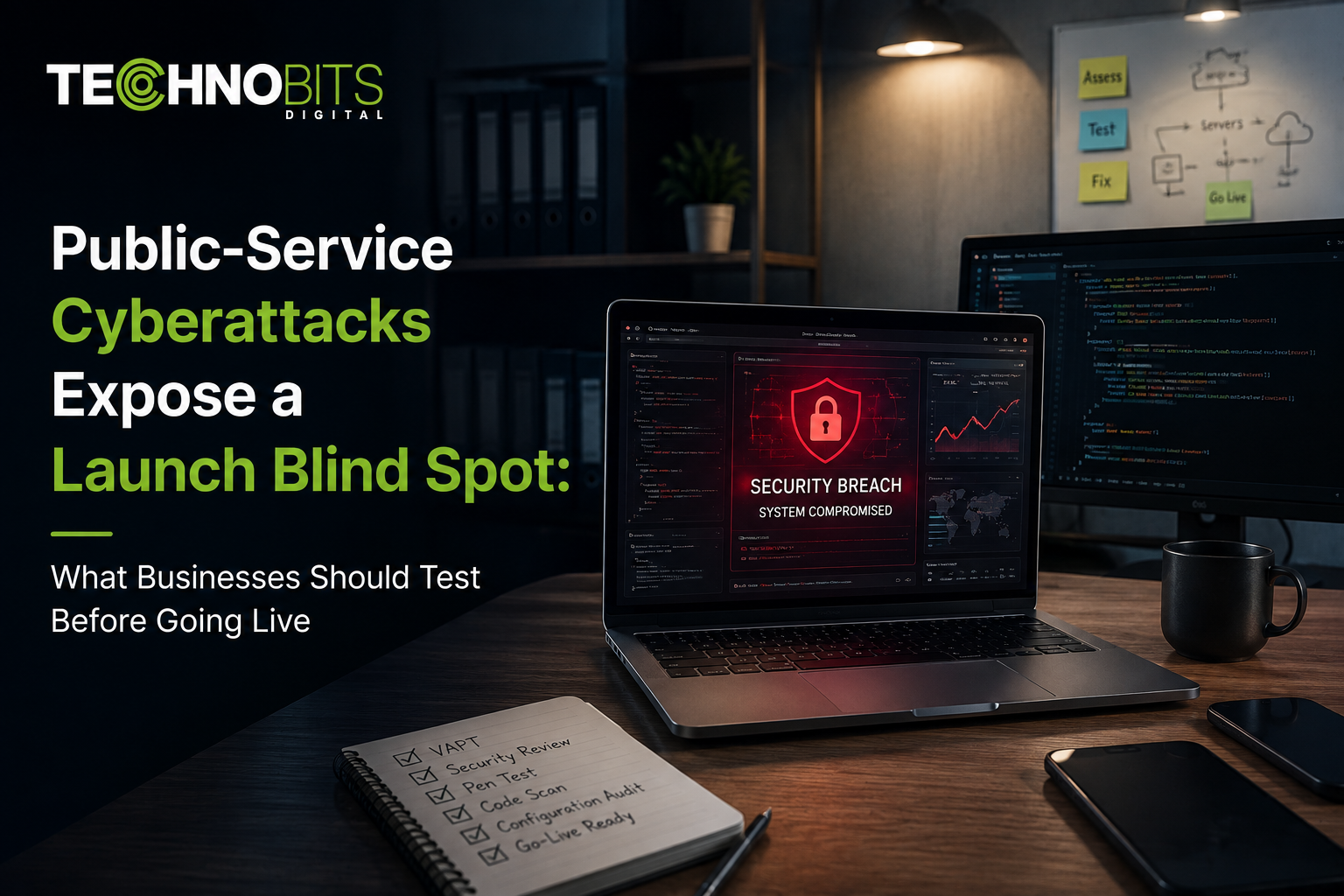
AI Cyber Defense security testing before launch should examine more than source-code vulnerabilities. Public-service cyberattacks show how identity systems, citizen-facing portals, third-party integrations, administrative tools and recovery processes can fail as one connected service chain. A product may pass functional testing while remaining exposed through excessive API permissions, weak administrator authentication, unmonitored cloud changes or a dependency that can interrupt the entire customer journey.
For founders and technology leaders, the launch blind spot is the difference between testing whether software works and testing how the operating environment behaves under hostile conditions. AI can help analyse large event streams, identify unusual access patterns, correlate activity across systems and prioritise suspected attack paths. It does not replace threat modelling, penetration testing, secure configuration, incident ownership or human approval. The practical objective is to combine AI-assisted detection with evidence-based release gates covering applications, infrastructure, identities, integrations and recovery.
Why Public-Service Cyberattacks Matter to Private-Sector Launches
Recent cyber incidents affecting public digital services illustrate why security testing needs to extend beyond the visible application. In August 2026, Norway's shared government digital infrastructure experienced a major DDoS attack that disrupted services supporting citizen logins and other public-sector functions. Recent reporting has also documented ransomware and data-security incidents affecting government and healthcare platforms in other countries.
These incidents do not mean that every commercial application faces the same threat model. However, they highlight a broader engineering lesson: digital services depend on interconnected identity systems, APIs, infrastructure, third-party services, monitoring and recovery processes. Testing only the user interface or application code can therefore leave important operational risks outside the launch scope.
Public-Service Incidents Expose the Dependency Chain Behind a Digital Launch
Public-service platforms make useful security case studies because their availability depends on several technical layers. A citizen portal may rely on a content management system, identity provider, payment gateway, document store, notification service, cloud network and internal case-management application. An attacker does not have to compromise every component. Stolen privileged credentials, an exposed remote-access service or an insecure integration may provide a route around controls built into the public interface. Commercial products have comparable dependencies: customer accounts connect to billing, support, analytics, fulfilment and internal administration. Your pre-launch scope therefore needs to include the complete transaction path, not merely the web or mobile front end.
Availability is also a security requirement rather than a separate operational concern. Distributed denial-of-service activity, ransomware, destructive administrative actions and resource-exhaustion attacks can prevent users from completing essential tasks even when no customer data is publicly disclosed. Before launch, test how rate limits, queues, caching, autoscaling rules and upstream service failures affect critical journeys. A booking platform should preserve confirmed reservations when notifications fail. An e-commerce operation should not create duplicate orders when a payment callback is delayed. These scenarios connect custom software testing with threat analysis because attackers frequently exploit the same unhandled states that ordinary reliability tests overlook.
The third lesson concerns operational trust. If a security team cannot establish which account changed a firewall rule, exported records or created an access token, investigation becomes slower and less reliable. Logs need consistent timestamps, actor identities, request identifiers and retention policies across the stack. Sensitive values should be masked without removing the context needed for investigation. An IT security audit can assess whether the design, configuration and operating procedures support this evidence chain. The goal is not to collect every possible event; it is to preserve the events needed to detect, explain and contain material behaviour.
Define Security Tests Across Identity, APIs, Infrastructure and Recovery
Begin with a threat model tied to actual business workflows. Document assets, entry points, trust boundaries, privileged actions and external dependencies. For each critical journey, ask what an unauthorised user, compromised employee account or malicious integration could attempt. An account-registration flow requires tests for enumeration, automated creation, verification bypass and session fixation. A file-upload workflow requires validation of content type, file size, malware handling, storage permissions and downstream processing. Administrative functions require stricter testing because a single privileged action may alter plans, user access or production configuration. This model gives your testers concrete attack hypotheses instead of a generic vulnerability checklist.
Test identity controls at both interface and protocol levels. Where MFA is required for privileged access, verify that the requirement is consistently enforced and cannot be bypassed through alternate authentication or recovery paths. For OAuth or federated identity, inspect redirect URI validation, token audience, issuer checks, scopes and refresh-token handling. API tests should verify object-level authorisation by changing resource identifiers, not simply by calling endpoints without a token. A user permitted to view one invoice must not gain access to another customer’s invoice by altering an ID. Automated AI quality assurance can broaden regression coverage, but authorisation expectations still need explicit rules and test data.
Infrastructure and recovery tests should verify whether the system remains controllable after prevention fails. Review internet-exposed ports, network segmentation, secret storage, cloud service identities, encryption settings and administrative access paths. Exercise restoration from protected backups in an isolated environment, then confirm application consistency rather than stopping when files are recovered. A database restored without matching object storage or message-queue state may leave transactions incomplete. Firewall and network security testing should also confirm that emergency restrictions can be applied without disabling the access responders need to investigate and recover.
Test area | Pre-launch question | Evidence to retain |
|---|---|---|
Identity | Can a stolen or stale account exceed its intended privileges? | Role matrix, session tests and authentication logs |
Application and API | Can inputs, identifiers or workflows bypass validation and authorisation? | Test cases, request traces and remediation records |
Cloud and network | Which services are reachable, and which identities can change them? | Configuration snapshots, exposure scans and change events |
Third parties | What happens when an integration is compromised or unavailable? | Scope records, failure tests and credential-rotation procedures |
Recovery | Can critical journeys be restored to a consistent state? | Restore results, integrity checks and incident decisions |
Use AI to Prioritise Security Signals Without Delegating Authority
AI Cyber Defense is most useful when it has a bounded analytical task. Models can group related alerts, identify deviations from established account behaviour, enrich events with asset context and rank activity for investigation. For example, a sequence involving an unfamiliar administrator login, creation of a new access key and a large database query may be more important than any event viewed separately. The model needs dependable inputs from identity platforms, endpoints, applications, cloud control planes and network controls. If asset ownership or timestamps are inconsistent, AI may create convincing summaries from incomplete evidence rather than improve detection.
Use representative attack simulations to evaluate the system before production. Feed it benign administrative changes, failed login bursts, impossible travel patterns, unusual API volumes and staged privilege escalation. Measure whether the workflow identifies the relevant evidence, suppresses known maintenance activity and routes uncertainty to an analyst. Evaluation should include false negatives, false positives and explanation quality. A detector that finds suspicious behaviour but cannot show the accounts, resources and rules involved may not support a defensible response. SIEM services can provide the correlation and investigation layer, while AI supports classification and prioritisation within defined boundaries.
Keep consequential actions deterministic or human-approved. Automatically disabling an account, blocking an IP range or isolating a production workload can interrupt legitimate operations. The appropriate automation level depends on confidence, reversibility and business impact. A low-risk response might attach context to an alert or request step-up authentication. Removing privileged access or changing network policy should normally require a documented rule, approval or carefully tested playbook. Protect the AI components as well: restrict access to security logs, defend retrieval sources against untrusted instructions, validate tool parameters and record every model-initiated action. An AI defence workflow is itself part of the attack surface.
Appropriate AI tasks: event clustering, behavioural anomaly detection, alert enrichment, attack-path suggestions and investigation summaries.
Human or policy-controlled tasks: declaring an incident, notifying affected parties, disabling critical services and approving recovery.
Evaluation inputs: realistic baseline traffic, privileged-user activity, integration failures, simulated attacks and known maintenance windows.
Required records: source events, model version, decision rationale, analyst action and final incident classification.
Turn Security Findings Into Engineering Release Gates
Security testing produces value only when findings influence the launch decision. Classify issues by exploitability, affected assets, required access and business consequence. A publicly reachable authorisation failure affecting customer records should not be grouped with a missing low-risk response header. Each material issue needs an owner, remediation decision, retest result and deployment reference. If a risk is accepted, record who approved it, why compensating controls are considered sufficient and when the decision will be reviewed. This creates traceability between security evidence and commercial accountability rather than leaving a spreadsheet detached from the release process.
Integrate repeatable checks into delivery pipelines without pretending every security decision can be automated. Static analysis, dependency scanning, secret detection, infrastructure-policy checks and container scanning can run on code changes. Dynamic tests can assess deployed builds in a controlled environment. Manual review remains important for business-logic abuse, complex authorisation and chained attack paths. AI-accelerated delivery can help engineers draft test cases, classify scanner output and investigate recurring failures, but generated tests must be reviewed against the architecture. Faster production of weak or irrelevant checks only increases noise and makes genuine release risks harder to see.
Run a final operational exercise before launch. Give responders a plausible scenario, such as compromised support credentials followed by unauthorised account changes. Test whether monitoring detects the sequence, the on-call team can identify affected systems, access can be contained and decision-makers know when to involve legal, communications or external providers. The exercise should expose missing contacts, unavailable logs and unclear permissions while changes are still manageable. Where applications, cloud platforms and business tools must exchange incident context, system integration services may support a more coherent monitoring and response design.
Map critical user journeys, assets, trust boundaries and third-party dependencies.
Create attack hypotheses for unauthorised access, service disruption, data extraction and administrative abuse.
Run automated, manual and AI-assisted tests in an environment that reflects production controls.
Retest material findings and preserve evidence linking fixes to builds and configurations.
Exercise detection, containment, communication and recovery with named decision owners.
Approve launch only when residual risks, monitoring coverage and rollback conditions are understood.
Questions Founders and CTOs Should Resolve Before Approving Launch
Can AI replace a penetration test?
No. AI can assist reconnaissance, test generation, signal correlation and reporting, but a penetration test applies contextual judgement to chained weaknesses and business logic. A model may identify an unusual API response without understanding that the response permits one tenant to approve another tenant’s transaction. Use AI to increase analytical capacity and repeatability, then retain qualified human review for exploitation decisions, safety boundaries and remediation priorities. Scope also matters: neither AI nor a penetration tester can assess an undocumented environment reliably. Provide architecture diagrams, roles, test accounts, data classifications and rules of engagement before testing begins.
How much of the production architecture should the test environment reproduce?
Reproduce the controls and dependencies that can change security behaviour: identity integration, network boundaries, API gateways, storage permissions, secret delivery, logging and representative third-party interfaces. Exact production scale is not always necessary, but materially different access rules can invalidate results. Use synthetic or masked data and prevent test systems from sending real customer messages or payments. Some checks, including final exposure validation and monitoring verification, must occur against production with tightly controlled methods. Record differences between environments so release owners understand which conclusions transfer and which risks remain untested.
What does full-stack security ownership mean for a business owner?
It means one release view covers the user interface, application logic, APIs, data stores, cloud configuration, networks, identity and operational response. Full-stack expertise can reduce gaps between specialists, but ownership must still be explicit. Developers fix code defects, platform engineers control infrastructure, security personnel validate threats and business owners approve residual risk. It should not create ambiguous escalation paths; every launch needs named contacts, access procedures and a single record of security decisions.
What Must Be Defined Before Funding an AI-Assisted Defence Programme?
Define the systems in scope, critical transactions, privileged roles, data sensitivity, threat scenarios and acceptable launch conditions before selecting security tools. Decide which events AI may analyse, where those events can be processed, how long evidence is retained and which responses require human approval. Establish baseline logging and asset ownership first; otherwise, sophisticated detection will be built over incomplete telemetry. Also specify how security tests enter the backlog, who verifies remediation and what conditions trigger rollback or delayed release.
Technobits Digital can assess the application stack, integrations, infrastructure and testing workflow as one technical system. That assessment can help identify whether the next step should be threat modelling, targeted testing, monitoring integration, network control review or an incident exercise. The engagement should be shaped around your architecture and release risk rather than a predetermined tool. Learn more about the technology and digital-solutions practice at Technobits Digital, then bring the architecture, known constraints and intended launch decision into the consultation.
Preparing a Digital Product for Launch?
Pre-launch security should cover more than application functionality. Identity, APIs, infrastructure, third-party integrations, monitoring and recovery can all affect how a digital service behaves under attack or failure.
Technobits Digital can help assess the relevant cybersecurity, VAPT, application-security, network-security and testing requirements based on your architecture and release scope.
Discuss Your Security Requirements
Planning an AI Product or Feature?
Before expanding an AI build, define the workflow, test the critical assumptions and determine what the production system actually needs across data, model integration, software architecture, security and evaluation.
Technobits Digital can help assess the technical requirements and determine whether the appropriate next step is a focused prototype, integration project or production-oriented AI application.